Listen to this article
Take the story with you. Choose a voice and a pace that suits you.
Or listen in another language / choose a voice
Getting your device voices ready…
The voice follows the displayed language and your browser’s regional preference when available. You can choose another narration voice.
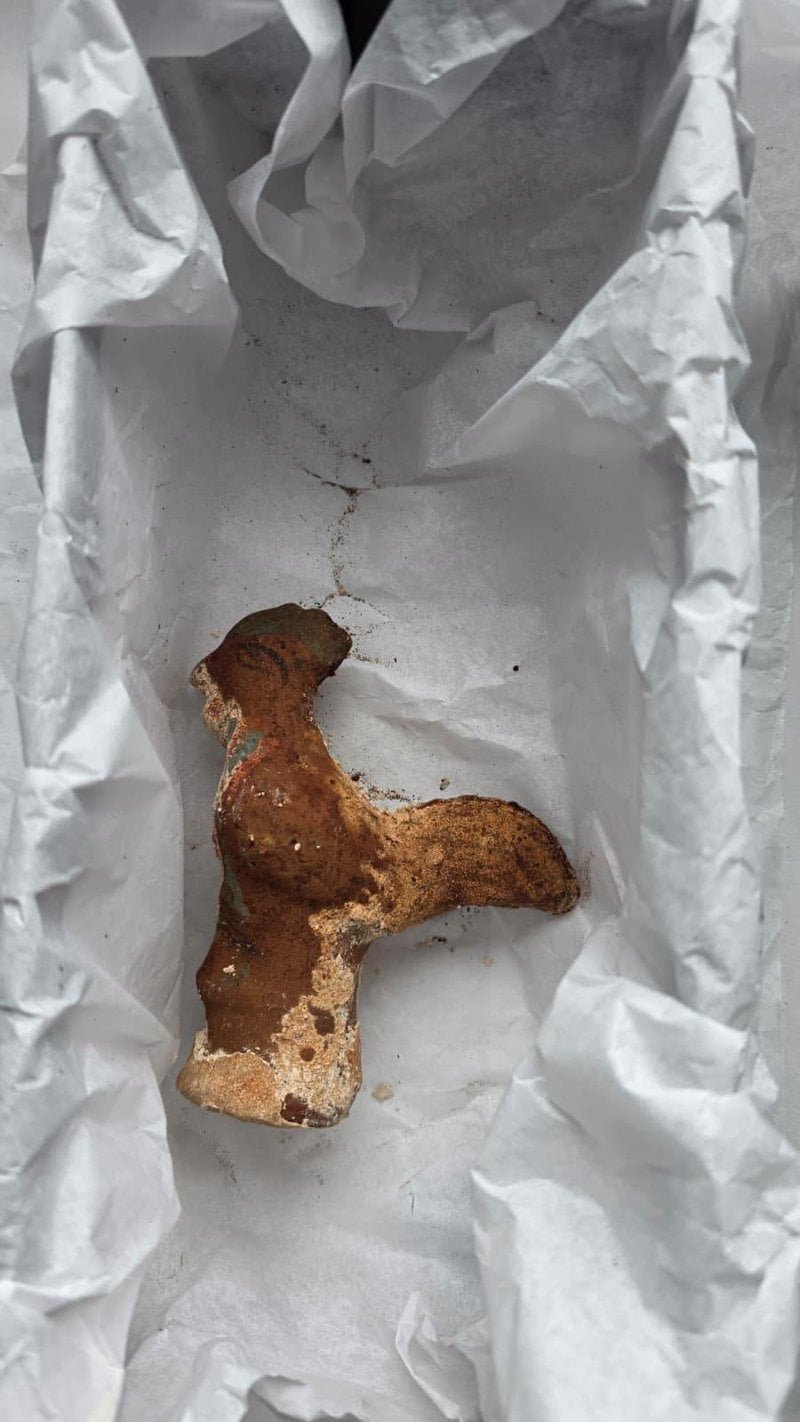
The Roman child sarcophagus Tomis archaeologists lifted out of the ground last week had not been opened in roughly 1,800 years. When conservators raised the lid on Tuesday 27 October 2026, they found a small wooden coffin, a burial shroud, folded leaves — and two clay toys, one of them a rooster that still rattles. The find, announced by the Museum of National History and Archaeology Constanța (MINAC), is the first well-preserved child sarcophagus discovered at Tomis, according to The History Blog’s 31 October report.
Information verified through 31 October 2026.
The Roman child sarcophagus Tomis team found before the builders arrived
The sarcophagus came to light during preventive excavations in Constanța’s Flămânda district — the digs carried out before construction covers whatever is buried. Archaeologists Constantin Băjenaru and Cătălin Nopcea first suspected an intact burial was in the ground on 22 October, and the stone box was cleared and moved to a museum building before anyone opened it (Bytes Europe, reporting the museum’s announcement).
The grave sits at the northern edge of the necropolis of ancient Tomis, about 1.5 kilometres from the ancient city, close to the old road that linked Tomis with Histria (Bytes Europe). Tomis, modern Constanța, began as a Greek colony and became one of Rome’s important Black Sea settlements; it is also the city where the poet Ovid was exiled in 8 CE and died in 17 CE (The History Blog).
Two lead clamps held the lid, and mortar sealed the joint. Inside, the wooden coffin survived almost intact — its dovetail joints still visible — along with the child’s shroud and hair (Bytes Europe). Museum director Delia Roxana Cornea described the wood as “extraordinarily well preserved, almost intact,” in remarks carried by Romanian press and translated in that report.
Romanian news outlet Informat, reporting the museum’s announcement on 27 October, listed the same core inventory: personal adornments, a coin, two clay toys and flower garlands, with research still under way (Informat).
Toys, a coin and two bullae
Start with the rooster. Archaeologist Ana Hamat told reporters the toys keep painted details — eyes, eyebrows — that rarely survive, and that the rooster still holds its rattle pieces: “What you will not see in the pictures is that the little rooster still keeps its rattle pieces” (Bytes Europe). The second toy is described slightly differently across reports — a small cart, or a little horse on wheels with one wheel detached. Cornea called them “the classic toys that were placed in children’s graves.”
The rest of the inventory is small and personal. Two small bronze bracelets, sized for a child’s arms, were found beside the body rather than on it, which leaves an open question the team wants to answer: did the child wear them in life, or were they bought for the burial? A coin was among the first items the museum listed (Informat).
Then there are the two bulla pendants. A bulla was an amulet Roman children wore around the neck — at first, in the standard reference account, only patrician children, later all children of free birth. Hamat told reporters the bulla served as protection and spoke of the child’s status as a citizen of the city (Bytes Europe).
A boy? And how young? The evidence is not settled
The museum has named the child “Băiețelul de la Tomis” — the Boy of Tomis. Treat that name as a working label, not a finding. The boy reading rests mainly on the bullae, and The History Blog is explicit that “the sex won’t be determined until the bones are thoroughly examined” (The History Blog).
Age is murkier still. Early museum estimates pointed to a child of 4 to 5 years; other early estimates, based partly on the sarcophagus’s size — a little over a metre long — ran from 2 to 4. The rattle pushed the team’s thinking younger. “When we brought out the rattle pieces, we realized that this is a very small child,” Hamat said, adding plainly: “We do not yet know the exact age of the child” (Bytes Europe). An anthropological study of bones and teeth is still to come, and the team hopes DNA analysis may be possible.
Băjenaru has suggested the plot itself carries information: the grave sits near other burials, in an area he believes “was very probably assigned to an important family” (Bytes Europe). That, too, is an interpretation awaiting evidence, as is his suggestion that a resin or a process resembling mummification may explain the preservation.
Why one small tomb matters for Roman funerary practices children left behind
Child burials are where Roman funerary practices children rarely speak in the record — children got smaller graves, cheaper goods, less inscription. An untouched inventory changes the arithmetic. Because nothing was robbed or disturbed, researchers can study the whole arrangement at once: coffin, shroud, garlands of folded leaves packed into small bundles, jewellery placed beside rather than on the body, toys at hand.
The next analyses are unglamorous and decisive. Identify the plants, and the team may recover the season of burial. Examine the teeth and bones, and the age argument ends. Compare the tomb with other Tomis burials, and the “important family” claim either hardens or dissolves. Hamat has said the child “will probably also be displayed, when the analyses are finished” (Bytes Europe).
For now, the record is a sealed box that kept its promise. A rattle that still sounds is not data, exactly. It is a reminder of who all this evidence was for.
Photo: MINAC Constanța (Muzeul de Istorie Națională și Arheologie Constanța)
Leave a comment
Comment as a guest and verify your email, or sign in or create a reader account. Guest comments reach our review queue after email verification; account holders can submit directly for review.