Research and commentary • 2 October 2026
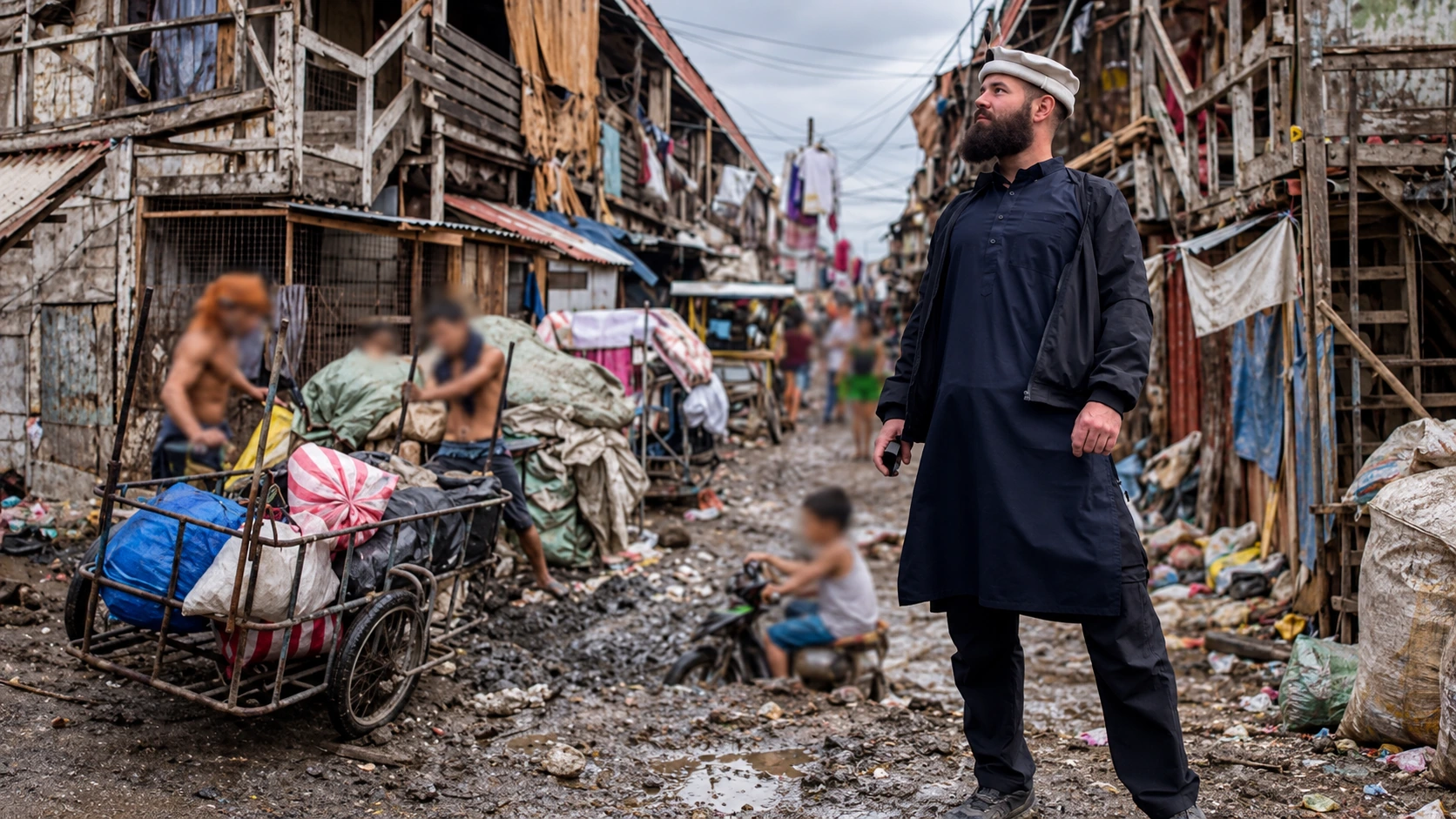
A child approaches a traveler. The traveler turns the camera toward himself. Later, a thumbnail adds an arrow and a label: “Beggar.” An encounter becomes a story about the visitor’s discomfort, while the child’s circumstances disappear behind a word.
The screenshots supplied for this article show that framing repeated across videos from Wild CARLOS appeared!, featuring encounters in Pakistan, India, Nepal, and the Philippines. Titles describe children as chasing or harassing the creator. Several thumbnails point directly at them. The pattern deserves scrutiny because the people used to advertise these stories are children whose ability to understand, negotiate, or refuse international exposure is uncertain.
The question is not whether a traveler must give money to everyone who asks. It is what responsibility comes with turning another person’s vulnerability into a public spectacle.
That question also reaches beyond travel videos. When missionary status, charitable authority, or a large online following gives outsiders access to vulnerable communities, who can challenge their conduct? This article examines how poverty content and bad-faith missionary activity can intersect with racial hierarchies, while keeping the evidence and the different forms of harm distinct.
The key points
- The packaging is verifiable. The supplied screenshots and accessible YouTube listings document recurring “beggar,” “chased,” and “harassment” framing.
- Views measure reach, not income. Millions of displayed views show substantial exposure; they do not establish earnings or how money was distributed.
- Refusing a request can be reasonable. Child-protection organizations warn that giving money, food, or gifts to children who beg can encourage continued street solicitation.
- A refusal does not settle the filming question. Privacy, consent, context, and dignity remain separate obligations.
- Research complicates the picture. Negative poverty imagery can increase support for aid while also reducing perceptions of the agency of people living in poverty.
- A charitable identity does not guarantee safety. Documented missionary-abuse cases show how positions of trust and control over resources can be exploited.
- White supremacy is also a question of institutional power. Scholarship examines whose authority, knowledge, and humanity humanitarian systems prioritize.
A recurring frame across countries
The creator’s own Philippines video listing describes a food vlog interrupted by children asking for money. Its title, “Nonstop Harassment By Filipino Beggars (Worse Than India!),” makes the encounter a selling point and turns two countries into a comparison of nuisance.
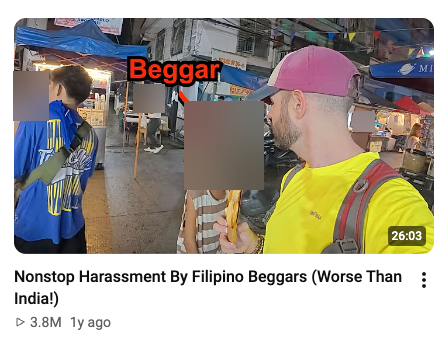
Figure 1. Supplied screenshot showing the Philippines title and a thumbnail arrow. The displayed 3.8 million views are a historical screenshot value, not a live count.
The Pakistan market video, titled “Chased By Pakistani Beggar Kids,” similarly places children at the center of the promotional frame. Its description also directs viewers toward other videos about encounters with children in India. That cross-promotion is evidence of a recurring content category, although it does not tell us what share of the channel’s output or revenue the category represents.
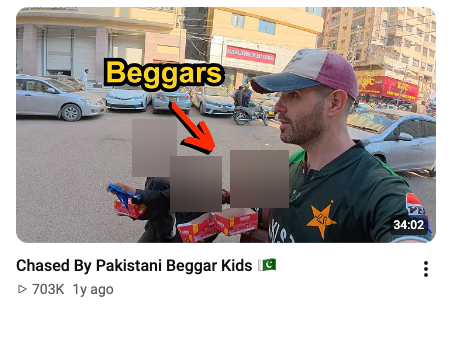
Figure 2. The supplied Pakistan market screenshot displays 703,000 views and labels the children collectively.
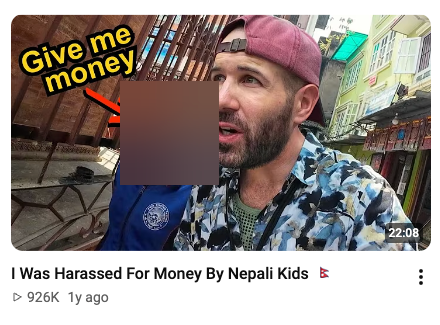
Figure 3. The Nepal screenshot repeats the harassment frame; its thumbnail uses a demand for money as the hook.
These titles express the creator’s perspective. They do not independently establish that every child shown harassed him, nor explain each child’s circumstances. A thumbnail can compress a complicated encounter into a simple opposition: the traveling protagonist and the people obstructing his experience.
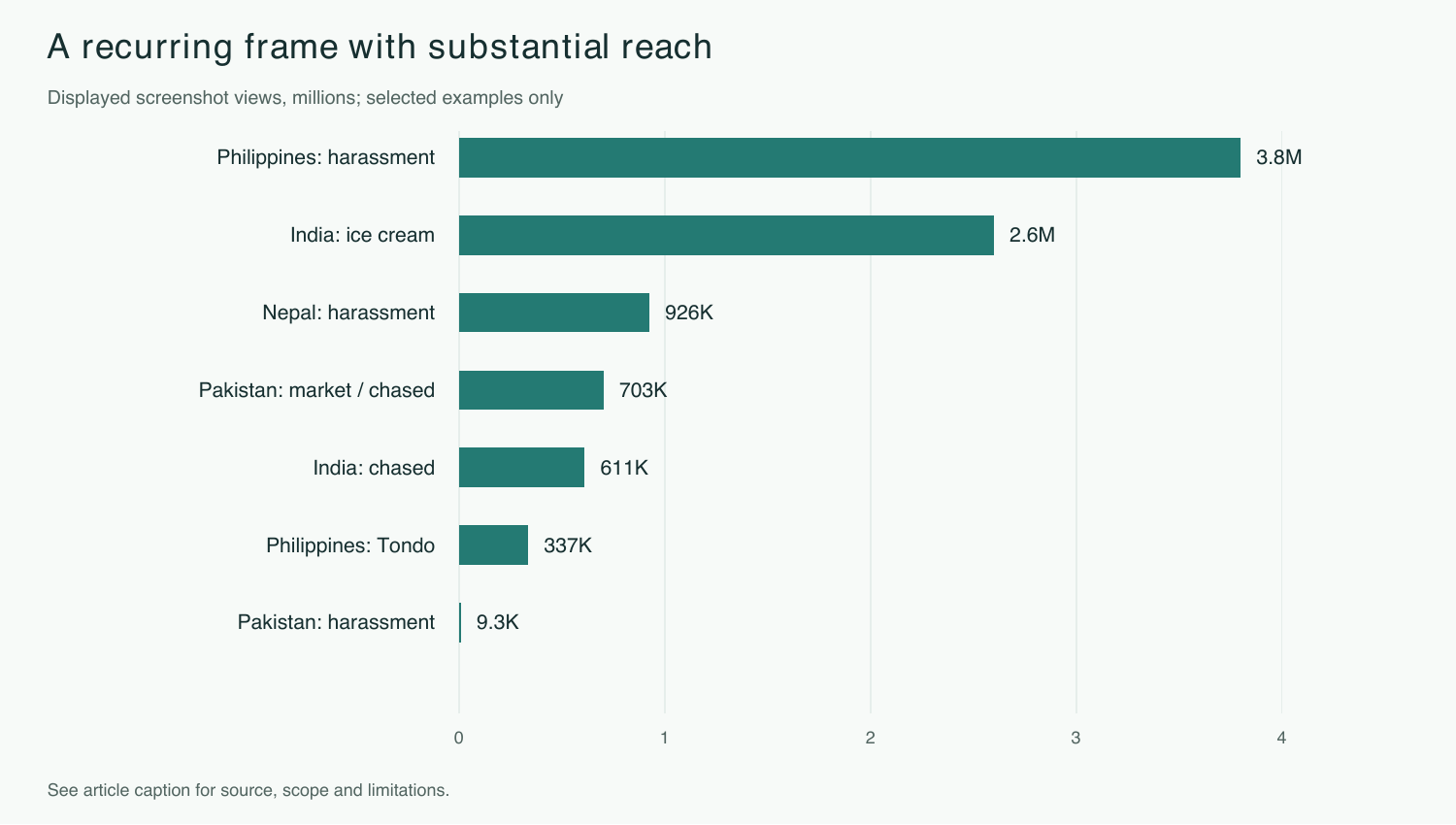
Chart 1. Views as displayed in the seven supplied video cards, compiled on 2 October 2026. Labels are shortened; values are rounded as shown by YouTube. This selected sample is not a channel-wide analysis, a ranking of all uploads, or an estimate of revenue.
What we can establish about the Pakistan incident
The supplied research brief points to an Instagram reel and describes the creator telling a child that begging is religiously forbidden and urging him to work. The reel could not be independently retrieved during this research. Those details therefore remain an account in the supplied brief, rather than a verified transcript. The screenshots do independently show a Pakistan video titled “I Was Harassed For Money By Pakistani Kids.”
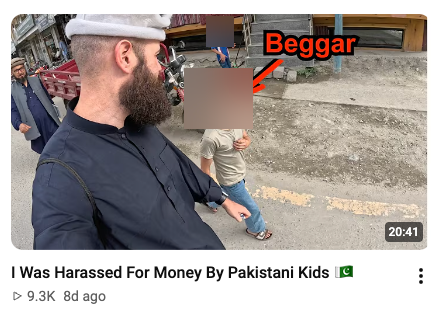
Figure 4. Supplied video card displaying 9,300 views. A title is evidence of the framing, not a complete record of the interaction.
If the exchange occurred as described, a lecture about work would need to be considered alongside the realities of childhood and educational exclusion. It would also require a complete recording and context before drawing conclusions about the specific encounter. This article does not attempt to resolve a religious ruling from an unavailable clip.
“Go to school” is not a policy
The UNICEF Pakistan education page estimates that 25.1 million children aged 5–16 are out of school, approximately 35% of that age group. It describes economic and social barriers, gender disparities, and inadequate education funding. Access is a structural problem, not merely a matter of a child choosing differently.
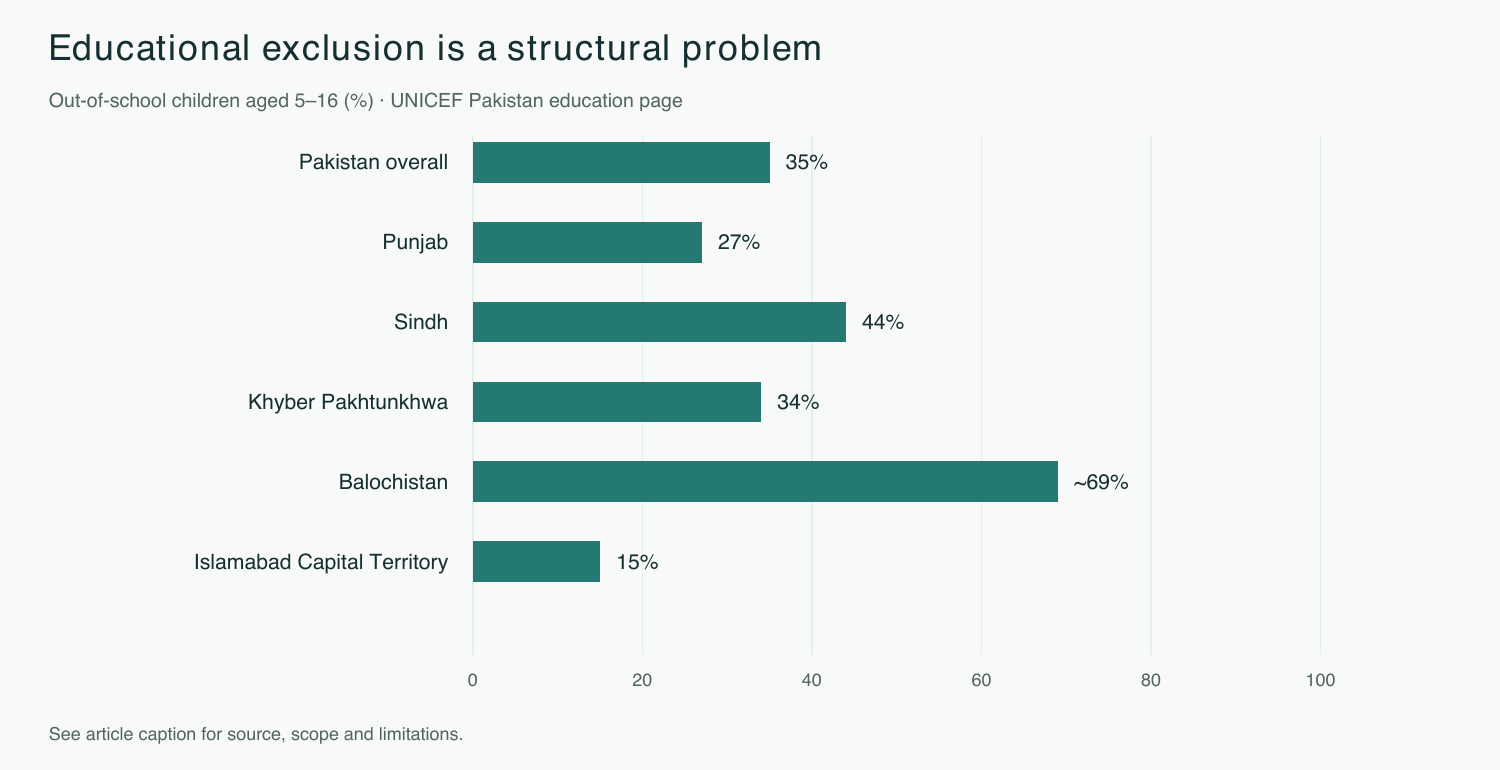
Chart 2. UNICEF’s published estimates for ages 5–16: Pakistan 35%; Punjab 27%; Sindh 44%; Khyber Pakhtunkhwa 34%; Balochistan approximately 69%; Islamabad Capital Territory 15%. All bars use a 0–100% scale. These figures describe populations, not the children in the screenshots. They provide no local estimate for Gilgit-Baltistan or a specific filming location.
A separate UNICEF-hosted State of Children report identifies costs such as uniforms as obstacles even when education is nominally free. Different reports give different national totals; estimates should be read with their underlying years and methods, rather than treated as interchangeable. Our chart consistently uses the UNICEF education page.
The response “get a job” also requires care. The joint ILO–UNICEF report on child labour, published in 2025 using 2024 estimates, reports nearly 138 million children in child labour worldwide. Children’s need for protection, schooling, and development cannot be reduced to an adult expectation of economic self-sufficiency. These global figures do not establish whether a particular child in a video is engaged in child labour.
What does “poverty porn” mean here?
“Poverty porn” is a critical term, not a clinical diagnosis or a verdict that every image of deprivation is exploitative. In this article, it describes the use of hardship as spectacle when the people depicted are reduced to suffering, nuisance, or props in somebody else’s story.
The term developed largely in debates about humanitarian fundraising. Applying it to travel entertainment is an editorial interpretation, with an important difference: charitable appeals usually ask audiences to help, while a travel video may invite them primarily to watch the visitor’s experience.
Research offers reasons to examine both the effectiveness and the human cost of these representations:
- Perceptions of agency: Emily Clough, Jill Hardacre, and Elizabeth Muggleton studied 450 UK respondents. Those exposed to negative charity portrayals rated people living in poverty lower on measures of agency—their perceived capacity to act and make decisions. The experiment studied advertisements, not Wild Carlos’s audience.
- Support for aid: A. Burcu Bayram and Marcus Holmes found that negative, personalized imagery increased expressed support for foreign development aid in a US adult experiment and a student replication. This measured attitudes, not actual donations or benefits to the photographed people.
- Authenticity and ethics: Shannon Duncan, Emma Levine, and Deborah Small found that participants judged staged or artificial poverty imagery more harshly than some exploitative uses of real imagery. A scene can be authentic and still raise questions about dignity and representation.
- Fundraising incentives: Shabbir and colleagues’ 2025 study examines poverty imagery, message framing, and spokesperson characteristics in two experiments. It places these visual choices within the business of humanitarian fundraising, rather than treating them as neutral documentation.
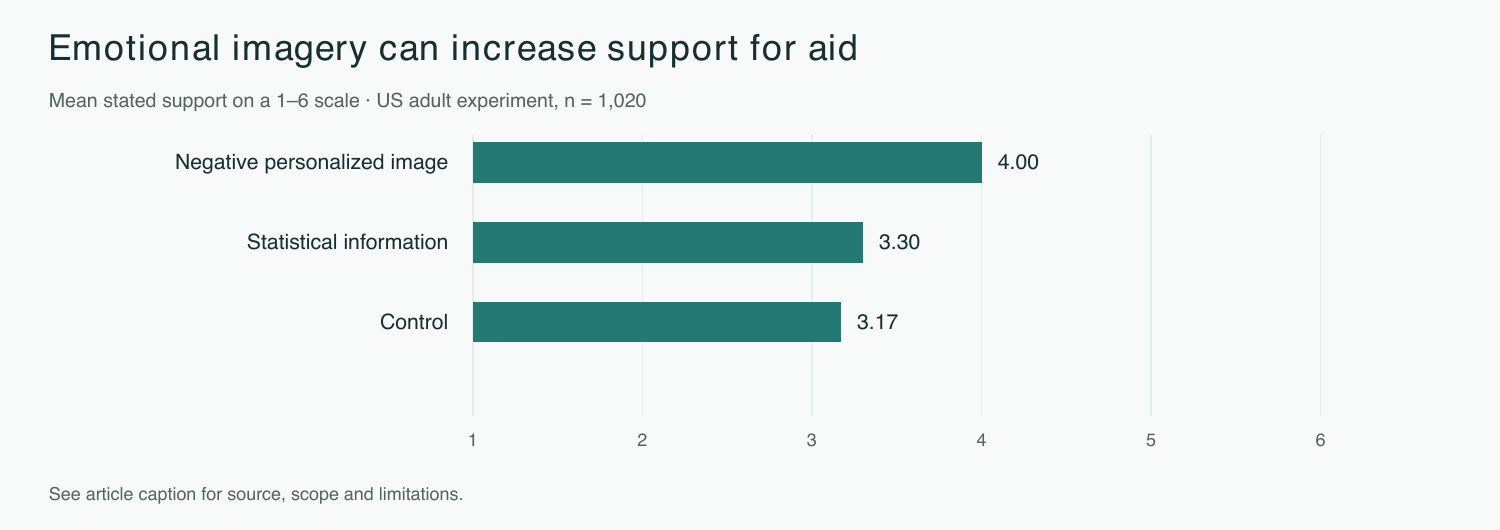
Chart 3. Bayram and Holmes’s US adult experiment (n = 1,020): mean support for aid was 4.00 with negative personalized imagery, 3.30 with statistical information, and 3.17 in the control condition, on a scale from 1 to 6. Descriptive means only; uncertainty intervals are not displayed. The scale begins at 1. This is not a study of YouTube content.
The research does not support the simple claim that distressing images always make audiences indifferent. It suggests a harder question: what happens when attention or sympathy is gained at the expense of someone’s agency?
The ice-cream example complicates the argument
The supplied material also includes “Buying Ice Cream For Indian Beggar Kid Gone Wrong.” In the creator’s published description, he says he decided to buy the boy ice cream after declining to give money. This matters: the evidence does not support a blanket claim that he never offers anything.
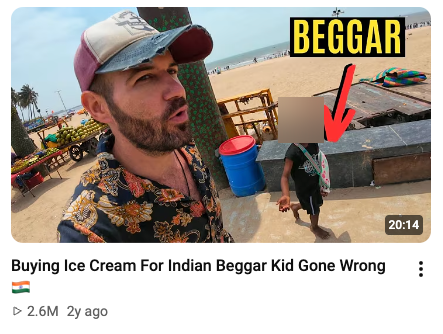
Figure 5. The screenshot displays 2.6 million views. The creator’s description reports an offer of ice cream; that does not establish its wider impact.
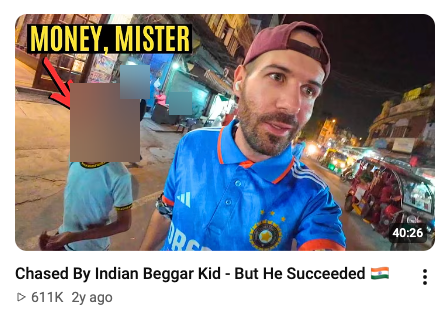
Figure 6. The supplied screenshot displays 611,000 views. An accessible listing corroborates the title.
An act of generosity can coexist with questionable presentation. Conversely, refusing a gift can be consistent with child-protection advice. The ethical assessment needs to examine the encounter, the publication decision, and the framing separately.
A responsible refusal is possible
The ChildSafe Movement’s traveler guidance warns against giving cash, food, or gifts to children who beg, or buying goods from them, because this can encourage continued solicitation. It recommends supporting organizations and local businesses that help children and families. This is safeguarding guidance, not evidence that every child who approaches a traveler belongs to an organized scheme.
That advice changes the debate. A traveler can decline, leave a stressful situation, and seek a better way to help. None of those choices requires a humiliating label or a child’s identifiable face in a thumbnail.
Whose neighborhood becomes an attraction?
The Tondo screenshot advertises a visit to the “Philippines Worst Slum.” The superlative is part of the creator’s title; this article does not endorse it as a verified comparison of Philippine communities.
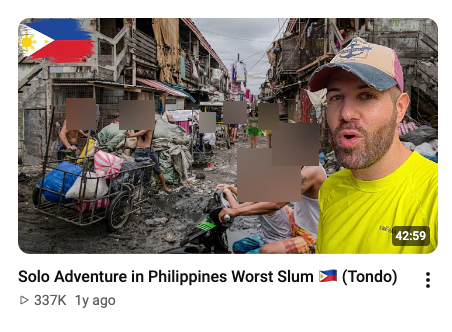
Figure 7. The supplied screenshot displays 337,000 views. A community is more than the deprivation visible in one frame.
Tianhan Gui and Wei Zhong’s 2024 systematic review examines 122 peer-reviewed articles on slum tourism. It identifies representation and socioeconomic impacts as central research areas, with gaps in understanding what residents gain or lose. Visiting a marginalized neighborhood does not, by itself, settle whether the visit is beneficial. Resident participation, control over representation, and material outcomes matter.
Caroline Scarles’s research on tourist photography in Peru likewise examines the interactions and values involved when visitors photograph local people. The camera is part of a relationship. The person holding it usually has more control over how that relationship will be presented to distant audiences.
Race, power, and the limits of the evidence
The racial dimension deserves discussion without unsupported biographical accusations. A traveling narrator who repeatedly defines Asian children through poverty and nuisance can reproduce a hierarchy in which the visitor’s comfort takes precedence over local people’s dignity. That is our interpretation of the framing, not proof of the creator’s private beliefs.
Nick Haslam’s review of dehumanization explains how people can be represented as animal-like or treated as objects lacking human qualities. It provides a framework for scrutinizing degrading comparisons; it does not diagnose this creator or his viewers. The UN Guiding Principles on Extreme Poverty and Human Rights also identify discrimination and stigma as obstacles faced by people living in poverty.
The supplied brief reports racist abuse and a comparison between children and pigeons in the Instagram discussion. We could not independently inspect the underlying comments during this research, and some reportedly were deleted. These accounts cannot establish who said what or what caused it. We therefore do not name alleged perpetrators or present the reported abuse as a verified finding.
Nor does the available evidence establish the creator’s ancestry, the children’s nationality or refugee status, their schooling, consent arrangements, actual video earnings, or whether communities received support. National labels in titles are the creator’s descriptions, not independently verified identities. A critique of public editorial choices does not need speculation about family history.
Sharbat Gula: worldwide recognition did not guarantee security
The story of Sharbat Gula, widely known as the “Afghan Girl,” offers another way to examine the distance between an image’s public meaning and its subject’s life. Steve McCurry photographed her as a child in a Pakistani refugee camp in 1984; the portrait appeared on National Geographic’s June 1985 cover. Her identity remained unknown to the magazine until 2002. National Geographic’s own retrospective records her recollection of anger at being photographed by a stranger and says she had not seen the famous portrait before the reunion.
The same account says she allowed the photograph to be taken. Those details should be read together. Agreement to a photograph is different from informed understanding of its worldwide publication and decades of reuse. The account also describes privacy practices in her household and social setting; these should not be generalized to every Afghan woman or community.
Her subsequent difficulties require an accurate chronology:
- 2016 — detention and deportation. NPR reporting carried by KPBS documents her conviction over an illegally obtained Pakistani identity card, a 15-day jail sentence, a fine, and deportation to Afghanistan. The report places this within pressure on Afghan refugees and records Amnesty International’s criticism of her treatment. These are documented actions by authorities, rather than evidence of community shunning.
- 2016 — an official welcome in Kabul. The same report records President Ashraf Ghani receiving her at the presidential palace. That public welcome contradicts a simple story of universal rejection, although it cannot establish every private community response.
- 2017 — a permanent home and financial support. National Geographic’s December 2017 report describes a government-provided 3,000-square-foot house and a roughly $700 monthly stipend for living and medical expenses. The permanent-house handover belongs to 2017, distinct from the welcome and housing promises in 2016.
- 2021 — evacuation to Italy. After the Taliban’s return to power, Italy organized her transfer to Rome. ANSA’s 25 November report, citing the Italian prime minister’s office, identifies it as part of an evacuation, reception, and integration program. This verifies that transfer, rather than her present private circumstances.
A Human Rights Watch researcher quoted by National Geographic interpreted the Pakistani publicity around her case as humiliation of Afghanistan, and the Afghan government’s welcome as a political response. That is an attributed assessment of political symbolism, not a proven account of every official’s motives.
We found no substantiated basis in the reviewed reporting for a claim that her Afghan community systematically shamed or ostracized her because of the portrait. Nor does the record establish that the photograph itself caused her arrest or later displacement. Her story is relevant because recognition, personal agency, immigration status, and safety are different things. A famous image can draw attention to a crisis without securing the rights of the person who becomes its symbol.
Bad-faith missionaries and the authority to “help”
Missionary work and travel blogging have different purposes. They can nevertheless bring outsiders into unequal relationships with people whose access to food, shelter, education, or public representation is limited. Religious status may confer moral authority; a camera and a following may confer narrative authority. Both require scrutiny when the people affected have little influence over the visitor’s decisions.
By bad-faith missionary activity, we mean the use of a religious or charitable role to conceal abuse, exert coercive control, or demean the people a visitor claims to serve. This criticism concerns conduct and power, rather than an assumption about every missionary’s intentions.
The Haiti cases below show why a reputation for helping cannot substitute for safeguards. Legal status matters: a charge is an allegation; a guilty plea or sentence establishes a different evidentiary position.
- Maylon Foshee — charged, September 2026. The U.S. Department of Justice says prosecutors secured a criminal complaint on 22 September 2026 against the 23-year-old Louisiana resident. The announcement describes ministry-related travel to Gonaïves, Haiti, between 2023 and 2026, and alleged abuse of minors who lived with him or received financial support. Three minors were interviewed. These are allegations; Foshee is presumed innocent unless proven guilty.
- Jeriah Mast — federal guilty plea, September 2026. According to the DOJ announcement, Mast pleaded guilty on 8 September 2026 to two counts of illicit sexual conduct with minors in Haiti. It records repeated travel between 2002 and 2019, including with Christian Aid Ministries. Federal sentencing was scheduled for 15 December 2026 and had not occurred at this article’s research date.
- James Daniel Arbaugh — sentenced, July 2018. The DOJ sentencing release records a 23-year prison sentence on 23 July 2018 after a guilty plea. It describes his years in Haiti and use of a Mennonite missionary role to befriend and groom children.
- Larry Michael Bollinger — 25-year sentence, January 2014. The DOJ’s archived sentencing release documents abuse of four Haitian girls during mission trips associated with the Lazarus Project. Contemporaneous reporting places the sentencing in January 2014, following his January 2013 guilty plea; the archived release contains an inconsistent year in its heading.
- Douglas Perlitz — guilty plea and sentence, December 2010. A DOJ account records that the operator of Project Pierre Toussaint in Cap-Haïtien abused at least 16 boys between 1998 and 2008. Food, shelter, and other benefits were used to secure compliance. After pleading guilty, he was sentenced on 21 December 2010 to 235 months, or 19 years and seven months, in prison. His case went beyond the 2009 indictment mentioned in the supplied notes.
These are selected cases, not a representative sample or an estimate of abuse rates in missionary organizations. They do establish how access, trust, and dependence can become instruments of exploitation. The victims’ circumstances are relevant to understanding coercion; they should not become another spectacle.
The criminal cases do not establish sexual abuse by Wild Carlos. No such allegation is made here. The connection under examination is the distribution of power and accountability, not an equivalence between objectionable editorial framing and criminal sexual violence.
How white supremacy can operate through benevolence
White supremacy can be studied as an institutional hierarchy as well as an explicit declaration of racial superiority. In this analysis, the concern is a system that grants white or Western outsiders disproportionate authority to define other people’s needs, competence, and worth—and lets a reputation for benevolence deflect scrutiny.
In Saving the souls of white folk: Humanitarianism as white supremacy, political geographer Polly Pallister-Wilkins argues that humanitarianism’s historical and contemporary practices can sustain racial hierarchies. Her argument addresses structures and institutions, including whose competence is presumed and who is recognized as a humanitarian. It is a scholarly interpretation, not a finding about the motives of every aid worker.
Maïka Sondarjee’s 2025 study of white savior narratives examines the Kony 2012 campaign. It identifies three features: centering white actors’ agency, simplifying socioeconomic conditions, and presenting intervention as an obligation. That framework helps explain how apparently benevolent stories can make outsiders the protagonists and affected communities the supporting cast.
Drawing on this scholarship, our argument is that bad-faith missionary activity and poverty-porn travel content can intersect through four arrangements:
- Authority flows toward the visitor. The outsider becomes the expert, rescuer, moral instructor, or narrator; local people’s accounts receive less weight.
- Need becomes access. Material hardship can make people dependent on a provider, or make their requests available as content. Dependency and filming are different relationships, but both demand meaningful limits on outsider power.
- The visitor’s reputation takes priority. A story about bravery, generosity, or endurance can obscure what the encounter costs the people being visited.
- Accountability travels poorly. The visitor can leave, publish to a distant audience, or retreat into a supporting institution while local people live with the consequences.
These are mechanisms to investigate, not proof that every case has the same cause. The Haiti prosecutions establish particular crimes or allegations; they do not, by themselves, establish a white-supremacist motive. The structural analysis asks why some outsiders’ authority is readily trusted and what safeguards protect people when that trust is abused.
For travel media, the parallel is visible in editorial control. The creator can label a child, choose an embarrassing moment, and circulate it internationally. The child may have no comparable platform to explain or contest that representation. Our criticism of the Wild Carlos thumbnails concerns that imbalance and the repeated framing of Asian children through nuisance and need.
When the missionary and the content creator are the same person
The Mac Miller controversy in Uganda brings religious identity, social media, and alleged racial contempt into the same account. Pulse Uganda’s 3 September 2026 report describes a self-proclaimed American missionary based in Mukono and public accusations that he engaged with racist online content. The outlet also reports a video in which he compared a Ugandan man to a monkey. This article attributes those details to the reporting; it has not independently authenticated the original posts or video.
In a 4 September follow-up, Pulse reports that Miller posted airport footage and aircraft photographs indicating he had left Uganda. It explicitly says police and immigration officials had not confirmed whether he was ordered out or left voluntarily. Departure is established in the reporting; formal deportation is not.
If substantiated, racist conduct toward the people a missionary claims to serve would directly contradict the claimed purpose of that work. The case also shows local audiences challenging a visitor’s public identity, rather than accepting a charitable label as sufficient evidence of goodwill.
Accountability beyond the white visitor
Other cases broaden the discussion without proving that all foreign misconduct has a single racial explanation:
- Sofia Benlemmane, Côte d’Ivoire, January 2024. AFP reporting carried by RMC Sport quotes a government spokesperson confirming the Algerian influencer’s expulsion after a video denigrating the host country. The tournament was the 2023 Africa Cup of Nations, held in 2024. The account supports expulsion; we do not assert a lifetime ban from this source.
- Liu Jiaqi, Kenya, September 2018. Citizen Digital reported that Kenya’s Immigration Department confirmed the Chinese businessman had been flown out after a recorded racist rant. He was a trader, not an established poverty-travel blogger. This is a case of anti-Black racism and immigration enforcement, not evidence that the offender was white.
- Johnny Somali, South Korea, April 2026. Associated Press reports that the American livestreamer was sentenced to six months in prison on 15 April 2026 for offenses including obstruction of business and distributing fabricated sexually explicit content. The report describes stunts involving a memorial to victims of wartime sexual slavery. It does not establish the broad claim that he was deported from every country he targeted.
These incidents demonstrate documented public objections and different forms of accountability. They do not establish a worldwide statistical trend. They also show why nationality, racial identity, religious affiliation, and a claim to be helping cannot substitute for examining conduct. Anti-Black racism can be expressed by people who are not white; discussion of that fact should remain precise about each case.
What ethical travel and missionary work should offer
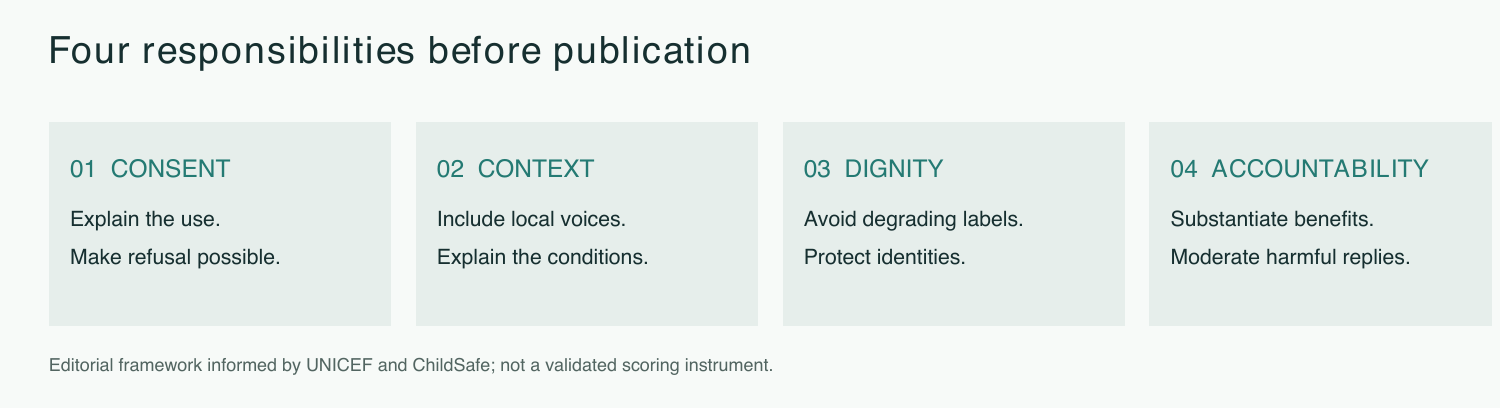
Visual guide. An editorial framework informed by UNICEF’s reporting guidelines and ChildSafe’s traveler guidance; not a validated scoring instrument.
UNICEF’s ethical reporting guidelines put children’s dignity, privacy, participation, and protection from harm first. They call for explaining the intended use of reporting, seeking permission from children and guardians, avoiding stereotypes, and giving accurate context. Obscuring a face alone cannot remove every risk of identification or harm.
For creators, editors, and viewers, those principles suggest practical questions:
- Consent: Does the child—and an appropriate guardian—understand the intended audience and publication? Can they meaningfully refuse?
- Context: Does the story explain relevant conditions and include local perspectives, rather than infer a life story from one request?
- Dignity: Would the title and thumbnail be acceptable if they depicted a child in the creator’s own community?
- Privacy: Are identifiable children necessary to the story? Could surroundings, clothing, or the original footage still identify them?
- Accountability: What benefit, if any, reaches the people whose lives provide the material? What can the creator substantiate?
- Audience conduct: Are comments moderated when children or communities become targets of racial abuse or degrading comparisons?
- Safeguarding: Do religious and charitable organizations screen staff, limit unsupervised access to children, provide reporting routes beyond the visitor’s control, and respond to concerns without protecting the institution’s reputation first? These are editorial recommendations prompted by the cases, not a claim that the named organizations all lacked every safeguard.
- Local authority: Can residents and local professionals shape the work, refuse access, challenge depictions, and obtain redress?
For this article, the supplied screenshots have been locally redacted, including partially exposed and background faces. Titles remain visible because they are the subject of the analysis. We link to source pages for verification rather than embed or autoplay the original videos.
Keeping the conversation open
Travel storytelling can expose injustice and introduce audiences to lives beyond their own. It can also make the traveler the central character in somebody else’s hardship. The difference rests in editorial choices: whose voice matters, whose privacy is protected, and whose interests the story serves.
At Evolving Humanities, we will continue researching poverty representation, missionary accountability, ethical travel media, and the relationship between these practices and white supremacy. We will seek stronger evidence and perspectives from affected communities, revise our conclusions as new information emerges, and keep this conversation open. Ongoing conversation matters because the people in these stories deserve more than a moment of visibility: they deserve safety, authority over their lives, and a voice in how those lives are understood.
Sources and research notes
This is a sourced commentary and targeted literature review, not an exhaustive review of all online research. Research was checked on 2 October 2026. Primary video listings corroborate several titles and descriptions; full videos and the Instagram reel were not independently reviewed. Seven distinct supplied video cards provide the visual evidence and historical view counts; a duplicate standalone thumbnail has been omitted. No interview or response from the creator was obtained.
Scholarly research
- Clough, Hardacre & Muggleton, Poverty Porn and Perceptions of Agency: An Experimental Assessment. Political Studies Review 22(2), 347–364 (2024; online 2023). Experimental study, 450 UK respondents.
- Bayram & Holmes, The Logic of Negative Appeals: Graphic Imagery, Affective Empathy, and Foreign Development Aid. Global Studies Quarterly 1(4) (2021). US adult experiment, n = 1,020; student replication, n = 219.
- Duncan, Levine & Small, Ethical judgments of poverty depictions in the context of charity advertising. Cognition 245, 105735 (2024). Publisher abstract and accessible preview consulted.
- Shabbir et al., Poverty Porn as Humanitarian Business. Business & Society 64(7), 1354–1391 (2025). Repository abstract consulted; two experimental studies.
- Gui & Zhong, When urban poverty becomes a tourist attraction. Humanities and Social Sciences Communications 11, 1178 (2024). Systematic review of 122 peer-reviewed articles.
- Scarles, The Ethics of Tourist Photography. Environment and Planning D: Society and Space (2013). Publisher abstract consulted.
- Haslam, Dehumanization: An Integrative Review. Personality and Social Psychology Review 10(3), 252–264 (2006). Theoretical review.
- Pallister-Wilkins, Saving the souls of white folk: Humanitarianism as white supremacy. Security Dialogue 52, supplement 1, 98–106 (2021). Critical theoretical analysis.
- Sondarjee, White Savior Narratives in International Development. The European Journal of Development Research 37, 985–1007 (2025). Discourse and content analysis of Kony 2012; updated publisher version consulted.
Missionary cases and other accountability reports
- DOJ: Maylon Foshee criminal complaint announcement, 30 September 2026; complaint secured 22 September.
- DOJ: Jeriah Mast guilty plea, 8 September 2026.
- DOJ: James Daniel Arbaugh sentencing, 23 July 2018.
- DOJ: Larry Michael Bollinger sentencing release; January 2014 contemporaneous reporting. Archived release has an inconsistent header year.
- DOJ: Douglas Perlitz case account, 12 April 2012, reporting the 21 December 2010 sentence.
- Pulse Uganda: allegations concerning Mac Miller, 3 September 2026; departure report, 4 September 2026. Underlying footage not independently authenticated.
- RMC Sport / AFP: Sofia Benlemmane expulsion, 19 January 2024.
- Citizen Digital: Liu Jiaqi deportation, 6 September 2018.
- Associated Press: Johnny Somali sentencing, 15 April 2026.
Reports and ethical guidance
- UNICEF Pakistan: Education. Source for all educational exclusion chart values.
- State of Children report, hosted by UNICEF Pakistan. Additional context on barriers and differing estimates.
- ILO–UNICEF: Child Labour: Global estimates 2024, trends and the road forward (2025).
- UNICEF: Ethical reporting guidelines.
- ChildSafe Movement: Seven tips for travelers.
- OHCHR: Guiding Principles on Extreme Poverty and Human Rights, adopted in 2012.
Sharbat Gula: chronology and representation
- National Geographic: A Life Revealed, April 2002. Publisher’s retrospective, including its account of the original sitting and Gula’s recollection.
- NPR / KPBS: deportation and presidential welcome, 9 November 2016.
- National Geographic: permanent home and stipend, 12 December 2017. Includes attributed Human Rights Watch commentary.
- ANSA: arrival in Rome, 25 November 2021, citing the Italian prime minister’s office.
Primary media
- Wild CARLOS appeared! channel.
- Philippines harassment video.
- Pakistan market video.
- India ice-cream video.
- India chase video.
- Instagram reel referenced by the supplied brief. Not independently retrievable during this research.