Listen to this article
Take the story with you. Choose a voice and a pace that suits you.
Or listen in another language / choose a voice
Getting your device voices ready…
The voice follows the displayed language and your browser’s regional preference when available. You can choose another narration voice.
Natufian clay figurines have moved a date that textbooks treated as settled. A study published in PLOS One on 11 November 2026 reports 154 clay figurative artefacts from three sites in what is now Israel, dating back as far as 15,000 years — the earliest known clay figurative tradition in Southwest Asia, pushing the timeline back by up to 3,000 years (PLOS One; AFHU). The Hebrew University announced the findings on 23 November 2026.
The old sequence was tidy. First farming, then pottery, then clay figures. These objects break it at the first step: they were made by hunter-gatherers who had settled in villages but planted nothing.
What the Natufian clay figurines actually are
The Natufian culture lived in the region roughly 15,000 to 11,650 years ago, the first communities in Southwest Asia to establish permanent or semi-permanent settlements (AFHU). Until this study, only two clay figurines had been identified in the entire Natufian repertoire; the known figures were carved from bone or stone, and clay figures were assumed to belong to the farming Neolithic that followed (PLOS One; Phys.org).
The new count comes from looking again at material earlier teams had set aside. Sorting through some 40 kilograms of clay from the three sites — Eynan-Mallaha in the Upper Jordan Valley, Hayonim Terrace in the Galilee, and el-Wad Terrace on Mount Carmel — the researchers found 15 recognisable figurines and 139 cylindrical fragments believed to be parts of figures, among tens of thousands of clay lumps (AFHU; Science News). Birds dominate: 11 of the 15 identifiable pieces. The rest include a mammal, a gazelle and two human forms. Some birds are simple shapes; others carry carefully marked wings, tails and feathers, and several seem to show ducks or geese with heads tilted down and turned left — a posture the researchers suggest may copy the courtship displays of ducks in breeding season (AFHU).
Colour was part of the craft. Several figurines carry traces of red colouring, including engobe — a thin layer of coloured clay — and one figurine dated to 15,000 years ago gives the earliest known evidence of that colouring technique, the study reports. A gazelle fragment was painted red to depict the animal’s eyes and fur pattern (AFHU; Phys.org). Most of the statues are small — under 2 centimetres — and show no signs of heavy use, which suggests they were not treasured heirlooms (Science News).
Natufian fingerprints children figurines: the hands give it away
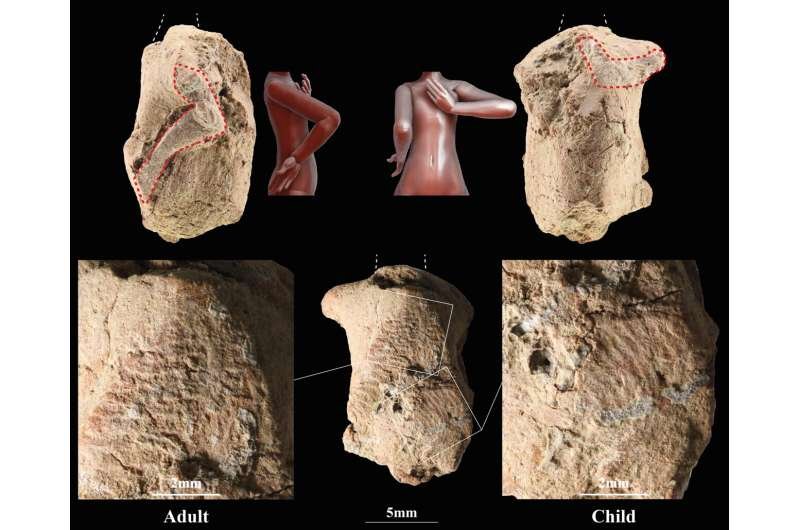
The fingerprints are the finding people will remember. Around 60 pieces preserve prints where makers pinched or prodded the wet clay. Ridge spacing, which varies with age and sex, indicates most of the figurines were made by women and children — some children likely younger than ten — with only a few sets of prints belonging to men (Science News; AFHU).
One human figurine carries the whole argument in miniature. On its back sit two overlapping fingerprints: one from a young adult or adult woman, covered by a child’s. The sequence in the wet clay reads like a hand passing the object over mid-making — what Phys.org, reporting the study, calls a rare direct testimony of intergenerational knowledge transmission in a hands-on apprenticeship (Phys.org). The children’s prints were not accidental smudges, either. Their placement shows children actively shaping and colouring pieces, not merely touching them (AFHU).
Lead author Laurent Davin of the Hebrew University put the claim plainly: “Thousands of years before agriculture emerged, people were already using clay to create figures, as part of their beliefs and knowledge of the natural world. What is particularly fascinating is the evidence that children were involved in making these objects, suggesting that creativity and cultural knowledge were shared across generations” (AFHU). The team included researchers from the University of Haifa, the Israel Antiquities Authority and the CNRS, among others (AFHU).
Outside the team, archaeologist Steven Dorland of Grand Valley State University called the evidence of intergenerational learning so far back fascinating, and a demonstration of how much researchers can learn by broadening their focus beyond adult males (Science News). Davin himself offers a guess at what the figures were for: they may have represented stories, the way children today draw characters they know. “Maybe the idea is that the role of children here is not necessarily to learn to make figurines, but more to learn the story behind them” (Science News). That remains a suggestion, not a finding — the study states the figurines’ purpose is unclear.
Clay figurines before farming change the sequence
The wider claim is about order. The earliest clay figurines Southwest Asia has produced now come from settled hunter-gatherers, not farmers. Clay, the authors argue, mattered as a medium: unlike carving stone or bone, it lets a maker build, reshape and decorate gradually, and it became these communities’ primary medium of figurative expression (PLOS One; AFHU). In the paper’s own phrase, the results shift back the “revolution of symbols,” and suggest the seeds of the region’s Neolithic culture were sown well before the agricultural revolution (PLOS One; Phys.org).
The study sits inside a larger project on the early symbolic use of clay in Southwest Asia, which has already produced the earliest known figurine depicting a human-animal interaction, from Nahal Ein Gev II, and the earliest known clay ornaments outside Europe (AFHU).
Analysis: the strongest part of this story is not the superlative. Dates move; another site may move this one. It is the fingerprints. Prehistory rarely preserves a teaching moment — an adult’s hand, then a child’s, on the same small bird. Whatever the figurines meant, somebody thought a child under ten should learn to make one, 15,000 years before anyone in that valley planted a crop.
Information verified through 25 November 2026.
Photo: Laurent Davin, via PLOS One (CC BY 4.0)
Sources
- PLOS One — Davin et al., Modelling symbols among the first-sedentary communities: Emergence of clay figurines in Epipaleolithic Southwest Asia (2026): https://journals.plos.org/plosone/article?id=10.1371/journal.pone.0360388
- AFHU / Hebrew University — Before Farming, Early Communities Were Already Shaping Clay into Symbols: https://www.afhu.org/2026/11/23/before-farming-early-communities-were-already-shaping-clay-into-symbols/
- Phys.org — Symbolic clay figurines change our understanding of the prehistoric Middle East: https://phys.org/news/2026-11-clay-figurines-prehistoric-middle-east.html
- Science News — Stone Age children left fingerprints on ancient art projects: https://www.sciencenews.org/article/stone-age-children-made-art-clay-sculpt
Leave a comment
Comment as a guest and verify your email, or sign in or create a reader account. Guest comments reach our review queue after email verification; account holders can submit directly for review.