Listen to this article
Take the story with you. Choose a voice and a pace that suits you.
Or listen in another language / choose a voice
Getting your device voices ready…
The voice follows the displayed language and your browser’s regional preference when available. You can choose another narration voice.
Two small mountain countries have asked the world’s climate conference to stop treating the Himalayas as scenery. On 31 October 2026, Nepal and Bhutan jointly proposed a dedicated agenda item for COP31 titled “1.5-Degree Temperature Rise in the Himalayan Region,” according to a statement from the secretariat of Nepal’s Minister for Agriculture, Forests and Environment, reported by IANS. A Himalayan climate agenda at COP31 would give mountain ecosystems their own standing slot in the negotiations, rather than a mention inside other countries’ speeches. COP31 runs from 9 to 20 November 2026 in Antalya, Turkey.
Nepal’s minister Geeta Chaudhary submitted the proposal on behalf of both countries under Rule 12 of the conference’s draft rules of procedure, the statement said (IANS). Asian Lite’s report carried the same details: the ask is for greater international recognition of threats that include glacier melt, glacial lake outburst floods and extreme weather, and of the growing vulnerability of the communities who live among them.
A Himalayan climate agenda at COP31, in four asks
The proposal is specific, which is part of its point. First, scientific studies: research on temperature rise in the Himalayan region and on what exceeding temperature targets would mean there. Second, a rhythm: an annual high-level dialogue on mountains and climate change, so the subject returns every year instead of competing for attention each time. Third, a process to develop an action plan for Himalayan ecosystems under the UN Framework Convention on Climate Change. Fourth, a place in the money conversations — mountain priorities written into international discussions on adaptation, climate finance, and loss and damage (IANS; Asian Lite).
The proposal warns that the changes under way risk irreversible damage to Himalayan ecosystems and to the communities that depend on them. Rivers originating in the region provide water, food and energy to more than two billion people living downstream, and the Himalayas contain nearly half of the world’s important biodiversity areas, according to the proposal as reported by IANS.
The science underneath: Himalayan glacier melt and water security
The monitoring record gives that warning a hard edge. The Hindu Kush Himalaya holds more than 63,700 glaciers covering nearly 55,782 square kilometres, and those glaciers feed at least ten major Asian river systems supporting the food, water, energy and livelihood security of about two billion people, according to the International Centre for Integrated Mountain Development (ICIMOD). Between 1990 and 2020 the region’s glaciers lost about 12% of their total area and 9% of their estimated ice reserves.
The pace is the problem. ICIMOD’s HKH Glacier Outlook 2026, drawing on 50 years of field observation, found that glacier wastage in the Himalayan region has doubled since 2000, and that 38 monitored glaciers have lost up to 27 metres of ice thickness since 1975. Around 78% of the region’s glacier area sits between 4,500 and 6,000 metres above sea level, where it is highly exposed to elevation-dependent warming. ICIMOD also notes a measurement gap the Nepal–Bhutan proposal speaks to directly: only 18% of those 38 monitored glaciers meet the World Glacier Monitoring Service’s benchmark standards, and major glacierised areas including Bhutan remain undermonitored (ICIMOD).
August’s floods did the arguing first
The proposal arrives with a damage bill attached. Floods in Nepal’s Bhotekoshi and Trishuli river systems on 26 August 2026, triggered by an avalanche damming a river, caused an estimated $2.7 billion in damage, with recovery and reconstruction expected to require $4.7 billion, according to a Rapid Disaster Needs Assessment prepared by the Nepali government and cited in the proposal (IANS).
Bhutan’s contribution to the file is fresher still. On the Thursday night before the proposal was announced, a flash flood triggered by the bursting of the Shintaphu glacial lake washed away infrastructure at the Gasa Tshachu natural hot springs. No casualties had been reported as of the following Friday (Asian Lite).
Analysis: Agenda items sound procedural, and they are — that is their power. A standing item creates a recurring deadline, a place where studies must be tabled and finance discussed in the open, year after year. Whether other delegations accept the item in Antalya is untested, and the proposal’s fate is not yet known. But Nepal and Bhutan have framed the choice neatly: either the mountains get a permanent seat in the process, or they keep arriving the way they did this August — as disaster news, after the water has already come down.
Information verified through 1 November 2026.
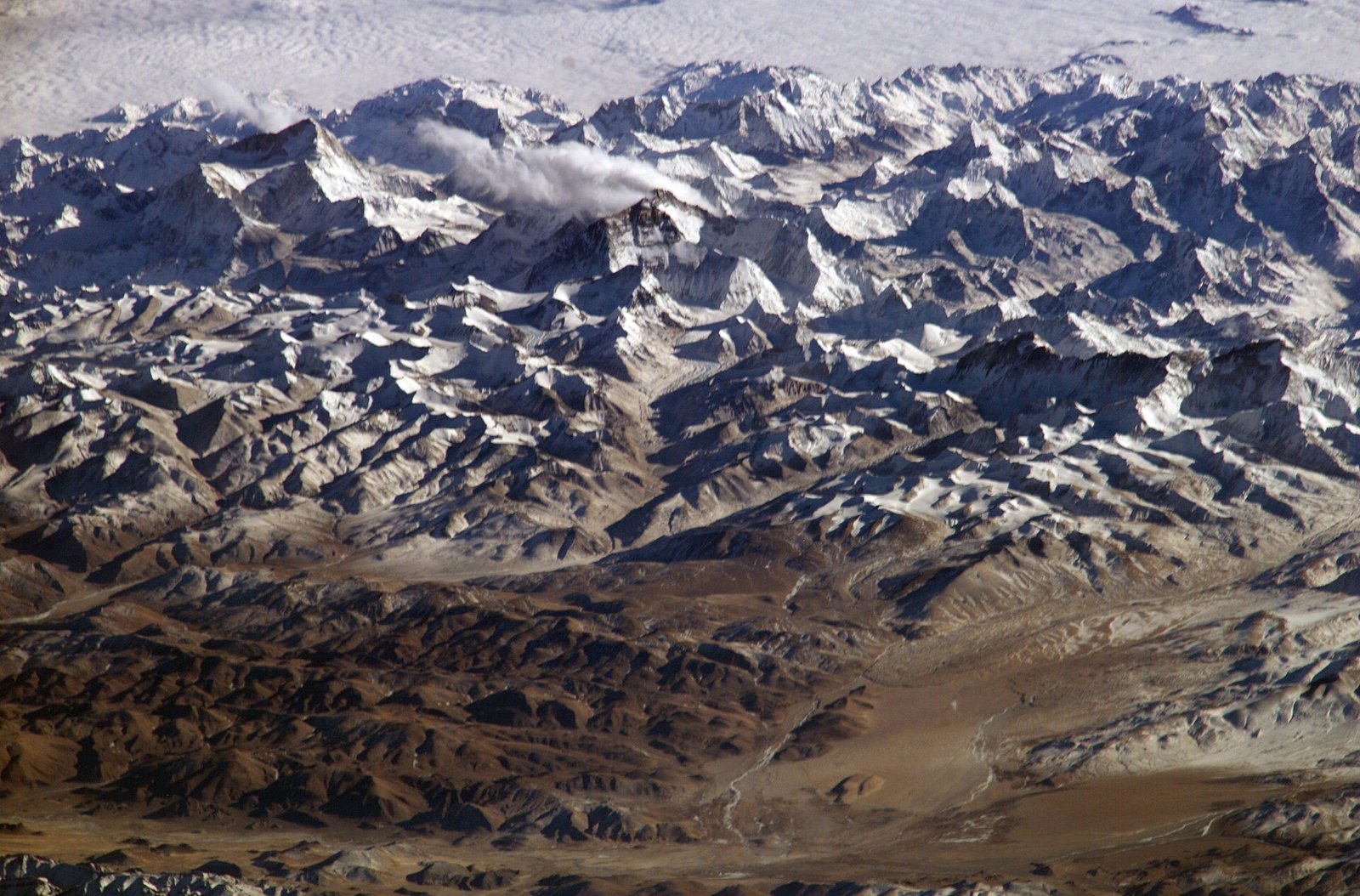
Photo: NASA, via Wikimedia Commons (public domain)
Leave a comment
Comment as a guest and verify your email, or sign in or create a reader account. Guest comments reach our review queue after email verification; account holders can submit directly for review.