Listen to this article
Take the story with you. Choose a voice and a pace that suits you.
Or listen in another language / choose a voice
Getting your device voices ready…
The voice follows the displayed language and your browser’s regional preference when available. You can choose another narration voice.
The Brancusi exhibition at MoMA opened on 25 October 2026, and its subject is not only a sculptor. It is a room. Brancusi: The Artist and His Studio runs through 27 February 2027 on the museum’s entire sixth floor, surveying Constantin Brancusi (1876–1957) through the Paris studio at impasse Ronsin where he lived and worked for more than 40 years, from 1916 until his death (ArtDaily). MoMA’s own account puts it plainly: the studio was where he lived, worked, entertained friends and clients, and displayed his sculptures (MoMA).
That framing matters. Most retrospectives line up masterpieces and ask you to admire them one by one. This one asks you to look at how the works sat next to each other, on bases Brancusi carved himself, in light he controlled, in arrangements he kept changing.
Information verified through 28 October 2026.
Brancusi exhibition at MoMA: Brancusi The Artist and His Studio dates and what is actually on view
The dates are 25 October 2026 to 27 February 2027, at MoMA, Floor 6, 11 West 53 Street, New York (MoMA). The Romanian Cultural Institute in New York supports the project, which is presented as part of Constantin Brancusi Year, marking 150 years since the artist’s birth (Informat.ro). On 28 October, the institute organised a cultural diplomacy event at MoMA with Romanian and American curators and specialists, the same report said.
The checklist mixes the famous with the things that usually stay home. Works on view include Leda (1926), Bird in Space (1928) and Fish (1930), alongside versions of Mlle Pogany and The Kiss, according to reporting on the Romanian Cultural Institute’s announcement (EuropeSays). ArtDaily’s account gives the same core group — Leda, Bird in Space and Fish as examples of a language in which forms are distilled to their essential elements — and notes that different versions of Mlle Pogany and The Kiss show motifs recurring across materials and configurations (ArtDaily).
Around the sculptures sits the working life: hand-carved furniture and bases, films, photographs, tools and archival materials from Centre Pompidou’s Atelier Brancusi (ArtDaily). Some sculptures are presented on original Brancusi bases, a detail the exhibition stresses because he treated those wood and stone forms as formally considered as the works they support.
Bird in Space MoMA exhibition: a sculpture a customs officer rejected
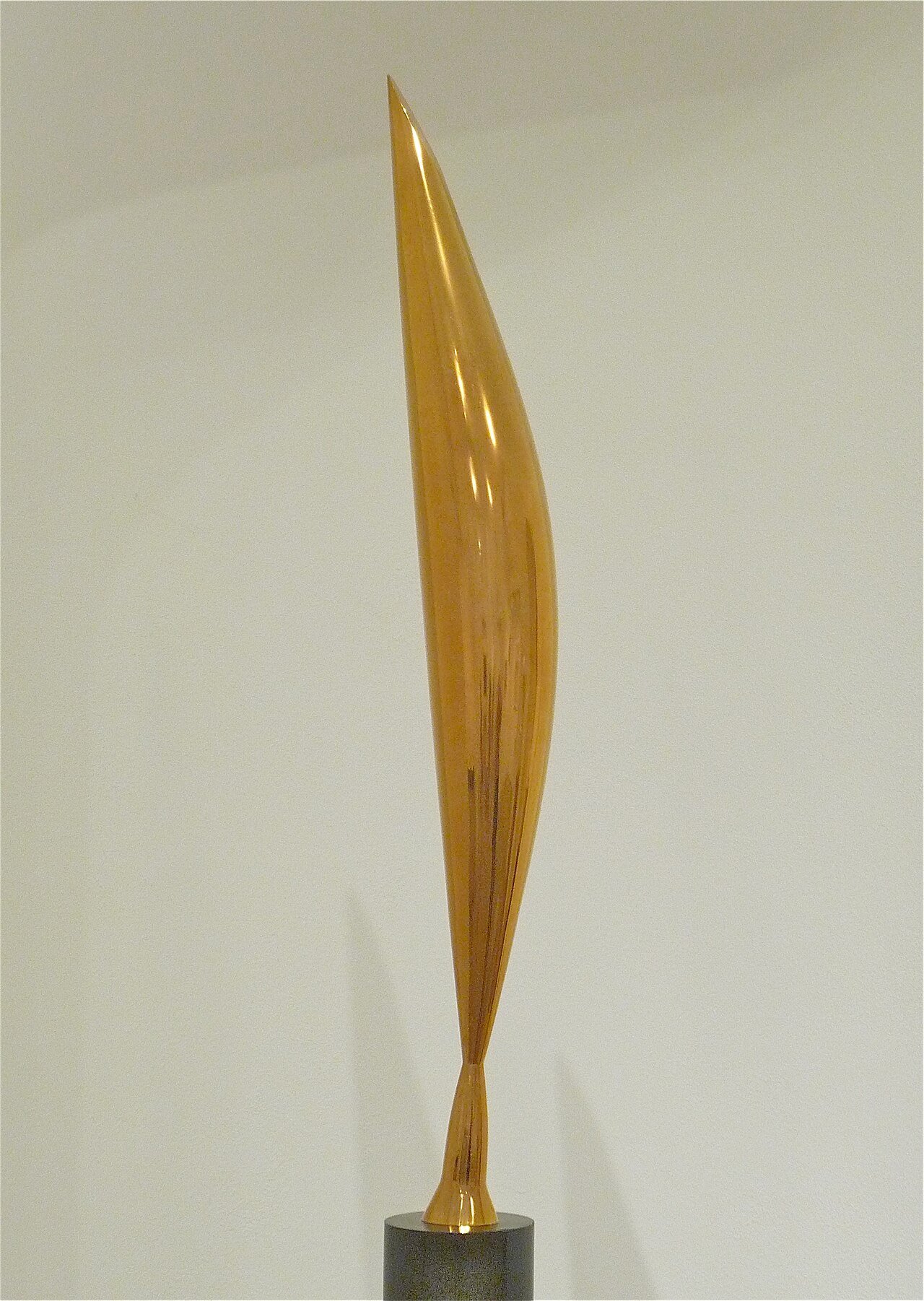
One work carries a New York story of its own. Among the groundbreaking pieces made in the studio was Bird in Space, “notoriously declared by a US customs agent to be inadmissible as a work of art,” MoMA notes (MoMA). A polished bronze bird, reduced almost to a single rising gesture, did not look enough like a bird to clear the border as art. A century on, it anchors a show in the city that once taxed it as something else.
Brancusi’s link to this museum is old. In August 1934, MoMA announced the acquisition of Bird in Space (1928), a polished bronze donated anonymously, and put it on view on 13 August that year, according to the account carried by EuropeSays (EuropeSays). Guest curator Anne Umland made the continuity point in ArtDaily’s report: Brancusi wanted his works experienced together, in relation to one another, and uniting MoMA’s holdings and local loans with rarely lent sculptures gives New York audiences that chance in a museum that has championed him from its earliest years (ArtDaily).
He also photographed them himself. After 1920, Brancusi increasingly withdrew from public exhibitions in France, preferred to receive visitors in the studio, and became the primary photographer of his own work because he was dissatisfied with how others captured it, ArtDaily reported. A companion volume draws on that habit, with more than 130 photographs taken by the artist, Informat.ro reported (Informat.ro).
Atelier Brancusi Centre Pompidou loans: why these works can travel now
There is a practical reason this gathering is possible in 2026, and it is a building closure in Paris.
Wanting to preserve the unity of the studio, Brancusi bequeathed its entire contents to France in 1957, MoMA explains, and the Atelier Brancusi is now part of Centre Pompidou’s collection — and, like that museum, it is currently closed for renovations (MoMA). “For the first time in decades, rarely lent sculptures will travel to New York,” MoMA says, along with photographs, films, furniture, pedestals, tools and archival materials. ArtDaily makes the same point from the other side: the show is part of a series made possible by the temporary closure of the Atelier during Centre Pompidou’s renovation, organised with that museum’s support (ArtDaily).
Go slowly in there. The contrast ArtDaily points to — rough-hewn bases against highly polished surfaces, hand-crafting against machine finishing, organic irregularity against geometric precision — only registers if you stop treating the pedestal as furniture. Brancusi, born in rural Romania and later embedded in cosmopolitan Paris, worked those tensions for four decades in one small impasse. New York has borrowed the evidence. It will not stay borrowed for long.
Photo: Art Poskanzer, via Wikimedia Commons (public domain)
Sources
- https://www.moma.org/calendar/exhibitions/5910
- https://artdaily.com/news/201595/MoMA-opens-major-exhibition–Brancusi–The-Artist-and-His-Studio-
- https://informat.ro/en/arts-lifestyle/brancusi-celebrated-in-retrospective-at-moma-with-support-from-the-romanian-cultural-institute-144950
- https://www.europesays.com/3332594/
Leave a comment
Comment as a guest and verify your email, or sign in or create a reader account. Guest comments reach our review queue after email verification; account holders can submit directly for review.