Listen to this article
Take the story with you. Choose a voice and a pace that suits you.
Getting your device voices ready…
The voice follows the displayed language and your browser’s regional preference when available. You can choose another narration voice. Enhanced device voices are preferred; availability varies.
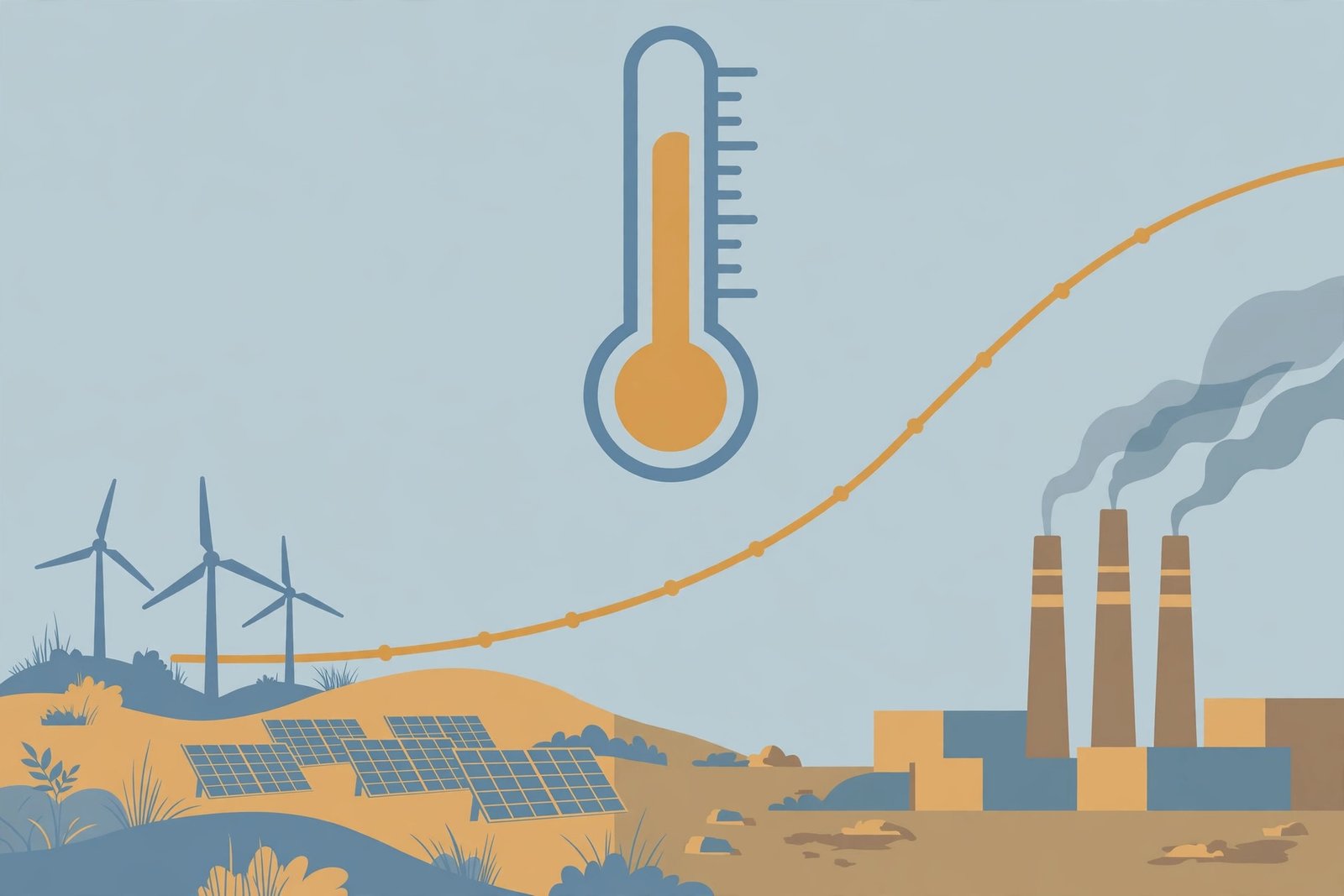
The sentence climate politics has avoided for a decade is now in an official UN report. The UN Environment Programme’s Emissions Gap Report 2026, titled “The Point of Return” and published on Wednesday 21 October, concludes that exceeding the Paris Agreement’s 1.5°C limit is “imminent and unavoidable”. The chance of holding warming below 1.5°C with no or limited overshoot has been lost, the agency said, after decades of insufficient action. Information verified through 21 October 2026.
What replaces the old target is a harder, stranger one: overshoot, then return. The report’s “lowest possible” overshoot scenario limits peak warming around mid-century to 1.7–1.8°C, then brings temperatures back to or below 1.5°C by 2100, with about a 50 per cent chance.
“Overshoot is not surrender,” UN Secretary-General António Guterres said in a message on the report, carried by UN News. “We can still keep it as small and as short as possible – and bring temperatures back below 1.5 degrees by the end of the century.”
The bill, itemised
The return path has numbers attached, and they are steep. Global greenhouse gas emissions would have to fall 18% by 2030, 45% by 2035 and 69% by 2040, relative to 2025 levels, UNEP said. Carbon Brief’s reading of the report puts the required pace at an average annual reduction of 5.7 per cent for 2025–2035 — faster than the roughly 5 per cent annual drop the IPCC’s earlier pathways required, back when cuts were supposed to start in 2019.
Against that, current national climate plans — the Nationally Determined Contributions, or NDCs — would cut emissions by only 5–8% by 2030 and 11–15% by 2035, even if fully implemented. UNEP said climate plans submitted since last year had made virtually no difference to future warming projections.
Stay on today’s policies and the century ends very differently. The report projected global warming of 2.8°C by 2100 under current policies, or 2.6°C if countries fully implement existing pledges. Nature’s coverage adds a tail risk: under current policies there is a 10% chance of warming exceeding 3.4°C, which researchers describe as catastrophic. Even the most optimistic scenario UNEP modelled — full NDC delivery plus net-zero targets — lands at 2.1°C of warming this century.
Both headline estimates are worse than last year’s. Reuters reported the shift reflects the US withdrawal from the Paris Agreement and revised assessments of historical emissions.
Emissions may have plateaued. That is not the same as falling.
There is one genuinely new signal in the data. Global greenhouse gas emissions in 2025 totalled 58.4 billion tonnes of CO2 equivalent, around 0.16 billion tonnes lower than 2024 — provisional figures, with high uncertainty, and the report says it is not possible to conclude the overall direction of 2025 emissions from them. Nature noted the fall was driven mainly by reduced land-use emissions, particularly wildfires, after unprecedented blazes in 2024.
Lauri Myllyvirta of the Centre for Research on Energy and Clean Air cautioned against reading a peak into one flat year. “Global emissions will have to fall several per cent before there can be any certainty that they have peaked,” he told Nature. Fossil-fuel emissions, Carbon Brief reported, rose slightly in 2025, by between 0.4 and 1.1 per cent.
The return path also leans on large-scale carbon dioxide removal, whose feasibility at the required scale the report treats as uncertain, and on delivery of the first Global Stocktake goals: tripling renewable energy capacity and doubling the rate of energy efficiency improvement by 2030, shifting away from fossil fuels, and halting and reversing deforestation. UNEP Executive Director Inger Andersen stated the stakes plainly: “Every additional fraction of a degree and additional year of warming above 1.5°C increases climate impacts and risks, such as the deadly floods, heatwaves and wildfires that have plagued many nations this year.”
Analysis: Read the report as a change of tense. For ten years, 1.5°C was a future to be defended. UNEP has moved it into a different grammatical position — a level to be returned to, from above, by a century’s end most negotiators will not see. That shift carries a risk the report itself cannot control: overshoot can be heard as permission, a decade of slack dressed as strategy. The numbers argue otherwise. A path that peaks at 1.7–1.8°C demands faster annual cuts than the path that was missed. The next test arrives quickly, at COP31 in Antalya in November, where the second Global Stocktake begins. Guterres called the emissions gap “now a leadership gap.” On the evidence of the NDCs filed this past year — which moved projected warming by almost nothing — that is a description, not a rhetorical flourish.
Sources
- UN News — “Global warming will breach 1.5°C – but deep, fast cuts can still bring it back” (21 October 2026): https://news.un.org/en/story/2026/10/1168634
- Reuters via Devdiscourse — “UN sees higher global warming, even in best-case scenario” (21 October 2026): https://www.devdiscourse.com/article/international/3995489-un-sees-higher-global-warming-even-in-best-case-scenario?amp
- Carbon Brief — “UNEP: Opportunity has ‘been lost’ to meet 1.5C warming limit without ‘overshoot'” (21 October 2026): https://www.carbonbrief.org/unep-opportunity-has-been-lost-to-meet-1-5c-warming-limit-without-overshoot
- Nature — “Global emissions slow — but world hurtles towards 2 °C of warming” (21 October 2026): https://www.nature.com/articles/d41586-026-03355-x
Leave a comment
Comment as a guest and verify your email, or sign in or create a reader account. Guest comments reach our review queue after email verification; account holders can submit directly for review.