Listen to this article
Take the story with you. Choose a voice and a pace that suits you.
Getting your device voices ready…
The voice follows the displayed language and your browser’s regional preference when available. You can choose another narration voice. Enhanced device voices are preferred; availability varies.
One in every 200 dollars. That is the share of global climate mitigation finance that went to super pollutants in 2023, according to a report published on 14 October 2026 by Climate Policy Initiative, commissioned by the Climate and Clean Air Coalition. The same pollutants drive around half of today’s warming. Half the problem. Half a per cent of the money. Information verified through 20 October 2026.
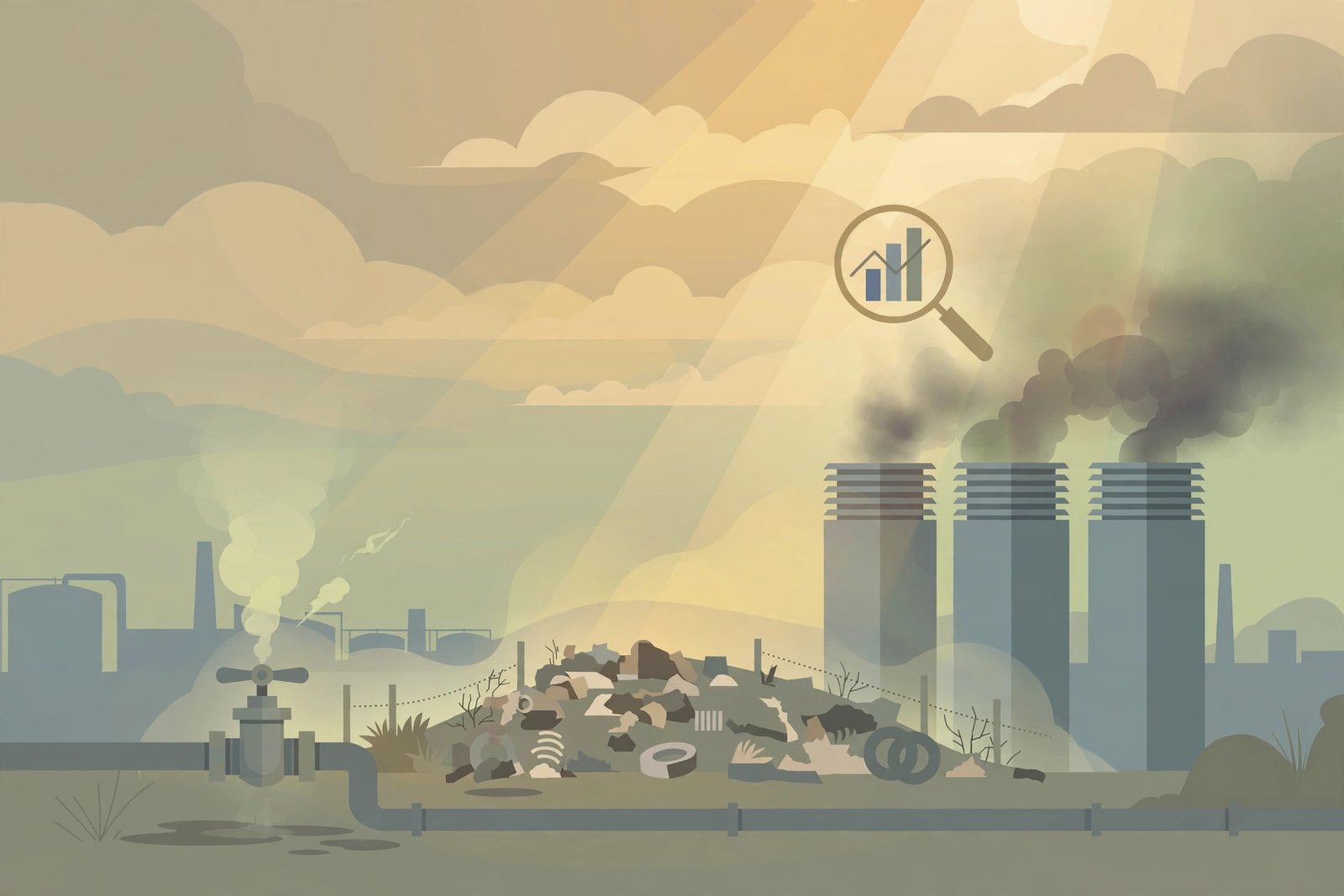
Super pollutants are not a new category of villain. They are familiar ones: methane, black carbon and hydrofluorocarbons (HFCs), plus ground-level ozone in the wider accounting used at the coalition’s Bangkok meeting, where experts described them as pollutants that remain in the atmosphere for weeks or, at most, a decade or two, compared with centuries for carbon dioxide. Short lives, fierce heat. Cut them and the air clears fast. Leave them and you feel it in lungs as well as thermometers.
What $9 billion buys, and where it went
The report, State of Super Pollutant Abatement Finance, calls itself the first global mapping of finance for super pollutant abatement, and it tracked US$9 billion in 2023 commitments, equal to 0.5 per cent of climate mitigation finance that year. Public finance supplied 54 per cent of the tracked flows. Private money stayed mostly domestic, mostly where a return was already visible.
Geography skewed hard. East Asia and the Pacific received 30 per cent of tracked finance and Western Europe 14 per cent, while Sub-Saharan Africa received 13 per cent and relied far more on international public finance. Sector skewed harder still. Waste took 42 per cent and transport 31 per cent, while industry, residential energy, power generation and fossil fuel activities together received just 3 per cent. Read that again. The places where methane leaks from pipes and wells barely registered.
The report adds a caveat worth keeping: data gaps mean low tracked flows do not always mean low actual investment. Fair. A first map has blank spaces. That does not rescue the headline number, though. Even generous allowance for missing flows leaves a gap, not a rounding error.
Methane gets the most. It is nowhere near enough.
Methane received US$5.2 billion, the largest share for any single pollutant. It sounds substantial until you set it against the targets governments have already signed. That sum is 18 per cent of the annual investment needed to meet existing national methane commitments, and 4 per cent of what reductions consistent with the Global Methane Pledge target require. Four per cent.
At the Bangkok conference, reported on 17 October, speakers pushed the same point in political language: benefits arrive within one political cycle, unlike the decades-long wait for carbon dioxide cuts to show. Their estimate, drawn from the coalition’s Hidden Assets assessment, was that action could avoid as much as 0.34°C of warming by 2050. Treat that as a modelled estimate, not a promise — the report itself frames such figures as scenarios. Still, the direction is not in dispute among the sources read for this piece.
The return that finance keeps ignoring
Here is the odd part. The economic case is not weak. A separate UNEP–CCAC assessment cited in the report estimates that every US$1 invested in 25 proven integrated climate and clean air solutions could generate around US$15 in economic benefits. Health Policy Watch, reporting the Bangkok meeting, put the Hidden Assets gains at $1.5 trillion a year for the global economy, with health costs described as immediate — lung disease and respiratory harm happening now, not in a distant model year.
So why the shortfall? The report points to plumbing, not physics. Super pollutants are inconsistently built into national climate plans and finance taxonomies, and clear technical fixes have not been packaged into projects investors can fund. Its three priorities follow from that diagnosis: build policy and data foundations, turn fixes into fundable projects, and use public and blended finance to de-risk work markets will not move on alone.
That diagnosis lands in a busy diplomatic season. On 12 October the Council of the EU set its position ahead of COP31 in Antalya, acknowledging that the Paris Agreement goal of 1.5°C is likely to be exceeded and calling for urgent action on an overshoot path. The Bangkok experts want COP31 negotiators to create a formal roadmap tackling air pollution and warming together. Whether that roadmap appears is unconfirmed at the time of writing.
Analysis: The cheapest-looking brake is not being funded because it does not fit the boxes finance already has. Carbon dioxide has markets, taxonomies and pipelines of projects. A leaking valve, a landfill, a coolant bank — smaller, scattered, harder to bundle. That is an institutional failure, not a scientific one, and institutional failures can be fixed without waiting for a breakthrough. The report’s real demand is boring on purpose: name these pollutants in national plans, count the money properly, package the work. Do that, and the 1-in-200 figure becomes a choice governments have to defend out loud, rather than an accident nobody noticed.
Sources
- Climate Policy Initiative — “Super pollutants drive half of today’s global warming, yet receive only 1 in every 200 dollars of climate mitigation finance” (14 October 2026): https://www.climatepolicyinitiative.org/press-release/super-pollutants-drive-half-of-todays-global-warming-yet-receive-only-1-in-every-200-dollars-of-climate-mitigation-finance/
- Climate Policy Initiative — “State of Super Pollutant Abatement Finance” (October 2026): https://www.climatepolicyinitiative.org/publication/state-of-super-pollutants-abatement-finance/
- Health Policy Watch — “Use This Emergency Brake On Climate Change And Air Pollution, Experts Urge Finance Ministers” (17 October 2026): https://healthpolicy-watch.news/use-this-emergency-brake-on-climate-change-and-air-pollution-experts-urge-finance-ministers/
- Council of the EU — “Council sets EU position ahead of climate change and biodiversity summits” (12 October 2026): https://www.consilium.europa.eu/en/press/press-releases/2026/10/12/multilateralism-council-sets-eu-position-ahead-of-climate-change-and-biodiversity-summits/
Leave a comment
Comment as a guest and verify your email, or sign in or create a reader account. Guest comments reach our review queue after email verification; account holders can submit directly for review.