Event date: 13 October 2026. Information verified through 19 October 2026.
No pills changed hands. In Barcelona, 320 lonely adults from 12 neighbourhoods with low socioeconomic levels were offered time outdoors — in a facilitated group, or pointed towards it on their own — and a year later they reported less loneliness (The Lancet Regional Health – Europe00233-4/fulltext)). The RECETAS findings were reported this month in the October issue of Lancet Regional Health (CU Boulder Today). The trial design was randomised and observer-blinded, built to test two routes a health service might actually pay for (The Lancet Regional Health – Europe00233-4/fulltext)).
The problem it was aimed at
In Spain, about 20% of the population reports experiencing loneliness, and in Barcelona an estimated 100,000 people are affected, a figure the trial paper says has risen almost two-fold since 2020 (ISGlobal via Medical Xpress; The Lancet Regional Health – Europe00233-4/fulltext)).
Loneliness, in this work, does not mean an empty room. Jill Litt, professor of environmental health at CU Boulder and a senior author, describes it as a “subjective disconnect between one’s expectations of their social relationships and one’s reality,” adding: “You could be in a room full of people and still feel lonely” (CU Boulder Today).
Two doors, same neighbourhood menu
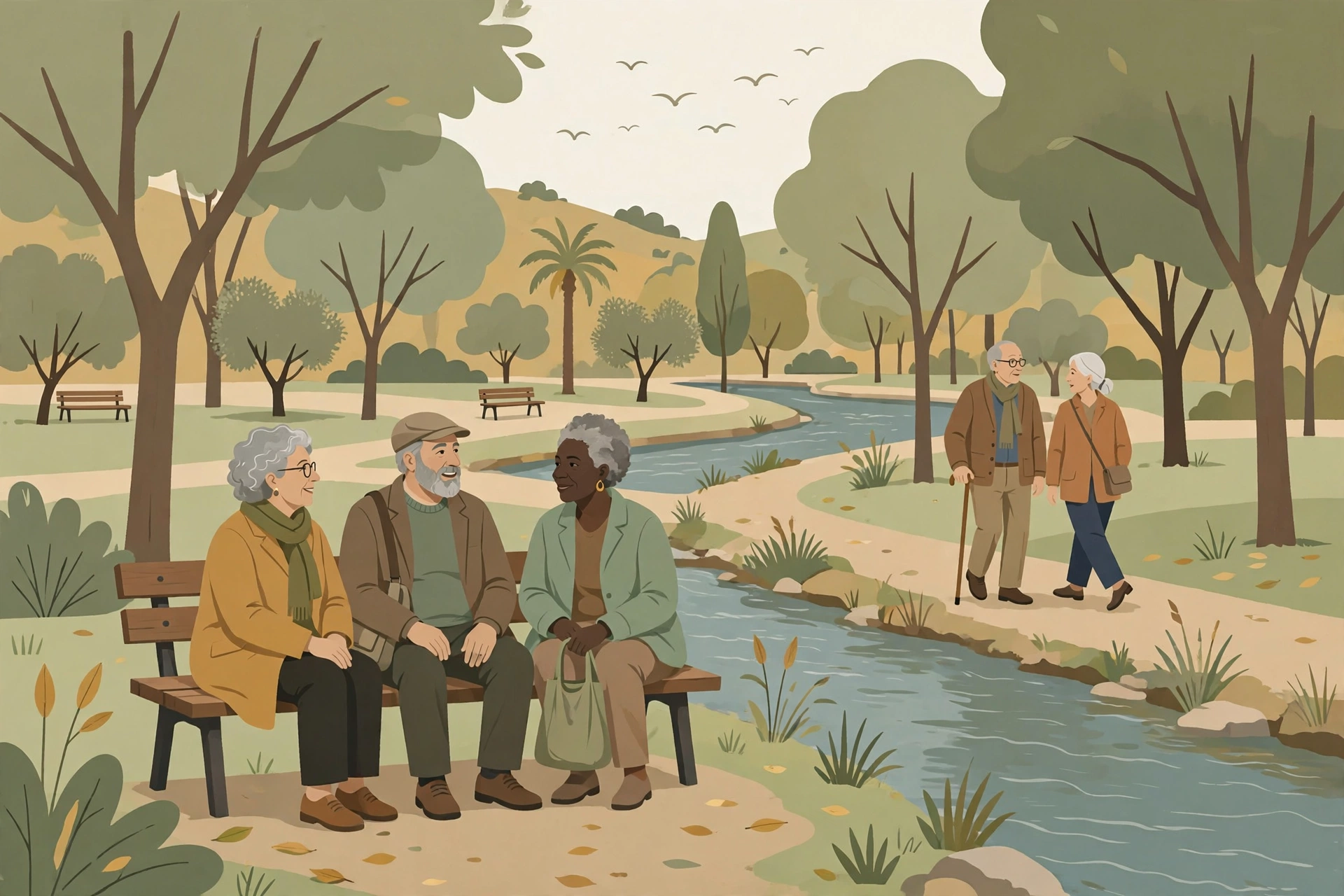
Half the participants joined Friends in Nature, known as FiN. They met in groups of 8–10, for two hours a week over nine weeks, with two trained facilitators, doing activities that included gardening, birdwatching and nature-based art (News-Medical). Sessions also took people to parks, riverways and coastal areas, from a menu co-created with local stakeholders (ISGlobal via Medical Xpress).
The other half got something lighter: a 30-minute motivational interview and information about free, nearby nature-based activities they could pursue independently (ISGlobal via Medical Xpress).
First author Laura Coll-Planas, a researcher at the University of Vic, explained the group model this way: “FiN combines strategies by building groups with peer support, providing social opportunities that are strengthened by experiences in nature and an empowerment process” (ISGlobal via Medical Xpress).
What fell, and what did not
Loneliness fell in both arms. Across all participants, scores dropped by 10.5% at three months and by 16.8% at one year; CU Boulder rounds the same trajectory to 11% at three months, 12% at six months and 17% at one year (The Lancet Regional Health – Europe00233-4/fulltext); CU Boulder Today).
Read the next line before turning that into a headline about group walks beating solo ones. At three months there was no significant difference in loneliness between the two groups, and no significant change in health-related quality of life (The Lancet Regional Health – Europe00233-4/fulltext)). Early dropouts were lower in the group arm — 14% against 28% (The Lancet Regional Health – Europe00233-4/fulltext)).
Where the split showed up was in who started worst off. Participants with higher loneliness and poorer emotional wellbeing benefited more from the facilitated groups, while people with less loneliness did comparably well with the lighter-touch interview and signposting (ISGlobal via Medical Xpress). That is the authors’ moderation analysis, not the main head-to-head result — a distinction worth keeping.
Why a park bench, not a waiting room
Litt argues that nature, with its sounds, smells and sights, can act as an “additional facilitator,” making social contact easier to start (Newswise). One 63-year-old participant put it more simply: “In the outings we have done I have learned to contemplate everything more, to be with the sounds, to focus. I have met people. I have shared. It has been wonderful” (CU Boulder Today).
Environmental psychologist Louise Chawla, a professor emerita at CU Boulder, describes a second effect: “Being out in nature forms this kind of reservoir of calm that we can return to later in life during stressful times” (CU Boulder Today).
Analysis: the community part may be doing as much work as the green part. The activities were local, free to access and chosen from a neighbourhood menu — repeatable after the nine weeks ended, not a one-off referral across the city.
A wider test, with limits in plain sight
RECETAS — Re-imagining Environments for Connection and Engagement — launched in 2021 and has studied Friends in Nature in 1,200 adults in six cities; randomised trials ran in Barcelona, Prague and Helsinki, with quasi-experimental studies in Marseille, Cuenca and Melbourne (CU Boulder Today). Helsinki differed: among frail older adults in assisted-living facilities, the group intervention did beat its control and improved several dimensions of health-related quality of life (ISGlobal via Medical Xpress).
Barcelona’s sample limits how far you can stretch its result. Participants had a median age of about 63 and 80% were women, which the researchers note may limit generalisation to men and younger adults (ISGlobal via Medical Xpress).
Public health agencies in Spain have begun to recognise Friends in Nature as a best-practice model, according to CU Boulder, and Litt is working to bring similar trials to the United States in the hope that insurers might one day cover a birdwatching club (CU Boulder Today). That coverage is an aspiration, not a policy already in place. What Barcelona establishes is narrower, and still useful: point lonely neighbours towards nearby nature, or walk them there in a small group if they are struggling most, and the loneliness score can still be falling a year later.
Sources
- The Lancet Regional Health – Europe — Coll-Planas et al., “Effectiveness of a nature-based social prescribing intervention on loneliness (RECETAS-BCN)”: https://www.thelancet.com/journals/lanepe/article/PIIS2666-7762(26)00233-4/fulltext
- CU Boulder Today — “Can a prescription for nature help cure the loneliness epidemic?”: https://www.colorado.edu/today/2026/10/13/can-prescription-nature-help-cure-loneliness-epidemic
- ISGlobal via Medical Xpress — “Helping people connect with nature and the community reduces loneliness in Barcelona trial”: https://medicalxpress.com/news/2026-08-people-nature-community-loneliness-barcelona.html?deviceType=mobile
- News-Medical — “Nature-based activities may offer lasting relief from loneliness”: https://Www.news-medical.net/news/20261013/Nature-based-activities-may-offer-lasting-relief-from-loneliness.aspx
- Newswise — “Time Spent in Nature Can Ease Loneliness”: https://www.newswise.com/articles/time-spent-in-nature-can-ease-loneliness