Listen to this article
Take the story with you. Choose a voice and a pace that suits you.
Or listen in another language / choose a voice
Getting your device voices ready…
The voice follows the displayed language and your browser’s regional preference when available. You can choose another narration voice.
The California Literacy Roadmap moved from development to statewide rollout on 17 November 2026, at a conference hosted by the Sacramento County Office of Education. State Superintendent Tony Thurmond joined more than 200 educators, district leaders and literacy advocates to launch the guidance and to recognise five school districts for literacy gains, according to the California Department of Education news release. The Roadmap is the state’s attempt to turn reading research into daily classroom practice across the largest public school system in the United States.
Information verified through 24 November 2026.
California Literacy Roadmap: guidance, not a set textbook
The Roadmap is a body of guidance and resources, not a mandated curriculum and not a single commercial programme. The California Department of Education developed it in consultation with the State Board of Education, and it shows teachers how to translate the state’s English Language Arts/English Language Development Framework, its Dyslexia Guidelines and evidence-based practice into classroom instruction, the department states.
Its approach treats reading as a bundle of connected skills. Foundational work on phonological awareness, phonics and fluency sits alongside language development, vocabulary, comprehension, writing, speaking and listening, with room for biliteracy for multilingual learners. The Roadmap was authorised through Senate Bill 114, Section 117 (2023–24), and builds on Thurmond’s Reading by Third Grade and Beyond initiative.
“Literacy is more than an academic skill. It opens doors to opportunity, independence, and a brighter future,” Thurmond said at the launch. “But today is not the finish line. The success of this Roadmap will be measured by what changes for students.”
California literacy coaches funding: $350 million to keep specialists in schools
Guidance alone does not change classrooms, and the rollout sits next to serious money. The 2026–27 state budget includes $350 million in one-time funding to support literacy coaches and reading specialists, plus $40 million for screening for reading difficulties, including dyslexia, the Department of Education confirms.
The coaching money extends an existing grant programme rather than opening a new competition. The Literacy Coaches and Reading Specialists Grant Program already runs in cohorts of schools, and the new allocation extends that support, on current fiscal guidance through 30 June 2031, LeapYear Publishing’s analysis of the department’s materials reports. Coaches work inside schools: modelling lessons, observing teaching, and helping staff act on assessment results. The $390 million combined figure is related state investment around the Roadmap, not a grant awarded to the Roadmap itself, and the distinction matters when judging what the announcement actually bought.
Reading difficulty screening California schools already requires
The screening side of the policy is already law in motion. Annual screening for risk of reading difficulties began in the 2025–26 school year for kindergarten, first-grade and second-grade pupils, using instruments from the state’s approved list, and the $40 million supports local agencies putting that requirement into practice, according to LeapYear Publishing.
Screening is not diagnosis. A screening result flags risk and points teachers toward closer assessment and support; it does not label a child. Done well, it catches struggling readers in the years when intervention works best, which is the same early window the Roadmap’s foundational-skills guidance targets.
The Tony Thurmond literacy announcement and the districts held up as proof
The launch doubled as an awards ceremony. Five districts in Thurmond’s Move the Needle initiative were recognised for sustained commitment to improving literacy: Alisal Union, Evergreen Union, Los Angeles Unified, Parlier Unified and Sanger Unified. Their gains exceeded both state averages and the Move the Needle cohort averages from 2024–25 to 2025–26, and across the longer span from 2022–23 to 2025–26, the department reports.
Holding those districts up is a deliberate choice. A guidance document invites the charge that it is paperwork. Naming districts where outcomes already moved gives the rollout evidence to point at, and gives other districts a peer example rather than a state lecture. The harder test starts now: whether hundreds of districts with different budgets, languages and staffing can make the same guidance work, and whether California’s reading scores move in the years the funding covers.
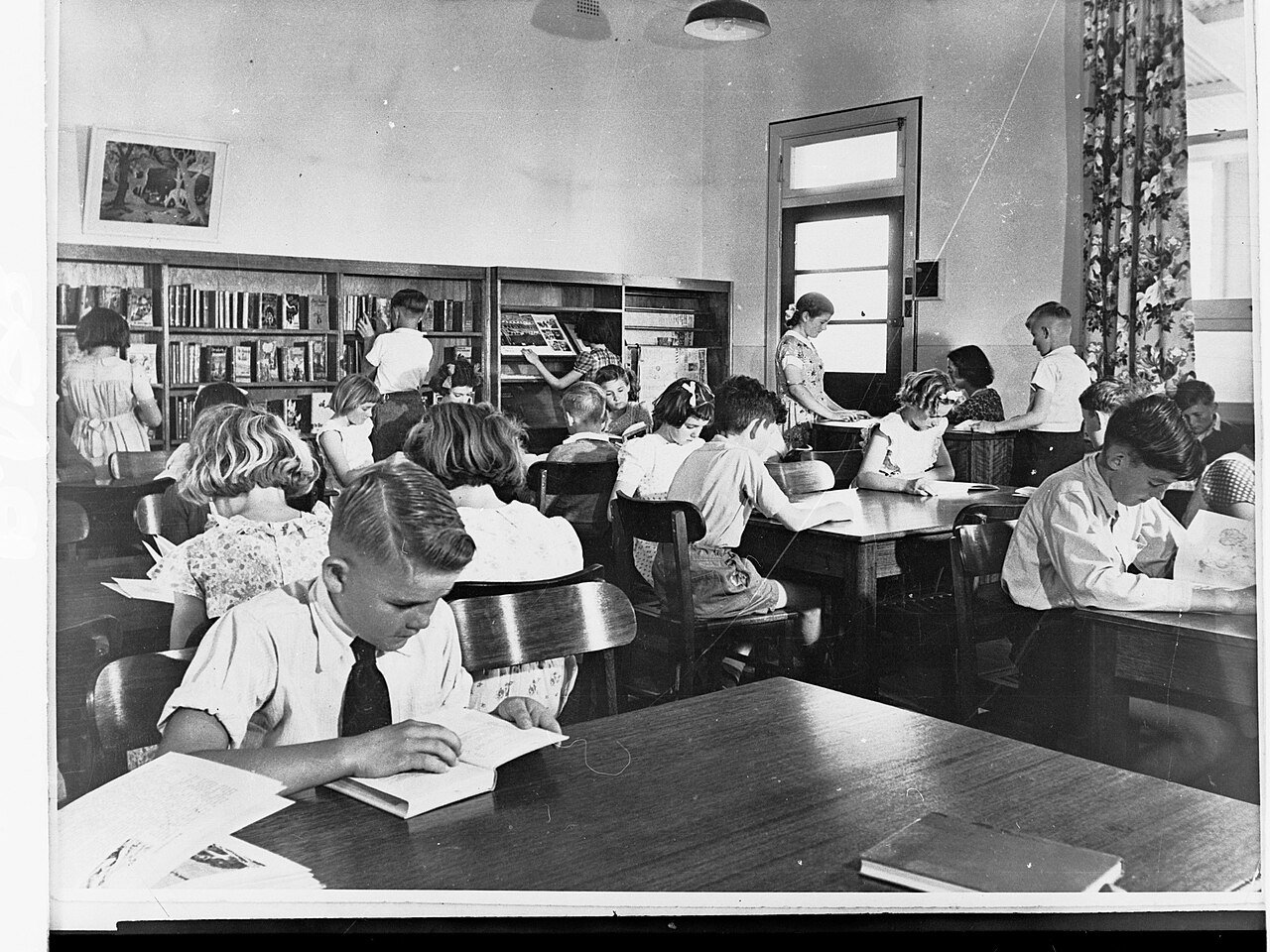
Photo: State Government Photographer, via Wikimedia Commons (CC0) — children reading in a school library.
Sources
- California Department of Education, News Release #26-47 (17 November 2026) — State Superintendent Tony Thurmond Celebrates California Literacy Roadmap Rollout — https://www.cde.ca.gov/nr/ne/yr26/yr26rel47.asp
- LeapYear Publishing — California Literacy Roadmap Launches With $390M in Support — https://leapyearpublishing.com/california-literacy-roadmap-390-million-reading-initiatives/
- Wisevoter — California Rolls Out Statewide Literacy Roadmap — https://wisevoter.com/world/us/ca/2026/11/18/california-statewide-literacy-roadmap-rollout
Leave a comment
Comment as a guest and verify your email, or sign in or create a reader account. Guest comments reach our review queue after email verification; account holders can submit directly for review.