Listen to this article
Take the story with you. Choose a voice and a pace that suits you.
Or listen in another language / choose a voice
Getting your device voices ready…
The voice follows the displayed language and your browser’s regional preference when available. You can choose another narration voice.
The Apophis curse ritual fragments turned up where nobody expected scripture to survive: a rubbish dump. Excavators working at the mortuary temple of Thutmose III in Thebes found 40 charred and pierced papyrus fragments in an ancient trash deposit, and the pieces turned out to be the burnt remains of a curse ritual aimed at Apophis, the great serpent who fought the sun god Ra, according to Phys.org and the University of Copenhagen release carried by Popular Archaeology. The fragments are around 3,400 years old. Each one is no larger than half a postage stamp.
Information verified through 24 November 2026.
Apophis curse ritual fragments: what the rubbish preserved
The ritual itself was violent by design. Apophis was drawn on papyrus in red ink, in the shape of a snake, with his name written out. The sheet was then trampled, spat on, pierced with a knife and burned while spells were recited, the University of Copenhagen release explains. Many of the 40 fragments show exactly that damage: stab marks and charring that match the ritual instructions closely.
That match is the point. The papyrus was supposed to be destroyed completely, because the curse only worked if the material carrying it was destroyed by fire. Finding any of it at all is luck. Finding 40 pieces, in a deposit the temple itself threw away, tells researchers the ritual was not a rare ceremony performed once and recorded. It was routine work, done often enough to leave scraps behind.
The copies look mass-produced, the release notes. Sheets were prepared with drawings ready to be cut out and used, much like a surviving example held by the Metropolitan Museum of Art, where a grid of serpent figures waits to be divided along its lines before use. A ritual with prepared stock is a ritual with regular demand.
The Cursing Apophis study and a 1,000-year pushback
Until this find, Egyptologists had exactly one copy of the Apophis ritual: a ritual manual from the late fourth century BC, with little independent evidence for how often the rite was performed, by whom, or where, according to the University of Copenhagen. The Thebes fragments are roughly 1,000 years older, dating to the New Kingdom. They are the earliest physical evidence that the curse was carried out in practice, not just written down.
The study behind the announcement, “Cursing Apophis: Text and Material Culture of an Egyptian Execration Ritual,” appears in the journal Zeitschrift für Ägyptische Sprache und Altertumskunde, as listed on the University of Copenhagen research portal. Professor Fredrik Hagen of the University of Copenhagen led the work.
“These tiny fragments give us a new indication of how widespread curse rituals were in ancient Egypt,” Hagen says in the release. “Our finds and the subsequent analysis of the ritual confirms that it was a regular part of temple life.” The article also examines which types of priests carried out the ritual inside temples.
A Thutmose III temple papyrus trail beyond the curse
The dump gave up more than curses. Other papyrus fragments from the same deposit turned out to be remains of the temple’s administrative archive, the release reports. Those pieces let researchers study the daily economy and logistics of the offering cult: what came in, what went out, and how a great mortuary temple actually ran.
Hagen makes the methodological point plainly. Egyptology has traditionally studied temples through their reliefs and statues. Rubbish deposits outside the walls get far less attention, yet they hold the paperwork of ordinary days. “We still lack knowledge about many aspects of the lives of ordinary people in antiquity,” he says. “We can only get that knowledge by looking in different places and investigating, for example, rubbish deposits.”
Egyptian execration ritual evidence and everyday magic
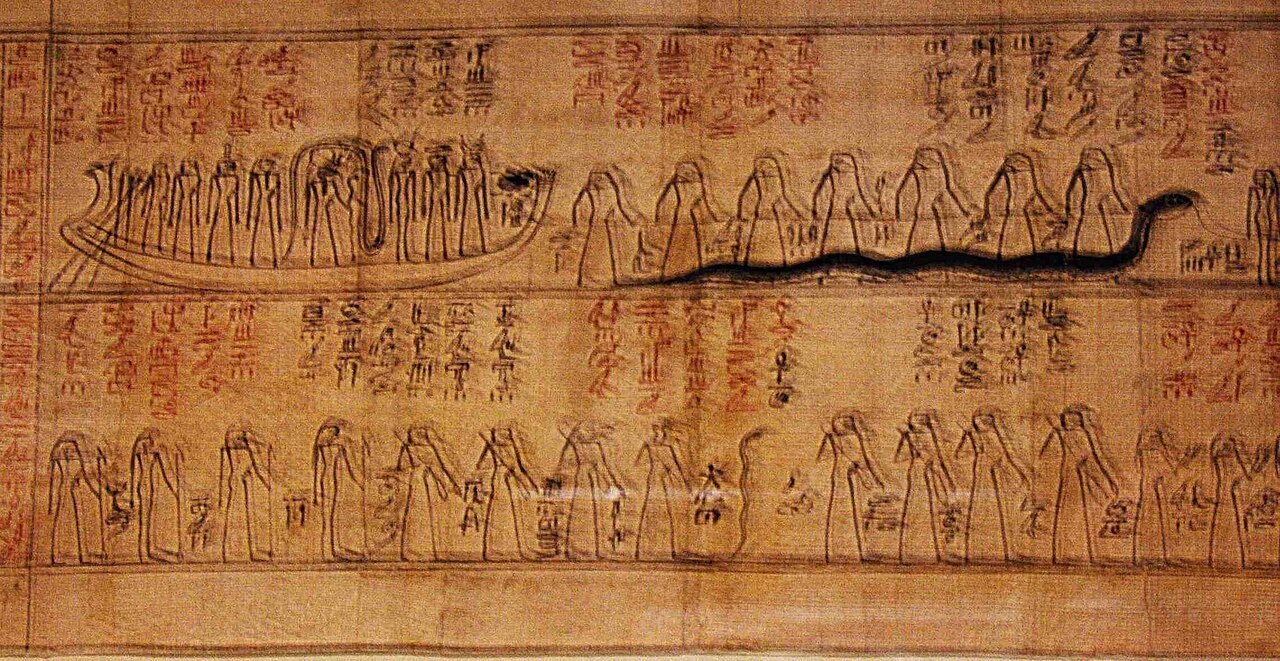
The curse was never only about the serpent. In Egyptian belief, Apophis tried each night to stop Ra completing his journey through the underworld, and destroying the serpent protected the order of the world, the release explains. Over time the same rite was adapted to curse the enemies of the pharaoh, to treat illness and poison, and to ward off bad weather.
It also escaped the temple. Literate people who were not priests had access to magical rituals and worked as magicians and healers, and people approached scribes for help with magic, for protection and for attacking others, Hagen notes. “It must have been widespread in ancient Egypt,” he says of the curse ritual. Forty scraps of burnt papyrus in a dump in Thebes now back that judgement with physical evidence, a thousand years earlier than the one surviving manual ever could.
Photo: Fredduf, via Wikimedia Commons (public domain) — Ra’s barque confronts the serpent Apophis.
Sources
- Phys.org — Discovery of curse ritual in ancient trash dump — https://phys.org/news/2026-11-discovery-curse-ritual-trash-dump.html
- Popular Archaeology (University of Copenhagen release) — Discovery of curse ritual in rubbish dump surprises Egyptologist — https://popular-archaeology.com/article/discovery-of-curse-ritual-in-rubbish-dump-surprises-egyptologist-it-must-have-been-widespread-in-ancient-egypt/
- University of Copenhagen research portal — Cursing Apophis: Text and Material Culture of an Egyptian Execration Ritual — https://researchprofiles.ku.dk/en/publications/cursing-apophis-text-and-material-culture-of-an-egyptian-execrati/
Leave a comment
Comment as a guest and verify your email, or sign in or create a reader account. Guest comments reach our review queue after email verification; account holders can submit directly for review.