Listen to this article
Take the story with you. Choose a voice and a pace that suits you.
Or listen in another language / choose a voice
Getting your device voices ready…
The voice follows the displayed language and your browser’s regional preference when available. You can choose another narration voice.
No bones. No skeleton to lift, bag and label. The Sutton Hoo sand body discovery, announced on 18 November 2026, is a person held only as a shape in the ground — a darker, harder outline where a body once lay in Garden Field, Suffolk (National Trust; PA via Glasgow Times).
Beside that outline sat small, ordinary things: beads, tweezers, a knife and a brooch (National Trust). Underneath it, the team found evidence suggesting someone else may be buried in the same grave. That second burial is not confirmed.
Information verified through 23 November 2026.
What the Sutton Hoo sand body discovery actually shows
The grave came up in the final week of a four-week dig. The National Trust, which cares for Sutton Hoo, ran the work with Time Team, and the results are being shown in a new four-part documentary, with the first episode released on YouTube on 14 November (National Trust).
Strip away the ghost language and the find is still precise. One burial, preserved as an impression. Four kinds of grave goods. A possible second burial directly below. Beyond that, the published record stops — no name, no date range for this individual grave, and no claim about status. Arkeonews makes the same caution plain: objects like these can inform work on burial customs and clothing, but their presence alone cannot establish who the person was (Arkeonews).
What is a sand body, exactly?
Ask what is a sand body and the answer starts with the soil. Sutton Hoo’s ground is acidic. Bone and soft tissue dissolve in it. In some burials the decaying body leaves hard sand in its place, holding the person’s form — in National Trust archaeologist Angus Wainwright’s comparison, “not unlike some of the bodies at Pompeii” (National Trust).
Wainwright called the 1980s sand bodies one of the strangest features of those excavations, and finding another in Garden Field a high point of this dig (PA via Glasgow Times). The same chemistry explains a famous absence nearby: no body survived in the great ship burial either, and its presence there was established by chemical analysis of the sand, a point the National Trust sets out in its history of the site. Absence, at Sutton Hoo, is not the same as nothing having been there.
Sand bodies are also fragile evidence. The outline can show posture and position. It cannot give you the bone chemistry or disease history a skeleton might.
Away from the mounds: the Sutton Hoo Garden Field cemetery
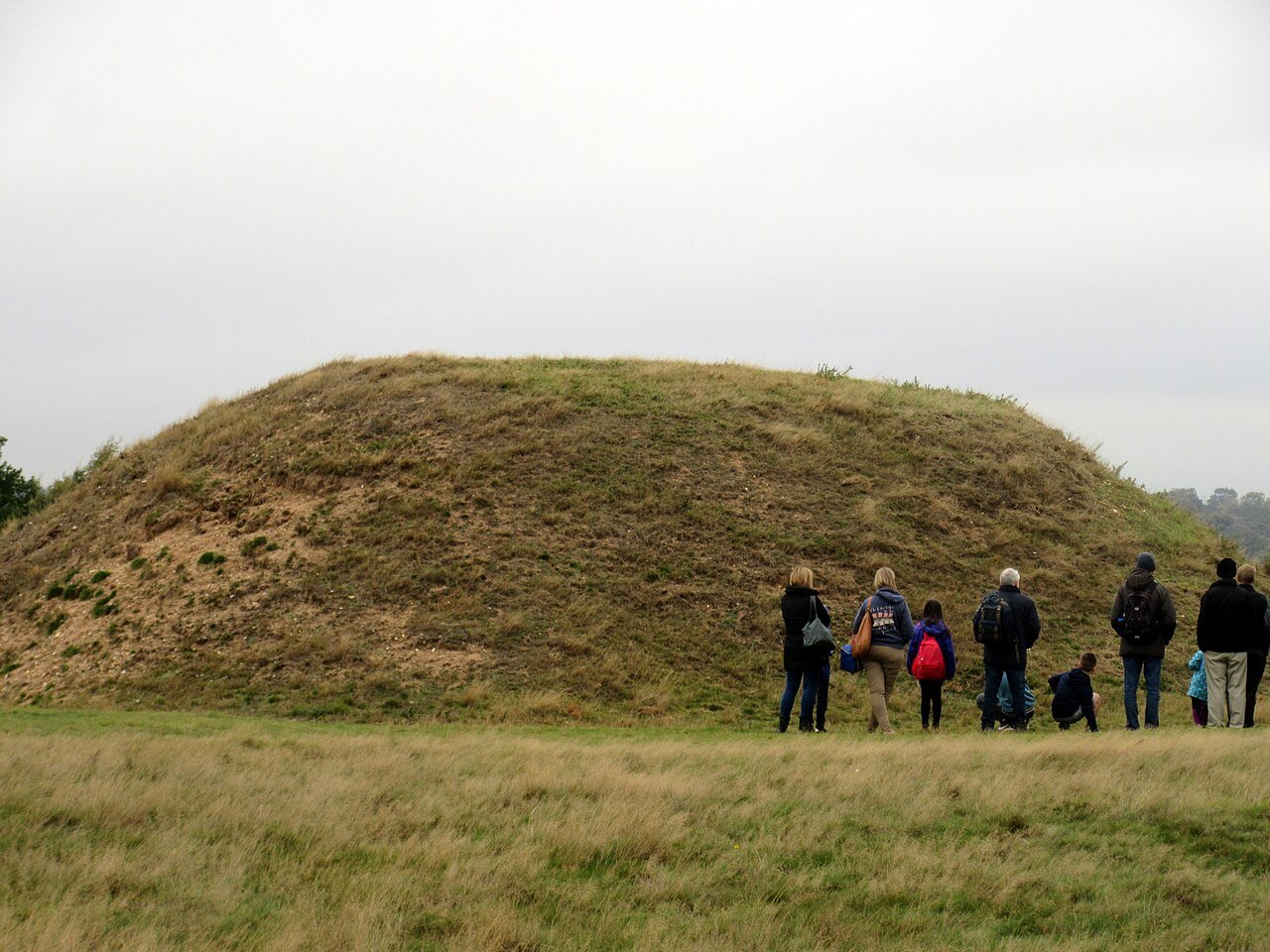
Most people know one image from this place: a 27-metre ship, found in 1939, its chamber crowded with weapons, gold and silver, often linked — never proven — to Rædwald, a seventh-century king of East Anglia (Arkeonews). That ship has swallowed the site’s public story ever since.
The Sutton Hoo Garden Field cemetery is a different ground. It sits apart from the royal burial mounds and the ship burial ground, and Time Team first investigated it in 2024, looking for the origins and development of the wider site (National Trust). Wainwright put the shift bluntly: archaeologists have focused on the royal mounds, yet those mounds stood in a landscape familiar to “the everyday East Anglians who lived in the villages and farms of the river valley,” and this excavation moves the focus to those people, their ancestors and their descendants (PA via Glasgow Times).
Garden Field had already produced a jolt in 2024. The team lifted the base of the sixth-century Byzantine Bromeswell Bucket in a single block; laboratory work showed it was intact and had held a cremation burial, with cremated human bone and bone from an animal larger than a pig (National Trust). Cremation in a Byzantine bucket one season, an inhumation preserved as sand the next. The cemetery was used in more than one way.
A four-week dig, a final-week find
The Time Team Sutton Hoo 2025 excavation was the second season of a two-year research project. The team returned hoping to establish how extensive the cemetery was, when it was used, and whether the people buried there were connected to the communities linked to the royal ground (National Trust). Across two seasons, metal detecting is now complete and features picked up by geophysical survey have been examined.
Time Team’s Anglo-Saxon specialist, Dr Helen Geake, was candid about how much remains open: the team was thrilled to locate and excavate the Bromeswell Bucket burial and set it in context, but questions remain about the bucket’s date, the choice of cremation and inhumation on this part of the site, and “the inhumation grave with its tantalising hint of another below” (National Trust).
So the open questions are the real result here. How big is this cemetery? When was it in use? Does it hold people who came before the royal cemetery — earlier generations whose presence might help explain why this particular place was chosen at all? The National Trust raises each of those questions itself, and answers none of them yet.
Analysis: the value of this find is not a new treasure. It is a change of subject. Sutton Hoo’s fame rests on a king’s grave goods you can photograph behind glass; a sand body gives you no object to marvel at, only a person-shaped gap and four small belongings. If Garden Field does turn out to predate or run alongside the royal ground, the site’s story stops being a single spectacular burial and becomes a community burying its dead over time, in different rites, in ground the kings later claimed.
Watch the remaining episodes, then. But read the eventual excavation reporting before treating the second burial as settled — at the time of writing it is evidence suggesting a burial, not a burial established.
Photo: John H Darch, via Wikimedia Commons (CC BY-SA 2.0)
Sources
- National Trust — National Trust and Time Team partnership: https://www.nationaltrust.org.uk/visit/suffolk/sutton-hoo/time-team-announcement?campid=Social_Central_Heritage_Threads_TimeTeam_120324
- Glasgow Times (PA) — ‘Mysterious’ Anglo-Saxon grave discovered at Sutton Hoo: https://www.glasgowtimes.co.uk/news/national/26743651.mysterious-anglo-saxon-grave-discovered-sutton-hoo/
- Arkeonews — New Anglo-Saxon Grave Found at Sutton Hoo Beyond the Royal Mounds: https://arkeonews.net/new-anglo-saxon-grave-found-at-sutton-hoo-beyond-the-royal-mounds/
- Archaeology Wiki — Mysterious Anglo-Saxon burial discovered at Sutton Hoo: https://www.archaeology.wiki/blog/2026/11/20/mysterious-anglo-saxon-burial-discovered-at-sutton-hoo/
Leave a comment
Comment as a guest and verify your email, or sign in or create a reader account. Guest comments reach our review queue after email verification; account holders can submit directly for review.