Listen to this article
Take the story with you. Choose a voice and a pace that suits you.
Or listen in another language / choose a voice
Getting your device voices ready…
The voice follows the displayed language and your browser’s regional preference when available. You can choose another narration voice.
Every few months the internet rediscovers that Mohandas Gandhi spent twenty-one years in South Africa, and every few months the argument runs on screenshots and slogans. This article goes to the record instead — the gandhi south africa record as Gandhi himself wrote it, in the Collected Works of Mahatma Gandhi, the Indian government’s own edition of his writings. What follows is quoted, dated and graded. Where the record does not support a claim — including claims made on our side of the argument — this article says so. The documented record is damning enough. It does not need help.
The words are his
Start in 1894. In an open letter to the Natal Parliament, the young lawyer Gandhi complained that Indians were being “dragged down to the position of a raw Kaffir,” and pointed out that “both the English and the Indians spring from a common stock, called the Indo-Aryan.” The argument was never that the ladder was wrong. The argument was that Indians had been placed on the wrong rung of it.
Two years later, speaking in Bombay on 26 September 1896, he said it in full: “Ours is one continual struggle against a degradation sought to be inflicted upon us by the Europeans, who desire to degrade us to the level of the raw Kaffir whose occupation is hunting, and whose sole ambition is to collect a certain number of cattle to buy a wife with and, then, pass his life in indolence and nakedness.” That is CWMG Volume 1, page 410 — the single most-cited passage in the whole controversy, reproduced identically by his critics and by the standard editions.
On 24 September 1903, in Indian Opinion, the newspaper he founded, he wrote: “We believe as much in the purity of race as we think they do… We believe also that the white race in South Africa should be the predominating race.” In March 1908, writing from prison, he described the African prisoners around him: “Kaffirs are as a rule uncivilised – the convicts even more so. They are troublesome, very dirty and live almost like animals.” And in 1905, objecting to a firearms law that restricted Indians and Africans together, he wrote the sentence that comes closest to the whole structure in one line: “The prominent race can remain so by preventing the native from arming himself.” Indians, in his argument, should be exempted from the restriction. The restriction on Africans could stand.
The third door
The Durban post office had two entrances: one for Europeans, one shared by natives and Asiatics. Gandhi’s Natal Indian Congress petitioned. The result was three entrances — Europeans, Asiatics, Natives — and Gandhi reported it in his 1896 Green Pamphlet as a win: “they have now provided three separate entrances for natives, Asiatics, and Europeans.” The outcome is documented; historians argue about the motive. But the post office was one item in a pattern that ran for fifteen years: petitions for separate railway compartments, separate schools, separate prison arrangements, and a 1904 letter demanding that “the Town Council must withdraw the Kaffirs from the Location” where Indians lived. He never, in South Africa, built a joint front with African organisations, and he never asked for African political rights. Days before he left in July 1914, he told the Transvaal Leader: “we have never asked for political equality.”
1906: he served the suppression
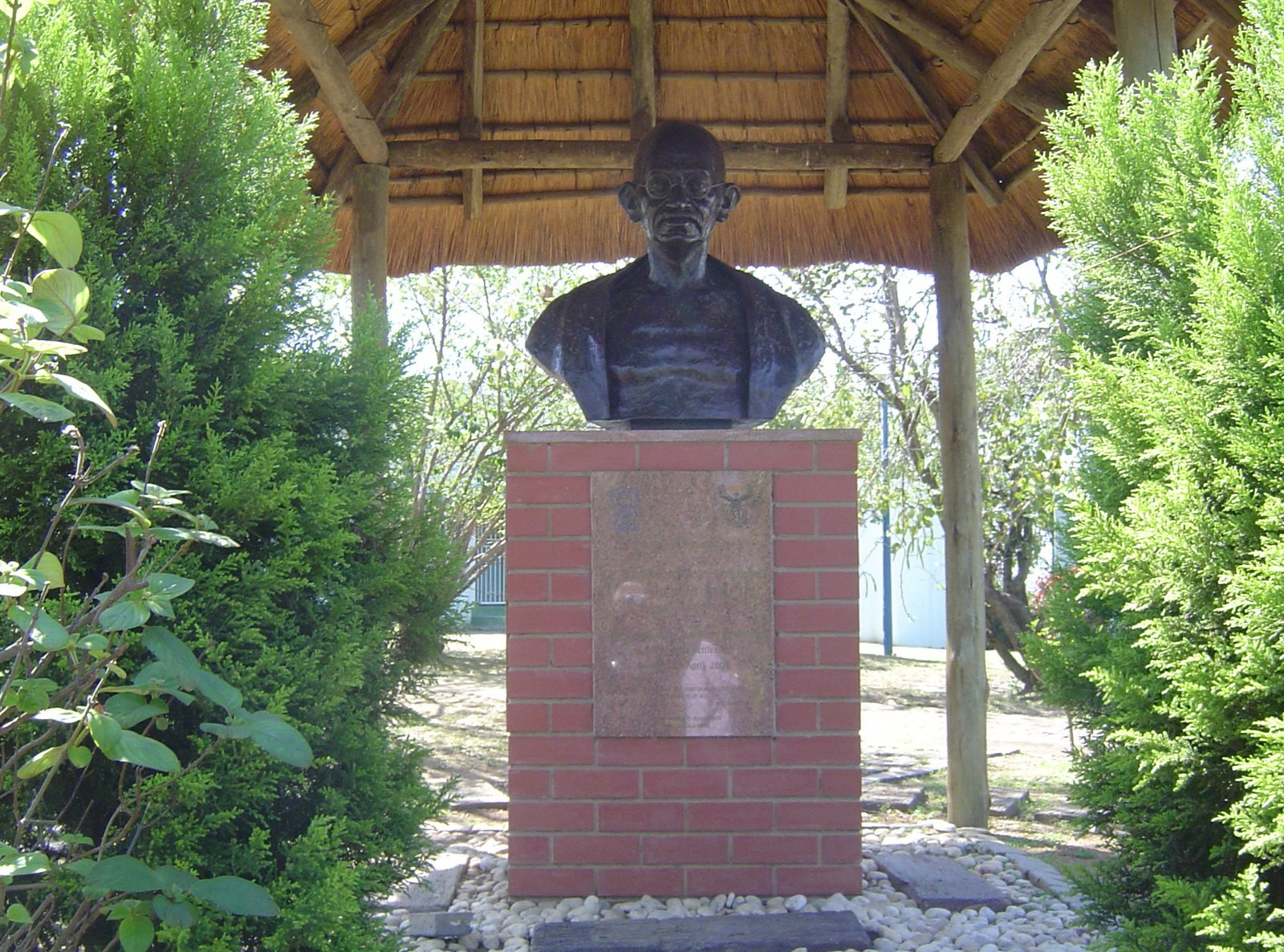
When Chief Bambatha’s Zulu resistance to a poll tax rose in 1906 and the colonial militia crushed it — killing three to four thousand Zulus — Gandhi raised a stretcher-bearer corps, took the rank of sergeant-major, and urged Indians to support the war effort as a way to legitimise their claim to citizenship. That much is documented conduct. What the corps ended up doing was nursing wounded Zulus whom no white nurse would treat, and Gandhi’s own autobiography later called the campaign “no war but a man-hunt.” Both things are in the record: he volunteered for the Empire’s side of a suppression of Africans, and the work horrified him. We print both, because both are true — and because the first one is the part the statues leave out.
What this article will not print
Precision is a weapon, so here is the line. It is often said — in exactly these terms — that Gandhi told white supremacists it was acceptable to harm Black people so long as Indians were spared. No primary source says that. No such sentence exists in the Collected Works or in the most hostile scholarship on him. What is documented is the structure underneath the paraphrase: a man who argued, for two decades, that his people should be ranked above Africans inside a white-supremacist order, who used its ugliest word for them as a matter of routine, and who served that order in its wars. That is the record. Stating it as a quotation he never uttered hands his defenders a rebuttal they do not deserve to have.
Two more corrections, in both directions. The claim that the bargain was for “his caste” is not in the South Africa record either — his constituency was British Indians as a category, in practice the trader class of the Natal Indian Congress; his caste politics belong to the later fight with Ambedkar in India. And the defence that he simply grew out of it by his mid-thirties fails against his own volumes: the same hierarchy language runs through 1906 to 1909. His language did soften by the late 1930s and 1940s — but even in 1939 he advised separate Indian and African struggles, not a joint one.
1923: asking America for whiteness
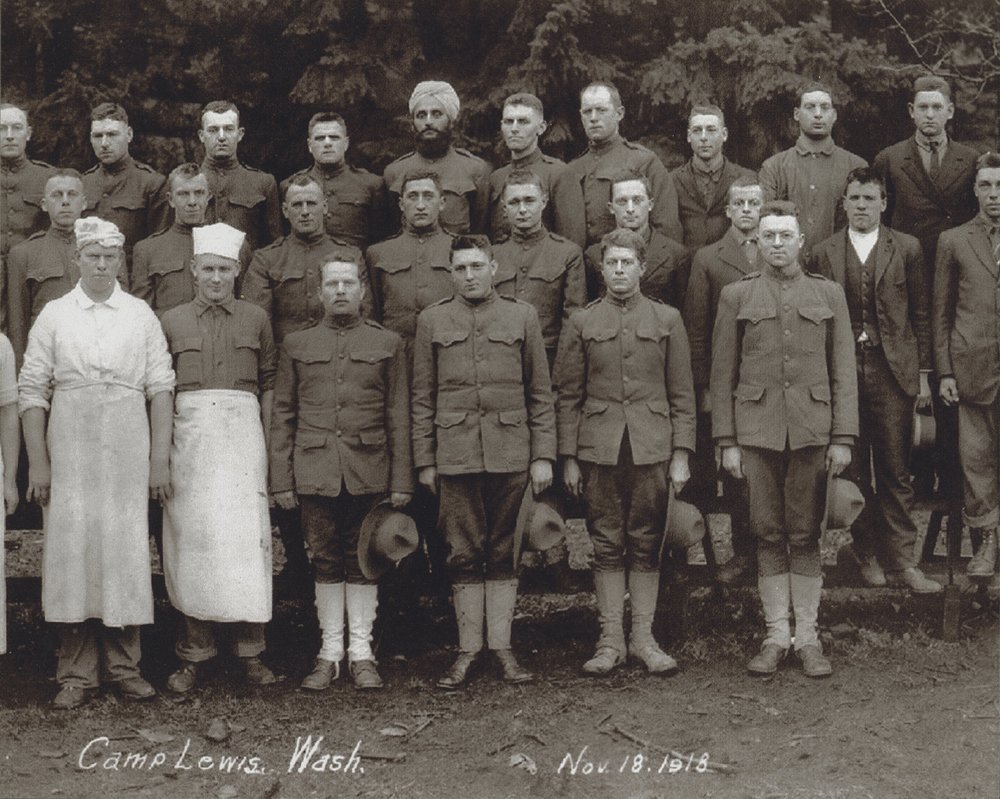
The same logic crossed the ocean. Bhagat Singh Thind, a Punjabi immigrant and US Army veteran, asked the United States Supreme Court to declare him a white person — because, as a “high-caste Hindu of full Indian blood,” he was Aryan, and Aryan meant Caucasian. His brief argued the point through caste purity, and it reached for the ugliest available comparison: “The high-class Hindu regards the aboriginal Indian Mongoloid in the same manner as the American regards the negro, speaking from a matrimonial standpoint.” Read that again. The claim to whiteness was built by standing on the same two ladders at once — caste at home, anti-Blackness in America. Two earlier Indian immigrants, in 1909 and 1913, had actually won citizenship on the “white Aryan” argument. On 19 February 1923 the Court, unanimously, shut the door: “Aryan” was a language, not a race, and whiteness was what “the common man” understood. Naturalised Indians were stripped of citizenship in the years that followed; the door did not reopen until the Luce-Celler Act of 1946. The grievance of not being accepted into whiteness is real history. So is what was offered as the admission ticket.
The hierarchy at home
None of this floated free of the system underneath it. Ambedkar named caste “graded inequality” — an ascending scale of reverence and a descending scale of contempt, sealed by marriage inside the group, so that nearly everyone has somebody below them. It is still measurable. India’s own IHDS-II survey (2011–12, over 42,000 households) found 27 percent of households admitting they practise untouchability — 52 percent among Brahmins — six decades after the constitution abolished it. Inter-caste marriage stood at 5.82 percent in 2011. And the colour ladder has a cash register: Unilever’s Fair & Lovely earned more than $500 million a year in India alone, on advertisements that for decades ran the same sequence — dark woman rejected, cream applied, life granted. In 2020, amid a global reckoning over race, the name became Glow & Lovely. The cream did not change. In the interest of the same precision demanded above: the one controlled résumé experiment on skin tone and hiring in India found no statistically significant bias, and we will not claim otherwise. The hierarchy is documented in law, in marriage data, in survey admissions and in a half-billion-dollar market. It does not need a statistic it has not earned.
2017: Greater Noida
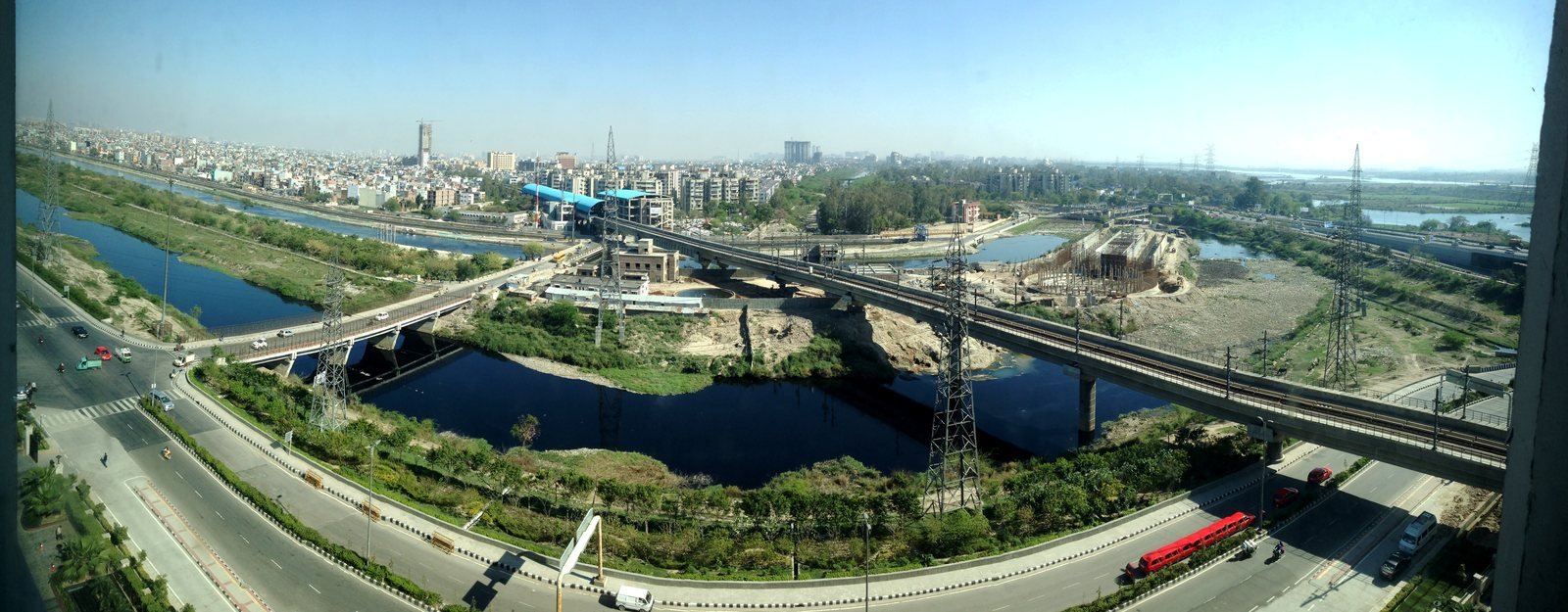
End the record in the present tense. On 27 March 2017, in Greater Noida outside Delhi, a candlelight vigil for a dead schoolboy turned into mob attacks on Nigerian students — beaten with chairs and metal dustbins at Pari Chowk and inside the Ansal Plaza mall, several hospitalised. The trigger was a rumour stack: the boy’s family blamed Nigerian neighbours for drugs; residents broke into five students’ home and searched their refrigerator, accusing them of cannibalism. Police arrested the accused Nigerians and released them for lack of evidence. The students beaten in the mall were not even from the boy’s colony. Posters went up calling for a “Nigerian-free Greater Noida.” The district magistrate announced: “It is absolutely not a hate crime.” The foreign minister called the attack deplorable — and then told Parliament it could not be called racist. African envoys, acting together, called the accumulated attacks “xenophobic and racial in nature” and threatened a UN Human Rights Council investigation. Five men were arrested out of some 600 booked. In the research behind this article, no conviction for the Greater Noida attacks was found — the same blank found after the 2016 beating of a Tanzanian student in Bengaluru and the killing, that same year, of a Congolese teacher in Delhi.
That is the through-line. A hierarchy that sorts people by birth at home does not check itself at the airport. A saint’s statue does not survive contact with his own collected works. And a people who were never the authors of that hierarchy — who were its cargo — are done being billed for it. The same sorting logic, priced at a Delhi ticket window, is examined in The One-Way Door: Dilli Haat’s Foreigner Price and the Black American Nobody Mentioned.
Verification date: 22 November 2026. Quotations from Gandhi are from the Collected Works of Mahatma Gandhi as reproduced in the sources below; the verdicts on contested points are stated in the text. The framing of what the record means is ours.
Sources and further reading
Checked 22 November 2026.
- Collected Works of Mahatma Gandhi, Vol. 1 (Wikisource) — the 1896 Green Pamphlet and the Durban post office passage
- Nishikant Kolge, “Was Gandhi a Racist? His Writings in South Africa,” Economic & Political Weekly, 30 January 2016
- United States v. Bhagat Singh Thind, 261 U.S. 204 (1923) — full opinion
- Falu Bakrania, “Caste-ing White Supremacy: Thind, Cisco, and the Politics of Belonging,” Ethnic Studies Review 46(1-2), 2023
- Human Rights Watch — “India Ignores Its Own Hate Crimes,” 30 March 2017
- The Caravan — reporting from Greater Noida, 30 March 2017
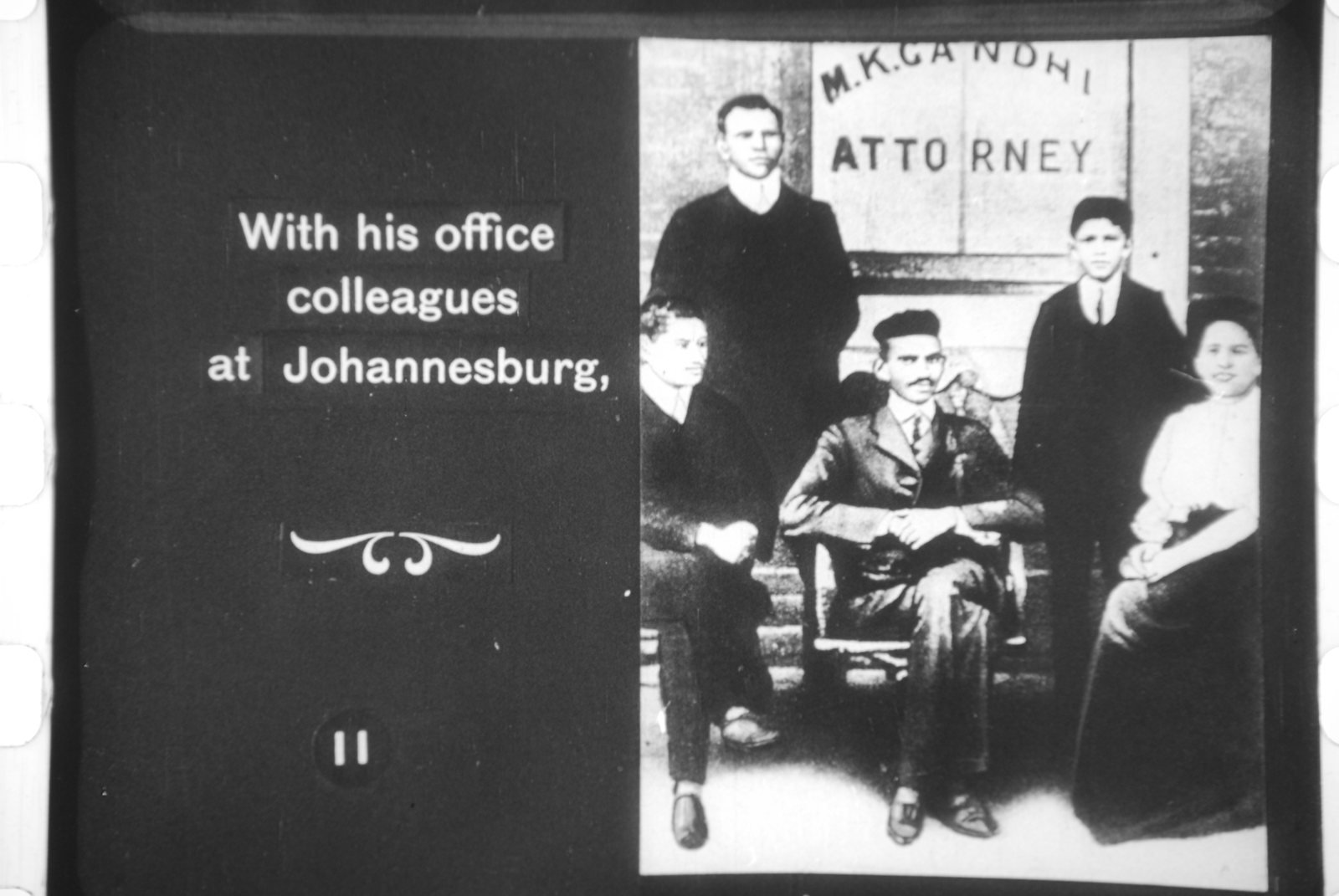
Cover photo: the young Gandhi, seated centre, with his office colleagues in Johannesburg. Public domain, via Wikimedia Commons
Leave a comment
Comment as a guest and verify your email, or sign in or create a reader account. Guest comments reach our review queue after email verification; account holders can submit directly for review.