Listen to this article
Take the story with you. Choose a voice and a pace that suits you.
Or listen in another language / choose a voice
Getting your device voices ready…
The voice follows the displayed language and your browser’s regional preference when available. You can choose another narration voice.
The Xiongnu tomb Roman cup Mongolia story starts with a broken, transparent glass cup. It has a handle. It lay in a wooden coffin about 14.5 metres underground in eastern Mongolia, and the archaeologists who found it think it may have been made inside the Roman Empire (Smithsonian Magazine; Seoul Economic Daily). That origin is not proven. Compositional analysis still has to pinpoint where the glass was made (Seoul Economic Daily).
Information verified through 22 November 2026.
Duurlig Nars Tomb 160: four years of digging
Duurlig Nars Tomb 160 was excavated from 2023 to 2026 by the National Museum of Korea, the Institute of Archaeology at the Mongolian Academy of Sciences and the National Museum of Mongolia, and the team announced the completed excavation on 6 November 2026 (Seoul Economic Daily; Archaeology Wiki). The cemetery at Duurlig Nars holds some 300 graves, and UNESCO added the complex to its World Heritage List earlier this year (Smithsonian Magazine).
Getting down to the coffin took patience. Builders in antiquity cut the ground in steps and filled the tomb with nine separate layers of stone; the modern team removed those layers one by one (Seoul Economic Daily). At the centre sat two layers of wooden outer coffin enclosing an inner coffin, with a lacquered carriage buried directly above the central chamber (Seoul Economic Daily). A carriage like that is not a modest burial good. It marks high status, and so does the sheer labour in the pit above it.
The largest Xiongnu tomb Mongolia has produced — with a small room at its heart
By the completed measurements, this is the largest Xiongnu tomb Mongolia has produced: about 73 metres long including the entrance passage running south, and 14.5 metres deep (Seoul Economic Daily; Archaeology Wiki). Smithsonian Magazine puts the length at nearly 240 feet (Smithsonian Magazine).
Then comes the odd part. For all that size, the central chamber was unexpectedly small and shallow. Comparable tombs in central Mongolia reach about 22 metres deep; Tomb 160 stops at 14.5 (Seoul Economic Daily). The tomb dates to the late first or second century CE, when Xiongnu power was gradually declining, and the excavation team suggests the reduced chamber may reflect changes in Xiongnu society at that time (Smithsonian Magazine; Archaeology Wiki). Suggests is the right word. One tomb can hint at a shift; it can’t prove one on its own.
Xiongnu tomb Roman cup Mongolia: what the 413 objects actually show
The team recovered 413 artifacts from the central chamber (Smithsonian Magazine). Fifteen pieces of jade lay in overlapping layers on the floor of the coffin. They were modelled on the bi disc, a Han funerary jade, but they are not tidy round discs — their shapes are irregular and their surfaces carry intricate carvings, which the researchers read as the Xiongnu adopting Han funerary culture while reworking its forms (Seoul Economic Daily).
Horses run through the rest. A gourd-shaped silver harness pendant, hammered from thin silver sheet, resembles ornaments from Lelang tombs, including Tomb No. 219 at Seogam-ri in Pyongyang — except this one sets a crystal at its centre (Seoul Economic Daily). A round gold ornament, backed with gold leaf and red and blue material beneath crystal so light glows softly through the stone, has been identified in a Xiongnu tomb for the first time, the team said (Seoul Economic Daily). The excavation team also said finds of this quality had not been reported before in eastern Mongolia (Seoul Economic Daily).
An exchange network, not a straight line from Rome
The National Museum of Korea put its conclusion in one sentence: “This excavation clearly shows that the Xiongnu of 2,000 years ago were linked to a broad exchange network reaching from Rome to the Korean Peninsula” (Smithsonian Magazine). Read that carefully. A network is not a direct route. The Xiongnu exchange network Rome to Korea framing points to objects, styles and materials moving across Eurasia, quite possibly through intermediaries, gifts and trade in stages — Archaeology Wiki makes the same caution, noting the similarities do not necessarily mean direct contact between every society involved (Archaeology Wiki).
Context helps. The Xiongnu thrived in Central Asia between the third century BCE and the second century CE, controlling vast territory without building cities or a central bureaucracy, as Bruce Bower wrote for Science News in 2023, quoted by Smithsonian Magazine (Smithsonian Magazine). An empire run by moving people can still move goods a very long way. Tomb 160 is physical evidence of that reach, buried with one person whose name we still don’t have.
The person in the coffin is still unknown
Nobody has identified the occupant. Teeth and hair recovered from inside the coffin are the next evidence: DNA analysis could establish sex and age, and — the team hopes — any relationship to people buried in nearby satellite graves (Seoul Economic Daily). The artifacts will be brought to South Korea by the end of the year for conservation and scientific analysis, with two Mongolian researchers taking part as conservation trainees, and records of the whole excavation captured in 3D will be turned into digital content (Seoul Economic Daily). The findings were presented at the 50th national conference of the Korean Archaeological Society in Gangneung on 6–7 November, and a full excavation report will follow (Seoul Economic Daily).
Analysis: the headline object may yet turn out not to be Roman at all, and the article of faith here should be the assemblage, not the cup. Jade reworked from a Han model, silver matching Pyongyang, a gold-and-crystal technique new to Xiongnu tombs — that combination doesn’t need a Roman label to matter. It already shows an elite burial assembled from a continent-wide conversation.
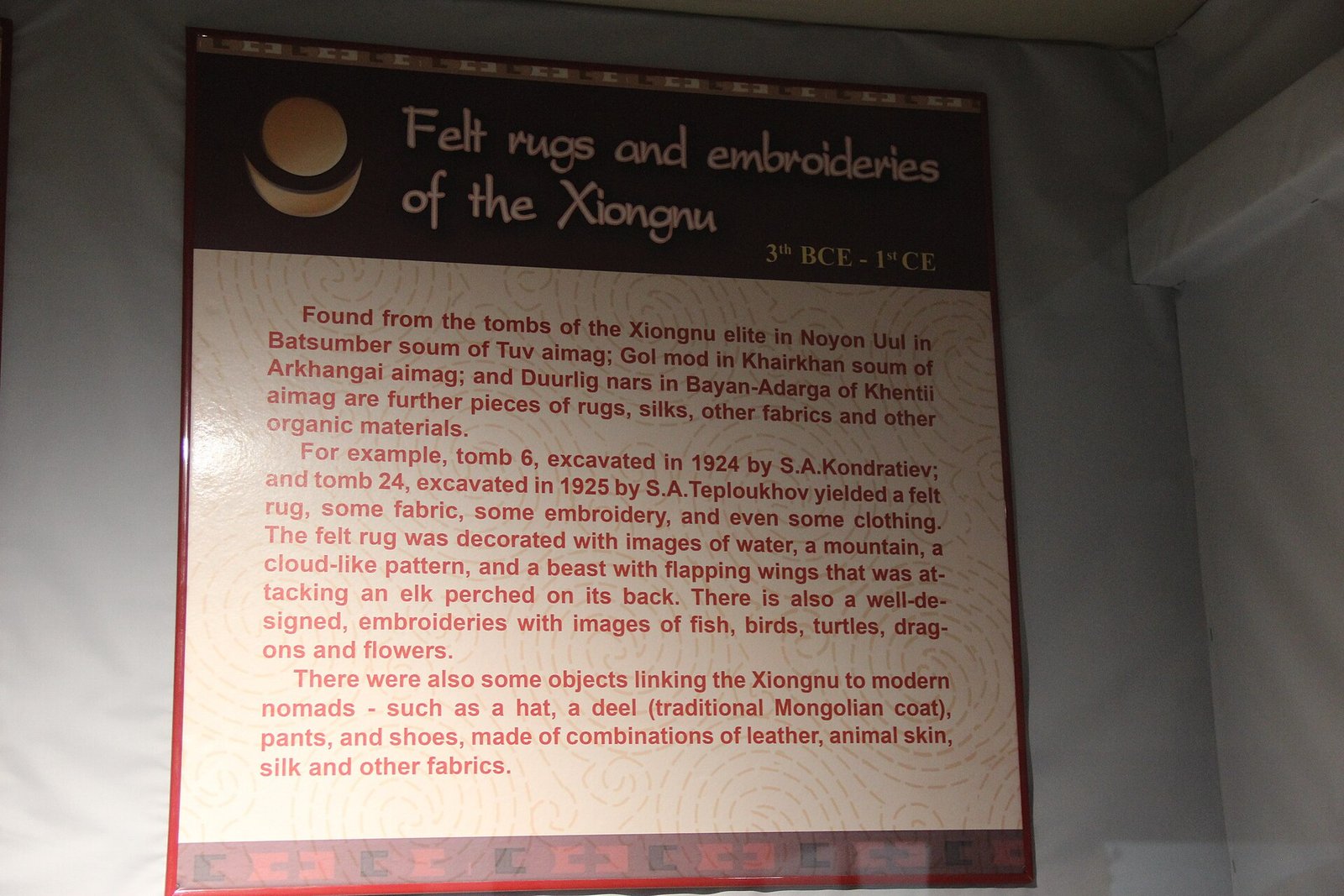
Photo: Gary Todd, via Wikimedia Commons (CC0) — felt rugs and embroideries of the Xiongnu, including pieces from Duurlig Nars, at the National Museum of Mongolia.
Sources
- Smithsonian Magazine — A Roman Cup and Hundreds of Other Treasures Unearthed in This 2,000-Year-Old Tomb Reveal the Rich Exchange Network of an Ancient Asian Empire: https://www.smithsonianmag.com/smart-news/a-roman-cup-and-hundreds-other-treasures-unearthed-in-this-2000-year-old-tomb-reveal-the-rich-exchange-network-of-an-ancient-asian-empire-180989920/
- Seoul Economic Daily — From Rome to the Korean Peninsula: Inside a Xiongnu Imperial Tomb: https://en.sedaily.com/culture/2026/11/06/from-rome-to-the-korean-peninsula-inside-a-xiongnu-imperial
- Archaeology Wiki — Treasures Unearthed in Mongolia’s Largest Xiongnu Tomb: https://www.archaeology.wiki/blog/2026/11/16/treasures-unearthed-in-mongolias-largest-xiongnu-tomb/
Leave a comment
Comment as a guest and verify your email, or sign in or create a reader account. Guest comments reach our review queue after email verification; account holders can submit directly for review.