Listen to this article
Take the story with you. Choose a voice and a pace that suits you.
Or listen in another language / choose a voice
Getting your device voices ready…
The voice follows the displayed language and your browser’s regional preference when available. You can choose another narration voice.
On November 19, a Jersey City tenant who posts as @thegabriellaeffect uploaded the first instalment of what she bills as a ten-part series: a heated hallway confrontation with her former landlord, filmed face to face. She moved out of the apartment on December 31, 2025. Her $3,900 security deposit was due back within thirty days. It is now late November 2026, and she says it has never arrived — no money, no itemized statement, and no word, in all that time, about where the deposit was even held.
Everything in her account is her allegation, and it is important to say so plainly at the start: none of the deposit facts has been independently corroborated, Gabriella has never publicly named the landlord, and because the landlord has not been identified, her side could not be sought. What can be checked is the law — and on the deposit at the centre of this fight, New Jersey law is unusually clear, and unusually favourable to tenants.
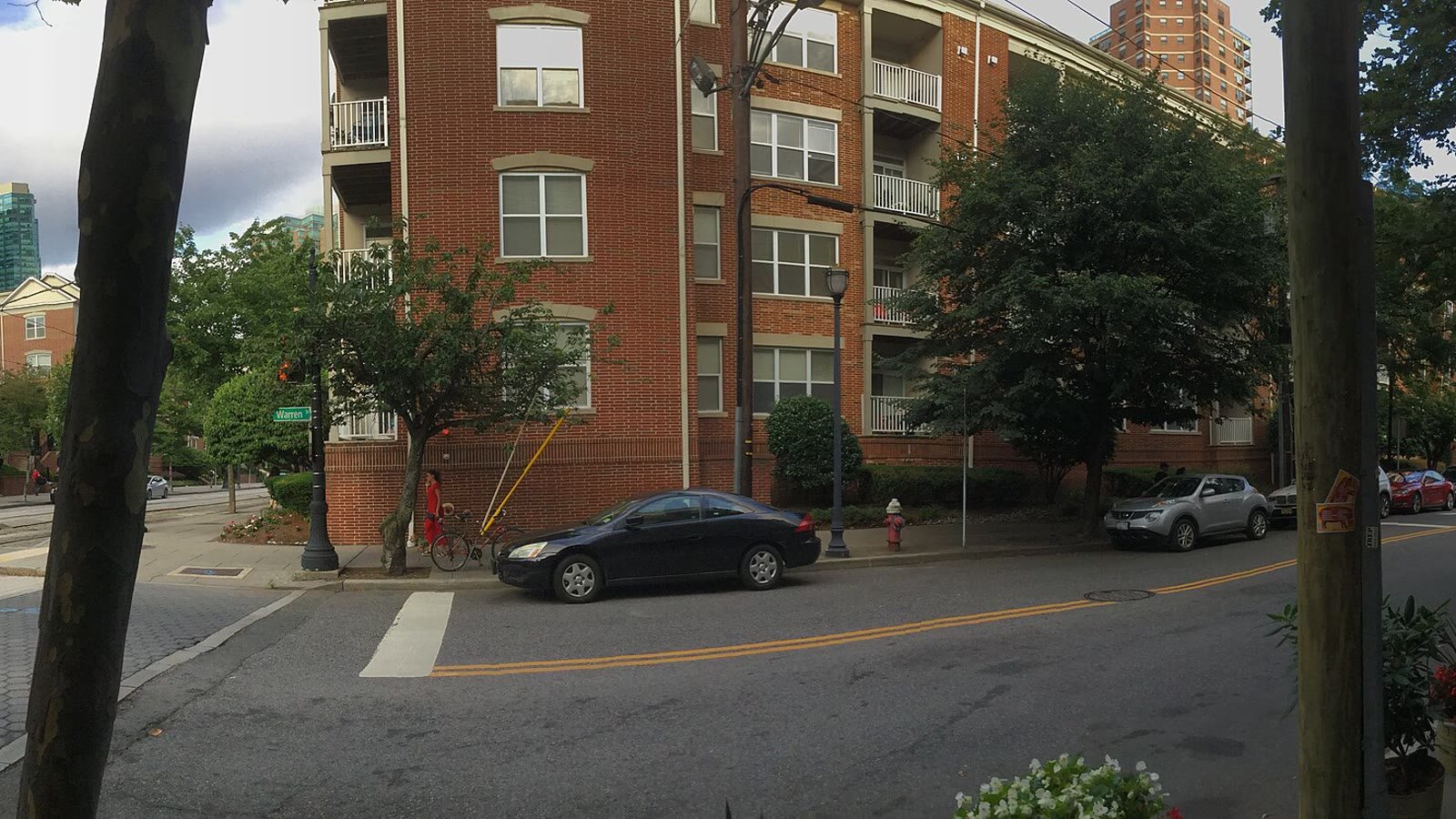
Photo: A residential block on Warren Street in downtown Jersey City. Photo: DavFace, Wikimedia Commons (CC BY-SA 4.0), cropped.
What she says happened
Gabriella’s written account, posted with the second video on November 20, runs like this. During the tenancy, she says, the landlord never maintained the property and never gave her the legally required information about where her security deposit was held or what interest it earned. On December 31, 2025, the family moved out. On January 1, she says, they personally returned four keys — and filmed the landlord accepting them, testing them in the locks, and walking through the property. They left the home clean, she says, and documented everything.
After that: nothing. The deposit was not returned. She says she never received the itemized damage statement the landlord now claims she emailed. Only after the family pursued legal action, she says, did the landlord allege more than $16,000 in damages — a figure the family strongly disputes. The matter, she writes, is “now being handled through attorneys,” and in a comment on her own post she added: “yes love I have court 12/11 this lady is the worst.”
In the confrontation video she can be heard demanding $8,000 — a number she never explains in anything she has posted. The statute, as we will see, explains it almost exactly.
The boiler room, the cameras — and the racism allegation
The second video shows a worker installing a lock on a boiler-room door while Gabriella objects. She says a plumber warned that locking the door creates a carbon monoxide hazard that could be fatal, and that her sister-in-law, a licensed plumber, gave the same warning. She says she recorded the plumber’s warning, called the police, and planned to call the fire department.
She also says the landlord put surveillance cameras in the basement — though her own wording is not consistent: the first video’s on-screen text says the landlord “tried to install cameras,” while the second post’s caption says cameras were “installed in the basement.” Both versions are hers, and the difference matters to any court even if it does not change the deposit fight.
It is in the boiler-room video, speaking to camera, that she makes the allegation that lifts this dispute beyond money. The landlord, she says, “wouldn’t put this in her house with her family and she think because we black, she could just come here and do what the fuck she want to do and treat us like shit with her racist ass.”
That allegation needs to be characterised precisely. It is tied to the boiler-room treatment — her claim is that the landlord would not endanger her own family this way and treated Gabriella’s family as disposable because they are Black. It appears only in that spoken passage: neither caption mentions race, and her written case is about the deposit, the missing paperwork, and the cameras. Nothing outside her own account supports or contradicts it. It is an uncorroborated allegation by a tenant about a landlord who has not been publicly identified, and we report it as exactly that.
The landlord is visible in the first video: a woman who appears to be of South Asian descent, responding calmly and saying, of the plumbing and electrical complaints, that she is “not a plumber.” Gabriella has never said her name, no management company or realtor is mentioned anywhere in her material, and no one speaking for the landlord has appeared anywhere we could find.
What New Jersey law says
New Jersey’s Security Deposit Act treats the deposit as the tenant’s money, held in trust. The landlord must tell the tenant in writing where it is held — the institution, the account type, the rate, the amount — within thirty days of receiving it. And within thirty days after the lease ends, the landlord must return the deposit plus the tenant’s interest, with every deduction itemized, delivered personally or by registered or certified mail. The New Jersey Courts’ own guidance states the same rules in plain language.
Measured against that, and taking her facts as she states them, her core claims are strong:
- The return. If the lease ended with the December 31 move-out, the deposit was due around January 30, 2026 — roughly ten months ago. A landlord must return the money or explain in writing; silence is itself the violation.
- The disclosure. She says she was never told where the deposit was held. One caveat: the disclosure may lawfully appear in the lease itself, and whether hers contained it is unknown.
- The itemization. The itemized statement was due in the same thirty days, whether or not the landlord later says she emailed one.
- The $16,000. A landlord may lawfully claim damages above the deposit and sue for the excess — the size and timing of the claim are not an offence in themselves. But the landlord must prove every charge, and a late figure does not cure the missed thirty-day itemization.
Then there is the penalty, and it is not discretionary. Under N.J.S.A. 46:8-21.1, a court that finds for the tenant shall award double the amount due, plus full costs, with attorney’s fees at the court’s discretion. What is doubled is the net amount owed. If the landlord proves nothing, the maths is 2 × $3,900 = $7,800, plus interest and costs — which is, to within a rounding of court costs, the $8,000 Gabriella is heard demanding in the hallway. A doubled claim of that size also sits above the $5,000 small-claims ceiling, so a case like hers belongs in the Special Civil Part.
Her other two claims are weaker. Cameras in a basement common area are generally lawful in New Jersey — the legal lines are cameras aimed into a private space, or cameras that record audio of conversations the landlord is not part of; placement and audio capability here are unknown. The boiler-room lock is not a violation in itself; boiler rooms are routinely kept closed. The live questions are combustion air and venting under the construction code — an inspector’s call, not a video viewer’s — and whether the carbon monoxide alarms the law requires near sleeping areas in buildings with fuel-burning appliances were present and working. A missing alarm would be the clean, citable violation.
Two caveats hang over the whole case. First, the Security Deposit Act does not cover owner-occupied premises with no more than two rental units, unless the tenant opted in during the tenancy — and the size and occupancy of Gabriella’s building are unknown. That is the single biggest open legal fact. Second, her exposure runs both ways: if the landlord genuinely proves more than $16,000 in damages, nothing is due to Gabriella, nothing is doubled, and she could owe the excess — roughly $12,100.
Another Jersey City tenant, a strikingly similar story
This second case is possibly related to Gabriella’s — or it could be another case entirely. Readers deserve both possibilities stated plainly, so here they are.
On October 28, a Jersey City tenant named Katrina Powell published a public warning on Facebook naming her former landlord as Kevin Harikrishin, a realtor at Pinnacle Real Estate Group LLC in Jersey City who, listing records show, also operates as a landlord in his own right. In Powell’s account, the dispute began over an unresolved squirrel problem. After she moved out, she describes weeks of text messages as harassment and intimidation, and damage demands she calls based on “unrealistic quotes and fraudulent invoices.” The case reached a three-hour court mediation, at which, she says, Harikrishin returned her full security deposit in an envelope — but produced deposit bank statements for only one of the three years of her tenancy. Every claim in that paragraph is Powell’s, from her own post.
Now the discipline, stated plainly: no public source connects Kevin Harikrishin or Pinnacle Real Estate Group to Gabriella’s tenancy, and on current evidence he is not her landlord — Gabriella’s landlord is a woman; Harikrishin is a man. Checks on his public record found a real estate office with strong reviews from sales clients, no regulator discipline, no news coverage, and no second tenant complaint. Nothing here identifies anyone in Gabriella’s case.
What the two cases share is a playbook, alleged independently by two tenants against, on current evidence, two different landlords in the same city: a deposit not returned inside the thirty-day window after a documented move-out; damage claims the tenants call inflated, surfacing after the tenant pushed back or sued; the legally required accounting of where the deposit was held withheld — never given at all in Gabriella’s account, produced for one year of three, at mediation, in Powell’s; and money moving only under legal pressure. Gabriella’s case adds two allegations Powell’s does not: the cameras and the boiler-room lock. The cases are linked by geography, pattern, and timing — not by any established identity. If Gabriella’s landlord is ever named, that comparison will have to be run again against the real name before any connection is asserted.
What we don’t know yet
The landlord’s name, her account of events, and any documentation for the $16,000. Whether the building was owner-occupied with two or fewer rental units — the fact that decides whether the Security Deposit Act applies at all. Whether the lease itself contained the deposit disclosure. Where exactly the cameras pointed and whether they recorded audio. Whether any inspector or fire officer ever attended the boiler room. And whether the December 11 court date Gabriella states — she gave no year; contextually it is 2026 — produces a hearing, a settlement, or a name on a public record.
A developing story
This story is not finished, and Evolving Humanities is actively following it. We are keeping a standing watch on Gabriella’s series — Parts 2 through 10 are still to come, and she has promised to “post all the evidence,” which is where leases, statements, or court papers carrying the landlord’s name would surface. We are watching the December 11 court date, and any naming of the landlord from any direction. When new information comes in, we will publish updates — and if the landlord in this story, or anyone speaking for her, wants to respond, our door is open.
We’ll keep you posted.
Sources
- Instagram — @thegabriellaeffect, “Part 1 of 10” confrontation video
- Instagram — @thegabriellaeffect, boiler-room video and full written account
- Facebook — Katrina Powell’s public warning post
- NJ Courts — What Happens to the Residential Security Deposit?
- Justia — N.J.S.A. 46:8-21.1, Return of deposit; civil penalties
Leave a comment
Comment as a guest and verify your email, or sign in or create a reader account. Guest comments reach our review queue after email verification; account holders can submit directly for review.