Listen to this article
Take the story with you. Choose a voice and a pace that suits you.
Or listen in another language / choose a voice
Getting your device voices ready…
The voice follows the displayed language and your browser’s regional preference when available. You can choose another narration voice.
The Abdullatif Al Fozan Award for Mosque Architecture winners for the award’s fifth cycle were announced at a ceremony on Tuesday 17 November 2026, with five mosques honoured in Bangladesh, the United Kingdom, Oman, Niger and Indonesia (Abdullatif Al Fozan Award for Mosque Architecture). Two special recognition awards went to the Mohammed bin Salman Project for Developing Historic Mosques in Saudi Arabia and to Djamaâ El-Djazaïr, the Great Mosque of Algiers (ArchDaily). The award, established in 2011, runs in three-year cycles (Abdullatif Al Fozan Award for Mosque Architecture).
Information verified through 21 November 2026.
Abdullatif Al Fozan Award for Mosque Architecture winners: judged on more than looks
The fifth cycle, covering 2023–2026, was themed The Living Mosque. The idea is plain enough: a mosque should work as an urban centre woven into everyday life, not only as a prayer hall — a setting for social interaction, education, cultural identity and public life as well as worship (ArchDaily).
An international jury of five experts assessed more than 200 nominated mosques against five criteria: Beauty, Sustainability, Technology, Social Connectivity and Economic Efficiency, across three typologies — Central, Neighborhood and Friday (Juma’) Mosques (ArchDaily). Social Connectivity sitting beside Beauty tells you what this cycle was hunting for.
Living Mosque fifth cycle winning mosques: brick in Bangladesh, water in Indonesia, restraint in Oman
Alfadanga Mosque in Bangladesh, by Marina Tabassum Architects, was designed as part of the redevelopment of a historic family site. It is a load-bearing brick structure, its openings cut to bring natural light into the prayer space, and it is conceived as an open pavilion that keeps sightlines to the greenery around it; the forecourt doubles as a gathering space for the local community (ArchDaily).
At the other end of the material spectrum sits Nurul Yaqin Mosque in Indonesia, by Dave Orlando and Fundy Gunawan. Built from concrete and brick with blue terrazzo flooring, it takes a minimalist form and a floating appearance created by the water surrounding it. Natural light and ventilation shape the interior, and subtle Islamic ornamental details sit inside an otherwise restrained shell (ArchDaily).
Bab Al Salam Mosque in Oman comes from Altqadum Office, a Muscat studio founded in 2017. It pairs the simplicity of traditional Omani architecture with modern spatial concepts, local materials and sustainable construction techniques, and serves as a community gathering place as much as a place of worship (ArchDaily).
Cambridge Central Mosque timber eco-mosque award: a forest you pray in
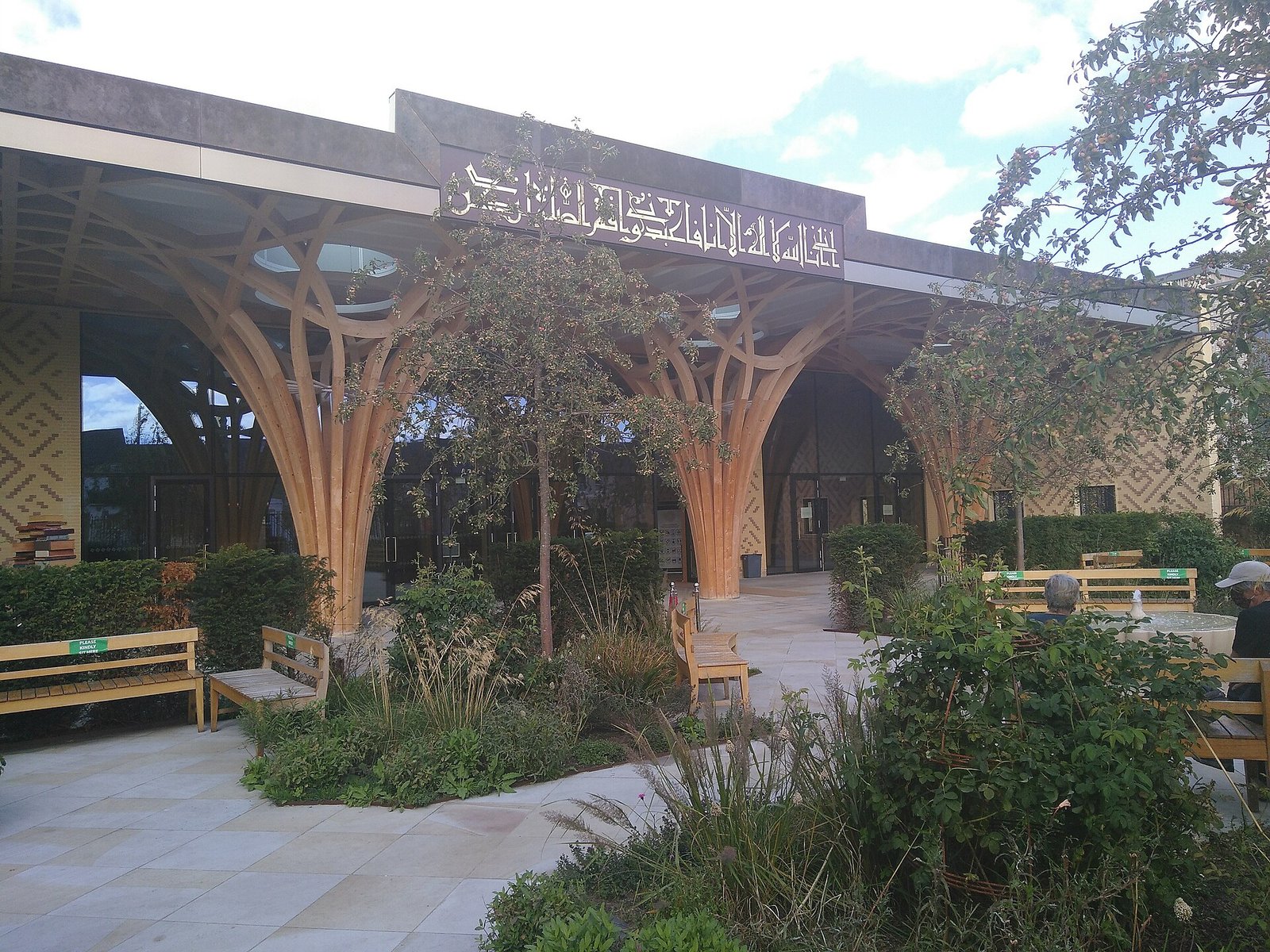
Cambridge Central Mosque, by Marks Barfield Architects, is the British winner. Its defining move is a tree-like timber structure that supports the roof and shapes the interior, merging Islamic and English architectural traditions in one gesture (ArchDaily). The building opened to the public on 24 April 2019 as the first purpose-built mosque in the city of Cambridge, with capacity for 1,000 worshippers (Wikipedia).
Look closer and the forest is literal engineering. Glulam columns branch like a canopy, glazed oculi pour sunlight into the prayer hall, and the building runs on air source heat pumps, photovoltaic arrays and rainwater harvesting (Wikipedia). Marks Barfield — the practice behind the London Eye — won the design competition in 2009, working with sacred-geometry scholar Keith Critchlow and garden designer Emma Clark (Wikipedia).
Hikma Community Complex mosque and library Niger: the old mosque became the library
The Nigerien winner makes the Living Mosque theme concrete. In the village of Dandaji, Mariam Issoufou Architects and Studio Chahar paired a new mosque with a library — the library installed inside the village’s old mosque, which had fallen into disrepair and faced demolition (Dezeen). The two buildings face each other on the same axis, entrances aligned, so the walk from study to prayer is a short path rather than a change of world (Dezeen).
The new mosque is built from locally fabricated compressed earth bricks, which keep the thermal behaviour of mud brick without its heavy upkeep. The United Nations Environment Programme reports that on the hottest days the interior can run up to 15°C cooler than the outside air, with no air-conditioning — vaulted ceilings six to nine metres high let hot air rise and escape, and a tree-filled garden fed by stored rainwater cools the site (UNEP).
Special recognition, and a sixth cycle that goes ecological
The two special awards honour stewardship at opposite scales. The Mohammed bin Salman Project for Developing Historic Mosques, launched in 2018, aims to restore 130 historic mosques across Saudi Arabia; 60 had been restored across its first two phases by 2025 (ArchDaily). Djamaâ El-Djazaïr in Algiers, by KSP Jürgen Engel Architekten, ranks among the largest mosques in the world and carries the world’s tallest minaret (ArchDaily).
The award has already opened nominations for its sixth cycle, themed The Ecological Mosque, calling for projects that work with renewable energy, natural ventilation and daylight, water-efficient ablution facilities and local, sustainable materials (ArchDaily).
Analysis: read the five winners as one argument and a pattern emerges. None of them wins on monumentality. A brick pavilion in Bangladesh, a floating box in Indonesia, an earth-brick mosque that cools itself in the Sahel — each spends its ingenuity on climate, material and the hours when nobody is praying. The jury’s criteria made that outcome likely, and the sixth cycle’s ecological theme doubles down on it. Big-budget mosque building still loves scale; this list suggests the prestige is quietly moving elsewhere.
Photo: Alarichall, via Wikimedia Commons (CC BY-SA 4.0)
Sources
- ArchDaily — The Living Mosque, 5 winning projects: https://www.archdaily.com/1188655/the-living-mosque-5-winning-projects-announced-by-the-abdullatif-al-fozan-award-for-mosque-architecture?ad_campaign=normal-tag
- Abdullatif Al Fozan Award — official site: https://alfozanaward.org/
- UNEP — self-cooling mosque story: https://www.unep.org/en/news-and-stories/story/could-self-cooling-mosque-be-future-construction-warming-world
- Dezeen — Atelier Masomi transforms derelict Niger mosque into library: https://www.dezeen.com/2019/01/12/atelier-masomi-dandaji-mosque-niger/
- Wikipedia — Cambridge Central Mosque: https://en.wikipedia.org/wiki/Cambridge_Central_Mosque
Leave a comment
Comment as a guest and verify your email, or sign in or create a reader account. Guest comments reach our review queue after email verification; account holders can submit directly for review.