Listen to this article
Take the story with you. Choose a voice and a pace that suits you.
Or listen in another language / choose a voice
Getting your device voices ready…
The voice follows the displayed language and your browser’s regional preference when available. You can choose another narration voice.
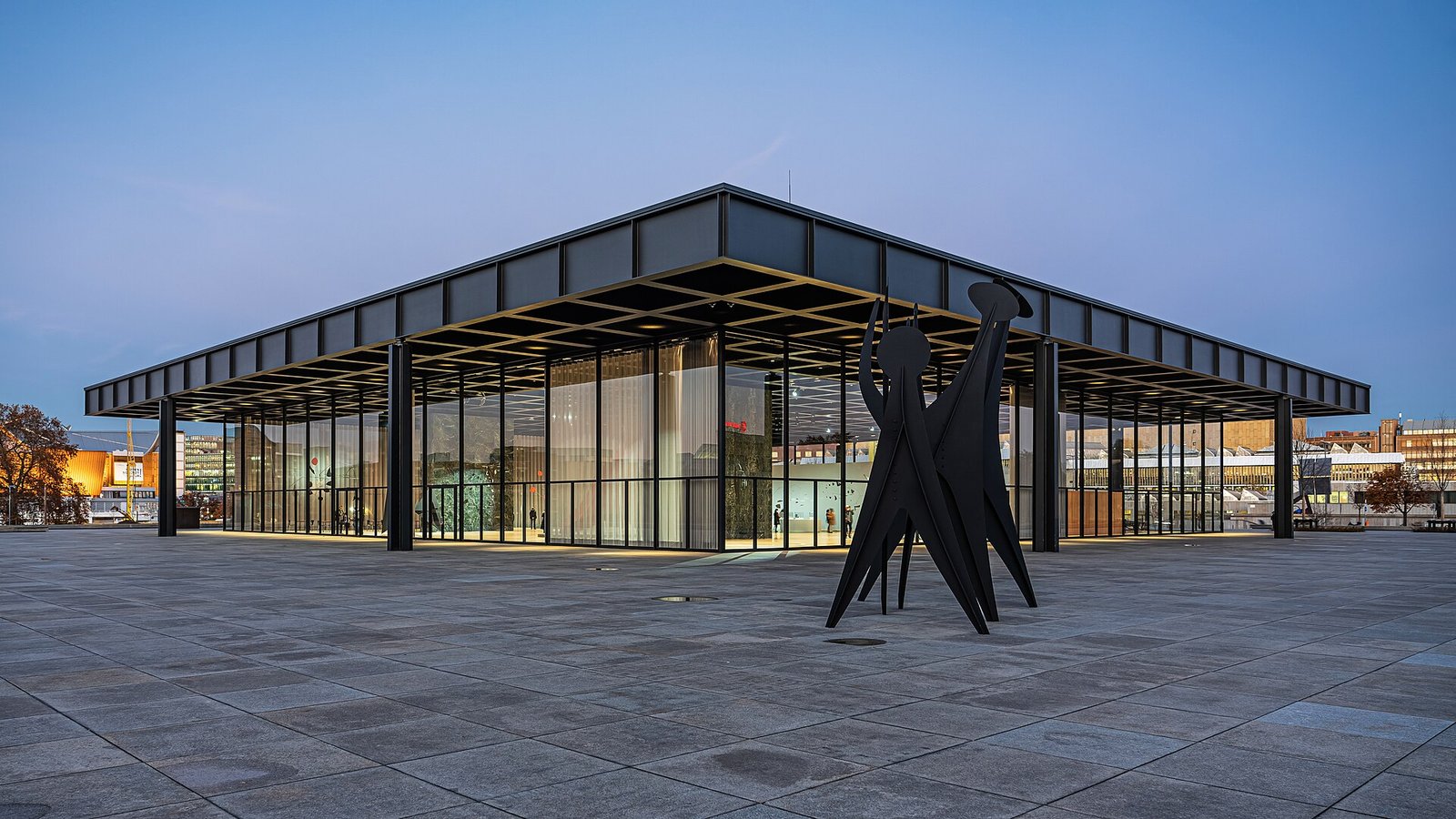
You enter the Maurizio Cattelan NIGHT exhibition Neue Nationalgalerie Berlin through a gate that should not be indoors. Purgatory (2026), a new commission, places a scaled-down Brandenburg Gate inside Mies van der Rohe’s glass hall — one of Germany’s most recognisable monuments shrunk into a threshold you walk around and through (ArchiProducts). The show runs from 10 September 2026 to 7 March 2027 at Potsdamer Straße 50 (e-flux).
Information verified through 18 November 2026.
It is the Maurizio Cattelan first major solo exhibition Germany has hosted, presented as part of the Preis der Nationalgalerie 2026, for which the Italian artist was selected by an international jury (Artprice). Cattelan, born in Padua in 1960, brings seminal older works together with new commissions conceived for this building (e-flux).
Maurizio Cattelan NIGHT exhibition Neue Nationalgalerie Berlin: a church with no religion
The Preis der Nationalgalerie 2026 Cattelan show is laid out like a place of worship. A central nave. Side aisles. A sequence of presences. The museum itself says the spatial configuration temporarily lends the building the character of a church, its scale, symmetry and silence acquiring a ritual quality (e-flux).
Cattelan explained the thinking in the museum’s announcement: “As a church, the building gives shape to something invisible. The Neue Nationalgalerie already has something ritualistic: its scale, symmetry, silence and distance from everyday life. I was interested in taking that quality seriously, but without making it religious” (e-flux).
The title works the same way. NIGHT, in the museum’s account, is not darkness itself but a condition of altered perception — things seen differently, certainty suspended, overlooked details coming into focus (e-flux). ArchiProducts described it as a loss of certainty, guiding an installation that moves between irony and unease, familiarity and disorientation (ArchiProducts).
Cattelan Him Dawn Purgatory Berlin exhibition centrepiece
At the centre of the hall, the Cattelan Him Dawn Purgatory Berlin exhibition axis does the show’s heaviest work. Him (2001), a kneeling male figure, stands in direct relation to Dawn (2007), a female figure suspended in a cruciform posture inside a transport crate — devotion, vulnerability and sacrifice aligned on one vertical line (e-flux). Seen from behind, Him first resembles a child kneeling in prayer, before revealing the face of Adolf Hitler; presented in Berlin, ArchiProducts noted, it gains resonance from the memory of Willy Brandt’s kneeling gesture in Warsaw in 1970 (ArchiProducts).
Overhead, thousands of taxidermied pigeons form People (2026), first shown in Venice in 1997, turning the ceiling structure into a collective, quietly unsettling presence (ArchiProducts).
Around that axis sit the career markers. Novecento (1997), a life-size taxidermied horse suspended in mid-air. La Rivoluzione Siamo Noi (2000). All (2007), nine shrouded life-size bodies carved from Carrara marble. Pentecost (2002), a donkey harnessed to an overloaded cart on the verge of collapse (ArchiProducts). Two new commissions address mortality directly: After (2026), a six-metre iron pipe struck like a bell with a sleeping dog at its centre, and Dust (2026), a fire extinguisher containing the cremated remains of a friend of the artist, made according to the deceased’s wishes (ArchiProducts).
The show leaks outside, too. On the terrace, Scar (2026) is a cast-iron manhole cover inscribed with the titles of every work in the exhibition, and high on the roof Never (2003) — an animatronic child drummer inspired by the protagonist of Günter Grass’s The Tin Drum — beats irregularly somewhere between parade and alarm (ArchiProducts).
Twenty years after the Biennale
NIGHT is curated by Lisa Botti, curator at the Neue Nationalgalerie, with museum director Klaus Biesenbach, in close collaboration with the artist (e-flux). It marks Cattelan’s return to Berlin twenty years after he co-curated the 4th Berlin Biennale in 2006 (ArchiProducts). The Preis der Nationalgalerie was founded by the FREUNDE der Nationalgalerie in 2000; the exhibition is made possible by the FREUNDE and supported by BMW (e-flux). Galerie Magazine framed the show on announcement as his first major solo exhibition in Germany, opening during Berlin Art Week (Galerie Magazine).
Analysis: Cattelan’s jokes have always had a body count, and Berlin is the one city where that stops being a metaphor. Putting a kneeling Hitler on the central axis of a Mies hall, in a capital still arguing with its own monuments, is either the show’s whole point or its cheapest trick — probably both, which is exactly the instability the title promises. Go before March and decide in the room, not from photographs.
Photo: A.Savin, via Wikimedia Commons (Free Art License)
Sources
- https://www.archiproducts.com/en/news/maurizio-cattelan-night-exhibition-at-berlin-s-neue-nationalgalerie_112803
- https://www.e-flux.com/announcements/6787953/maurizio-cattelannight
- https://news.artprice.com/en/15749/maurizio-cattelan-in-berlin-the-neue-nationalgalerie-unveils-night-from-10-september-2026-to-7-march-2027
- https://galeriemagazine.com/night-at-neue-nationalgalerie-will-be-maurizio-cattelans-first-berlin-retrospective/
Leave a comment
Comment as a guest and verify your email, or sign in or create a reader account. Guest comments reach our review queue after email verification; account holders can submit directly for review.