Listen to this article
Take the story with you. Choose a voice and a pace that suits you.
Or listen in another language / choose a voice
Getting your device voices ready…
The voice follows the displayed language and your browser’s regional preference when available. You can choose another narration voice.
The winning building is fifteen years old, made of handmade brick, and you could walk past its green roofs without realising a building is there at all. The Friendship Centre Bangladesh Ambasz MoMA prize was announced in November 2026: the Museum of Modern Art in New York selected Kashef Chowdhury/URBANA as the recipient of the first Ambasz–MoMA Annual Prize for Nature–Reconciled Architecture, for the Friendship Centre in Gaibandha, Bangladesh. ArchDaily published its report on 16 November 2026. Information verified through 17 November 2026.
MoMA describes the prize as the largest award for a single architecture project, open to work completed anywhere in the world in the past 30 years that is exemplary in repairing architecture’s relationship with nature. Architectural Record makes the comparison concrete: the Pritzker is $100,000 and goes to an individual, while the triennial Aga Khan Award is $1 million split between multiple recipients.
How the Friendship Centre Bangladesh Ambasz MoMA prize splits its $200,000 — the Ambasz MoMA Annual Prize for Nature Reconciled Architecture
Half the money behaves like no other major prize. Of the $200,000 total, $100,000 goes to the architect and a further $100,000 to Fundación Gran Chaco in Formosa, Argentina, to plant trees in the Gran Chaco forest in the name of the project’s client, the Friendship NGO. The award will be presented at a ceremony at MoMA on 12 December 2026.
The prize is named for Emilio Ambasz, MoMA’s curator of design between 1968 and 1976, who in 2020 donated the funds for the institute that now runs it, and it is funded by a major gift from the Legacy Emilio Ambasz Foundation. The centre was picked from nearly 140 international projects identified through institute research and 30 regional nominators. The jury joined MoMA’s Martino Stierli, Evangelos Kotsioris and Paula Vilaplana de Miguel with two external members, Shelley McNamara of Grafton Architects and Wang Shu of Amateur Architecture Studio.
Kotsioris, who directs the Ambasz Institute, said the project “demonstrates how a remarkable economy of means can yield a richness of spatial experience, offering a compelling vision of how architecture might reconcile with nature.”
The Kashef Chowdhury URBANA Friendship Centre Gaibandha, up close
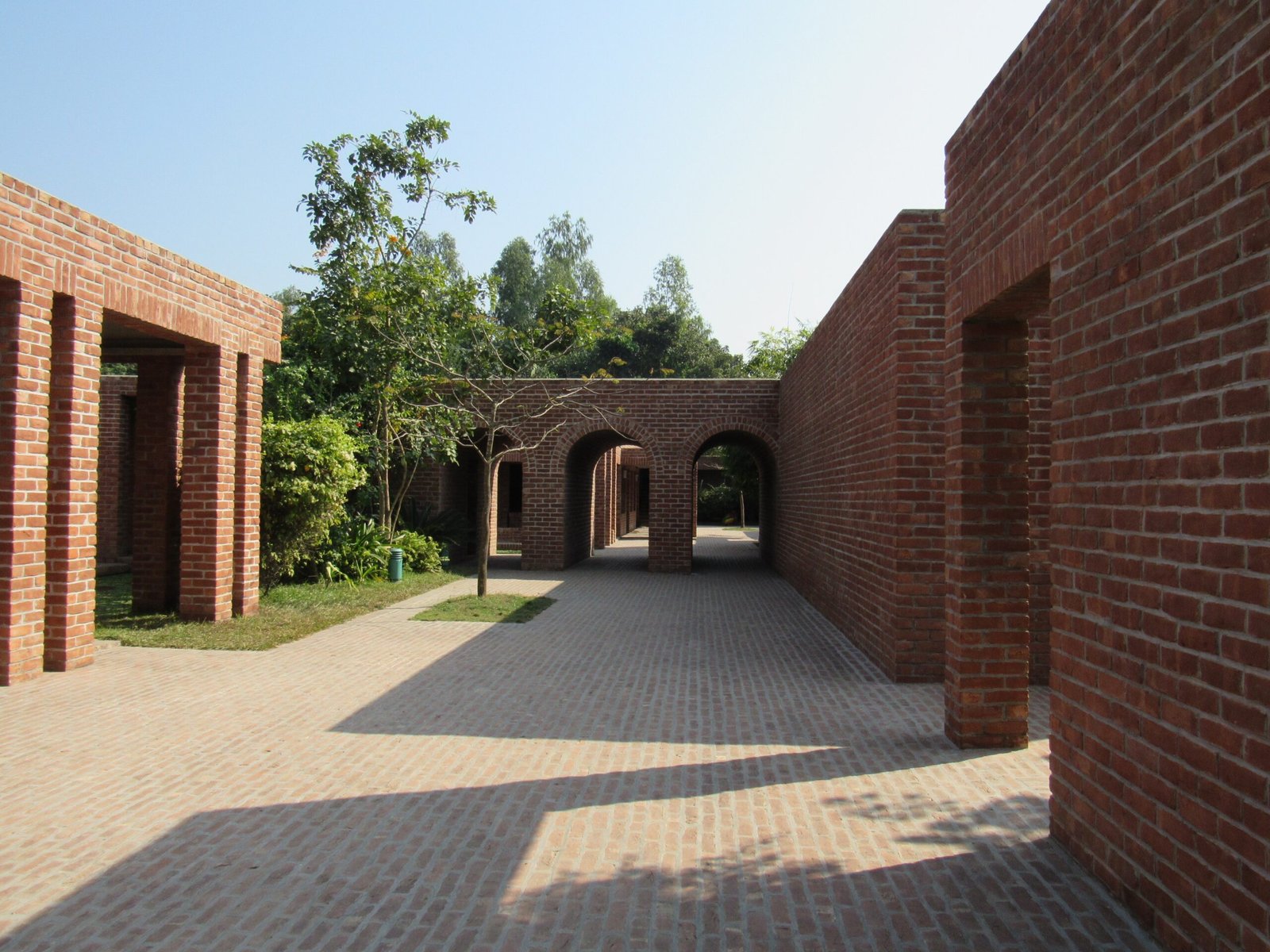
The centre, completed in 2011, is a rural training facility and meeting space for communities in Bangladesh’s flood-prone Jamuna River delta, built for the NGO Friendship. ArchPaper describes a home base for an organisation fighting poverty in a region of mostly agricultural workers, faced in brick handmade by community members, read as a labyrinth of arches, courtyards and trees. Inside the two blocks sit offices, classrooms, a library, meditation spaces, dormitories and dining facilities.
This is not the building’s first honour. It was previously one of six recipients of the 2016 Aga Khan Award for Architecture. URBANA itself is a Dhaka practice founded in 1995 by Chowdhury with Marina Tabassum, who left a decade later to found her own studio.
Flood resilient architecture Bangladesh delta: sit low, borrow from 300 BC
The site fights you. Floods come with the delta, earthquakes are a risk, and the soil bears little weight. URBANA skipped expensive piles: the centre relies on a compacted earthen embankment for flood protection and builds directly on the original, low-lying ground, handcrafted mostly from local clay bricks. Cooling is passive work — green roofs, open-air courtyards and interconnected rainwater harvesting pools handle temperature control and natural ventilation, and Record notes the pools help with microclimatic cooling while the sunken complex keeps the landscape’s horizontal line.
The plan’s ancestor is 2,300 years old. The layout echoes the nearby third-century BCE ancient city of Mahasthangarh. Chowdhury said it himself: “The Friendship Centre has been in service to an underserved community for 14 years. Yet, it is not a building of 14 years of age, but rather 2,300 years of age, as it draws its inspiration for flood protection from the nearby third-century BC settlement of Mahasthan.”
Analysis: prizes usually chase novelty — the newest tower, the newest material. This one rewarded the opposite bet. A low building that hides in its landscape, built by the people who use it, from a flood strategy older than Rome, beat nearly 140 rivals. Whether the Ambasz prize keeps that nerve in year two is the real test of what “nature-reconciled” means. Year one, at least, the phrase meant something you can touch: brick, water, shade, and ground left where it was.
Photo: Afifa Afrin, via Wikimedia Commons (CC BY-SA 4.0)
Sources
- https://www.archdaily.com/1188667/kashef-chowdhury-urbana-receives-the-first-ambasz-moma-annual-prize-for-nature-reconciled-architecture?ad_medium=gallery
- https://www.archpaper.com/2026/11/urbana-kashef-chowdhury-prize/
- https://www.architecturalrecord.com/articles/18552-kashef-chowdhury-of-urbana-wins-ambaszmoma-annual-prize-for-naturereconciled-architecture
- https://archinect.com/news/bustler/11192/kashef-chowdhury-urbana-wins-inaugural-moma-prize-for-bangladesh-sustainable-center
Leave a comment
Comment as a guest and verify your email, or sign in or create a reader account. Guest comments reach our review queue after email verification; account holders can submit directly for review.