Listen to this article
Take the story with you. Choose a voice and a pace that suits you.
Or listen in another language / choose a voice
Getting your device voices ready…
The voice follows the displayed language and your browser’s regional preference when available. You can choose another narration voice.
Eight months. That is all it took for the rigorous research base on classroom AI to more than double — and the AI in K-12 evidence review published by Stanford’s SCALE Initiative on 10 November 2026 still cannot say the tools produce lasting learning gains. The update counts 52 studies with strong causal evidence, up from 20 in the March 2026 edition, yet concludes there is insufficient evidence to establish whether AI tools deliver lasting improvements in academic performance (Wisevoter). Information verified through 13 November 2026.
The review, by Seth Walker, Lily Fesler, JP Martinez Claeys, Chris Agnew and Susanna Loeb, examines randomised controlled trials and quasi-experimental studies of generative AI’s effects on students and educators (Stanford SCALE Initiative).
What the AI in K-12 evidence review actually counted
The funnel is steep. SCALE’s Research Repository grew from 818 papers in March 2026 to 1,686 by the end of June 2026. Of 868 papers added in the review period, 201 used randomised controlled trials or quasi-experimental designs, 97 advanced to human review, and 32 met the team’s strong-causal standard, drawn from the What Works Clearinghouse’s Procedures and Standards Handbook (WINS Solutions). Those 32 join the earlier 20 to make the 52.
Of the new papers, 28 examine student-facing tools and four examine educator-facing tools (Stanford SCALE Initiative). Five of the new student-facing studies were conducted in United States K-12 settings — compared with none in the March review — and United States-based student-evidence papers rose from 3 to 18 overall (WINS Solutions).
Two cautions are built into the method. The repository draws primarily from arXiv preprints, which have not undergone peer review, and an automated screening pass precedes the human review of each candidate paper (WINS Solutions). And most of the new student research still took place in postsecondary settings, not school classrooms — one reason the authors warn their findings “should not be treated as broadly generalizable across U.S. K–12 settings” (Stanford SCALE Initiative).
Does AI improve student learning? The answer splits by use
The review’s central distinction is between two ways of using the same tool. “AI appears more likely to support learning when students use it to understand new material than when they use it to produce work for them, although neither type of use consistently improves learning,” the authors write. “Using AI to offload academic tasks can reduce student learning. The evidence is more favorable (although still mixed) when students use AI explicitly to study and learn” (Stanford SCALE Initiative).
A second finding will be familiar to any teacher who has watched a class enjoy a lesson it did not retain. AI tools can improve students’ learning experiences even when they do not improve learning outcomes: students often report more positive experiences with AI, and those experiences often do not translate into stronger results (Stanford SCALE Initiative). Design matters too — interactive formats, adaptive sequencing and guidance on how to use the tool show promise — but the evidence remains unclear on which characteristics matter most (Stanford SCALE Initiative).
Generative AI causal evidence in schools: the teacher side is thinner still
Only four of the 32 new papers study educator-facing tools, and the picture there is double-edged. AI can save teachers time on tasks such as lesson planning, and educators handed ready-made draft feedback by a tool gave students more of it, and better, without spending more time on the task (Stanford SCALE Initiative). But one new study found that providing teachers with an AI support tool reduced students’ motivation and confidence, and another found a broad teaching-support chatbot reduced achievement among students of lower-performing teachers (Stanford SCALE Initiative).
The coverage is lopsided in subject terms as well. Papers measuring science and technology outcomes grew from 3 to 16, and social-emotional outcome papers from 3 to 11, while the update provides little new evidence on whether AI narrows or widens gaps between student groups (WINS Solutions).
SCALE plans its next comprehensive review for spring 2027 (Stanford SCALE Initiative).
Analysis: schools are buying at commercial speed and evidencing at academic speed, and this review is the clearest map yet of the gap between the two. Its practical message is narrower than either the sales pitch or the panic. AI used as a study aid has a mixed but real case behind it; AI used as a subcontractor for homework has evidence pointing the other way. For a district leader, the useful question is no longer whether a tool “works” but which of those two uses a given product, lesson plan and homework policy actually produces — because the same chatbot can be either, sometimes in the same afternoon.
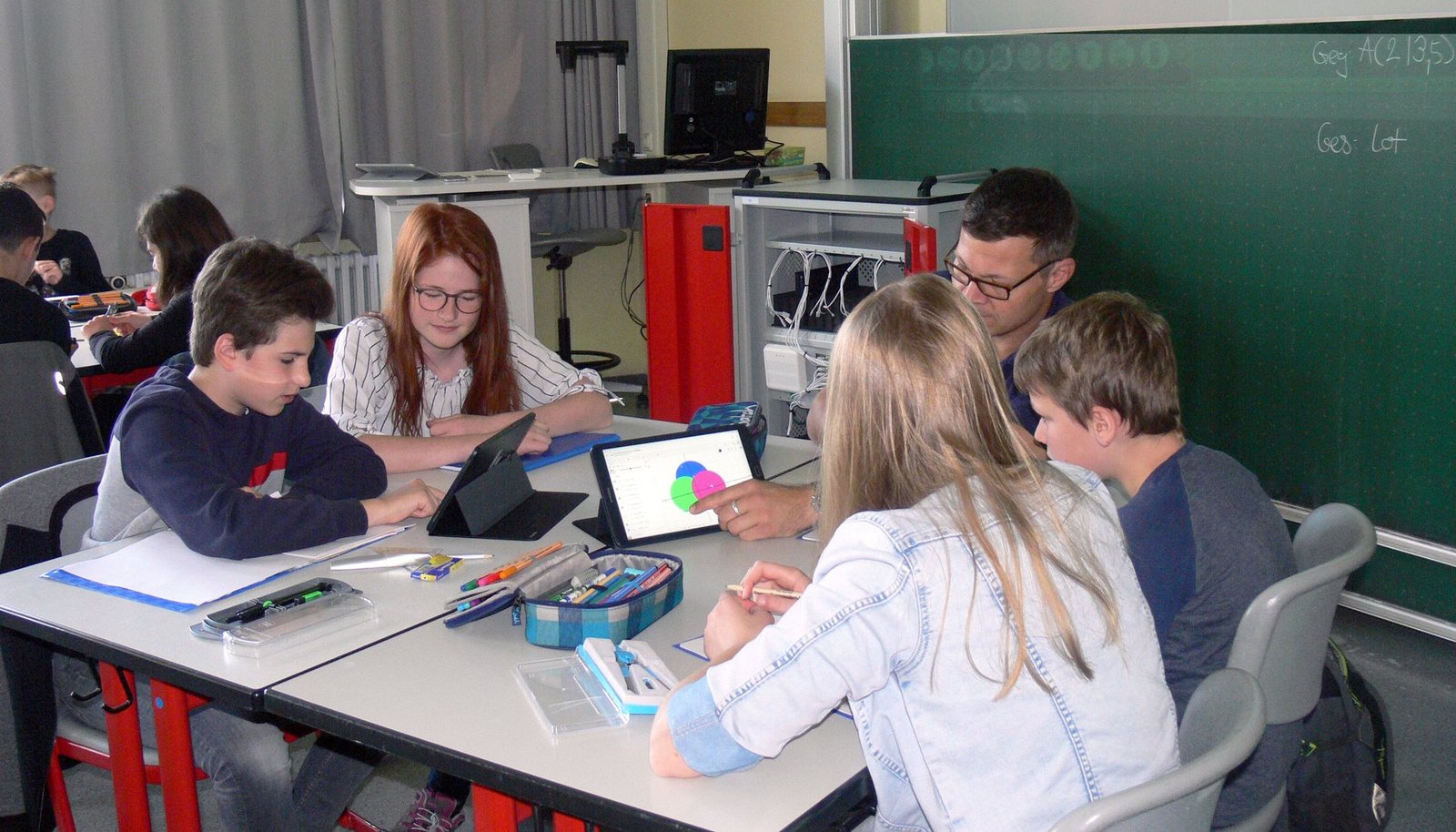
Photo: Aigner Ronja and Kohlmeier Michelle, via Wikimedia Commons (CC0)
Leave a comment
Comment as a guest and verify your email, or sign in or create a reader account. Guest comments reach our review queue after email verification; account holders can submit directly for review.