Listen to this article
Take the story with you. Choose a voice and a pace that suits you.
Or listen in another language / choose a voice
Getting your device voices ready…
The voice follows the displayed language and your browser’s regional preference when available. You can choose another narration voice.
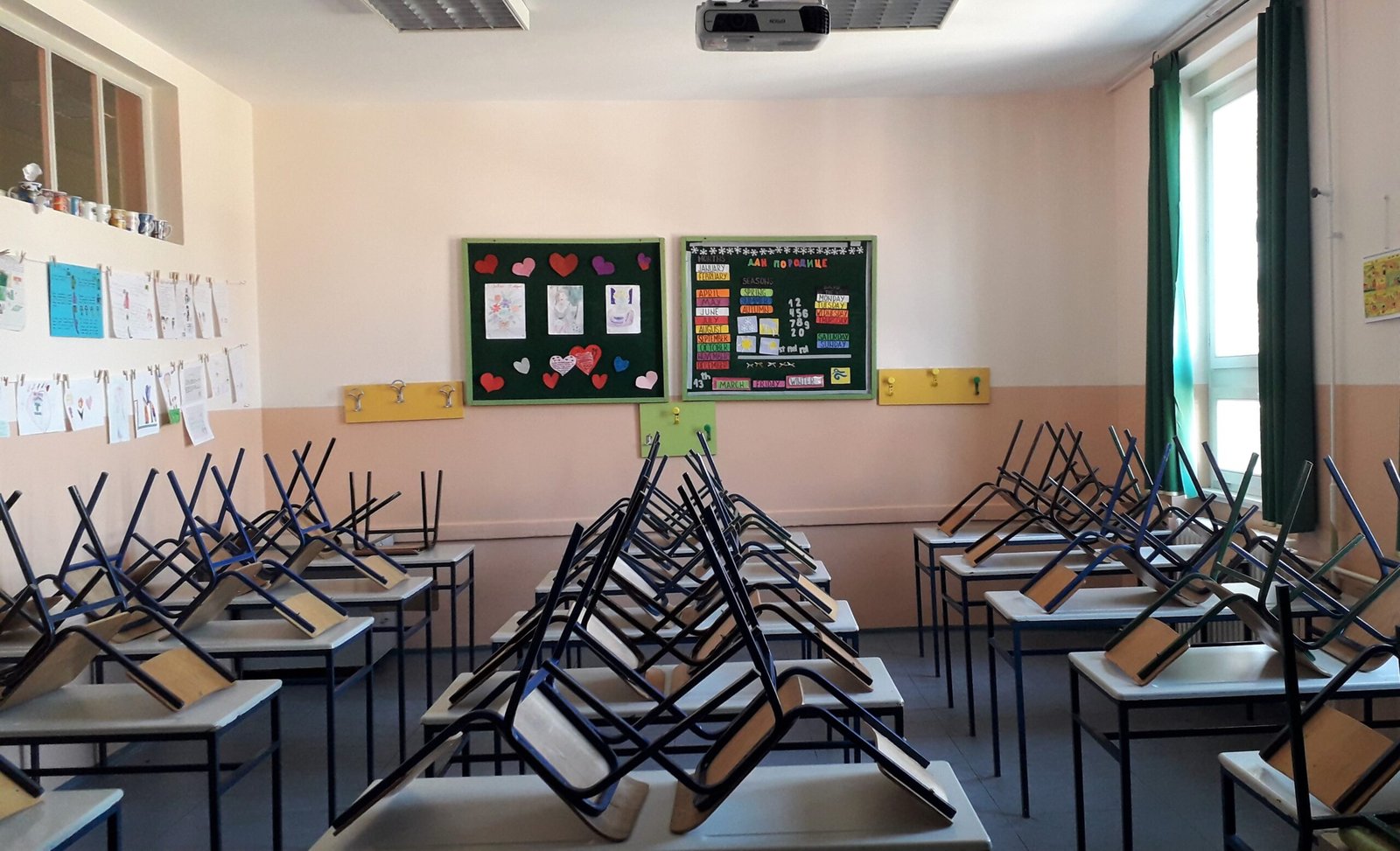
Falling public school enrollment has not emptied America’s school map. It has emptied America’s classrooms — one in four public schools now enrols at least 15% fewer pupils than before the pandemic, while the number of schools operating is effectively the same as in fall 2019 and teacher numbers have grown (Stanford / SIEPR). The findings come from a working paper released on 9 November 2026 by Stanford researchers Thomas S. Dee and Jaymes Pyne (Stanford / SIEPR). Information verified through 12 November 2026.
More than a million pupils have gone. The buildings stayed. So did the staff. That is not a rounding error; it is a structural mismatch districts will have to pay for, one way or another.
Falling public school enrollment, in the numbers
Dee and Pyne analysed federal data on nearly every US public school from 2010 to 2024. Average school enrollment fell by about 18 pupils, or 3%, after the pandemic, with the steepest drops in elementary and middle schools (Stanford / SIEPR). The average hides the spread. For the typical elementary school, a 15%-plus fall means at least 70 fewer children in the corridors (Stanford / SIEPR).
National totals tell the same story at scale. Public-school enrollment fell from about 50.8 million in fall 2019 to 49.4 million in fall 2024, a 2.8% drop, and the federal statistics agency projects further declines through 2031 (The American Quorum). Lower birth rates are the largest driver, compounded, in the AP partnership reporting, by immigration enforcement, expanded private-school vouchers and homeschooling (Political.org).
California shows the pattern in one state. It has lost more than 400,000 pupils since October 2019 but closed less than 1% of its schools, while teacher full-time equivalents rose 3% over the same period (Stanford / SIEPR).
A pupil-teacher ratio at a 15-year high for staffing
Here is the number that cuts both ways. The national pupil-teacher ratio has fallen 4% from its pre-pandemic baseline, leaving public schools with more teachers per pupil than at any point in the last 15 years (Stanford / SIEPR).
Smaller classes sound like a gift. Parents like them. Teachers like them. But a ratio improved by empty desks rather than by hiring decisions is an accident, not a policy — and accidents get corrected by budgets, not by pedagogy. Dee was blunt about the underlying behaviour: enrollment losses are putting budgetary pressure on districts and communities are having difficult discussions about closures and layoffs, yet overall the data show districts have been largely unresponsive to the enrollment changes (Stanford / SIEPR).
Why the delay? The researchers point to the political economy of district decision-making: closures and layoffs are highly visible to parents and teachers, and superintendents often serve short terms, which stalls exactly these decisions (Stanford / SIEPR). Nobody wins an election by closing the neighbourhood school early. So the adjustment arrives late, and usually larger.
School closures lag enrollment decline — then arrive all at once
Closures are no longer hypothetical. A total of 1,156 US schools closed during the last academic year, the highest number since the pandemic, according to Big Local News at Stanford’s analysis of federal data, produced with the Associated Press and The Hechinger Report (Political.org). Yet even that record pace only brings the total stock of schools back to about pre-pandemic levels — closures are still running behind the shrinkage (Political.org).
Vallejo, California shows where the lag ends. Enrollment there has fallen from nearly 18,000 in fall 2006 to about 9,300, and district leaders have closed five campuses since 2025 — a quarter of the district’s schools (Political.org). Two decades of drift, then a quarter of the estate gone in roughly a year. That is what deferred adjustment looks like when it finally lands.
And the equity pattern is already visible. Where closures did happen between 2019 and 2024, they fell disproportionately on lower-income neighbourhoods, schools serving higher concentrations of Black students, and charter schools (Stanford / SIEPR). More than 80% of districts, meanwhile, operated exactly the same number of schools in 2024 as in 2019 (Stanford / SIEPR).
District budget pressure from falling enrollment does not fix itself
The money follows the children, mostly. Bellwether and WestEd estimate declining enrollment could cost schools $11.5 billion in state revenue annually by 2030–31, with declines projected in 40 states and the District of Columbia (The American Quorum). Costs do not follow the same curve. A school with 450 pupils instead of 550 still needs a principal, heating, bus routes and enough teachers to cover every grade (The American Quorum).
Worse, closing the building does not reliably rescue the budget. California research covering 2011 to 2019 found closures were associated with lower spending but also lower revenue as more families left, with overall fiscal effects not statistically distinguishable from zero (The American Quorum). The AP reporting reached a similar caution: closures rarely deliver the financial relief districts hope for, and can push families toward charter or private schools (Political.org).
Dee’s prescription was managerial, not dramatic: financial training and support for school board members, multi-year budgeting, attractive pre-K offers that widen the age range a district serves, and — where downsizing is unavoidable — keeping the most effective teachers and schools (Stanford / SIEPR). He called the moment both a crisis and an opportunity: districts have not yet right-sized, which means they can still choose how to do it (Stanford / SIEPR).
Analysis: the empty desks are not the crisis. The crisis is the gap between a slow, predictable demographic slide and institutions built to react only when the money runs out. Districts that plan on a five-year horizon get to pick which schools, which staff and which pupils bear the change. Districts that wait get Vallejo’s version — the same decision, made in a hurry, at the worst possible price.
Photo: Dobrislava, via Wikimedia Commons (CC BY-SA 4.0)
Sources
- https://siepr.stanford.edu/news/despite-falling-enrollment-public-schools-havent-downsized-according-stanford-research
- https://political.org/2026/11/08/school-closures-accelerate-across-the-us-as-1156-campuses-shut-last-year-highest-since-the-pandemic/
- https://www.theamericanquorum.com/school-closures-accelerate-as-us-enrollment-keeps-shrinking/
Leave a comment
Comment as a guest and verify your email, or sign in or create a reader account. Guest comments reach our review queue after email verification; account holders can submit directly for review.