Listen to this article
Take the story with you. Choose a voice and a pace that suits you.
Or listen in another language / choose a voice
Getting your device voices ready…
The voice follows the displayed language and your browser’s regional preference when available. You can choose another narration voice.
The Centre Pompidou exhibition Mexico City opens this month at the Museo del Palacio de Bellas Artes, carrying a slice of Paris’s modern art collection across the Atlantic while its home building is shut for renovation (Artprice). “Las formas de la energía. Obras emblemáticas del Centre Pompidou” runs from 12 November 2026 to 28 February 2027, according to the Institut français d’Amérique latine, though the Centre Pompidou itself lists 13 November to 27 February — check the dates before visiting (Artprice).
A museum that cannot open its own doors has found other doors to open.
Las formas de la energia exhibition: light, matter and movement
Energy is the thread. The show gathers works from the Centre Pompidou’s collections and uses energy as a common thread to explore a range of 20th-century artistic experiments, from the avant-gardes to optical and kinetic investigations (Artprice). Light, colour, matter and movement are not just themes here — they are the instruments, changing how a visitor relates to the work in front of them (Artprice).
Three announced works give the idea shape. Nicolas Schöffer’s Lux 1 (1957) is a light-sculpture experiment; Lucio Fontana’s Concetto spaziale, La fine di Dio (63−FD.17) (1963) cuts and punctures the picture surface; Victor Vasarely’s Meh (2), also titled Abeille (1967–1968), sets geometric forms vibrating against each other (Artprice).
Vasarely is the show’s best test case. His geometric forms put the eye to work: movement is suggested rather than depicted, emerging from the relationship between the elements of the painting and the viewer’s gaze (Artprice). He imagined those forms escaping the frame altogether, into architecture and everyday surroundings, even picturing a “polychrome city of happiness” (Artprice). Stand in front of one long enough and the stillness starts to argue with itself.
Palacio de Bellas Artes Centre Pompidou November 2026, in a building with its own history
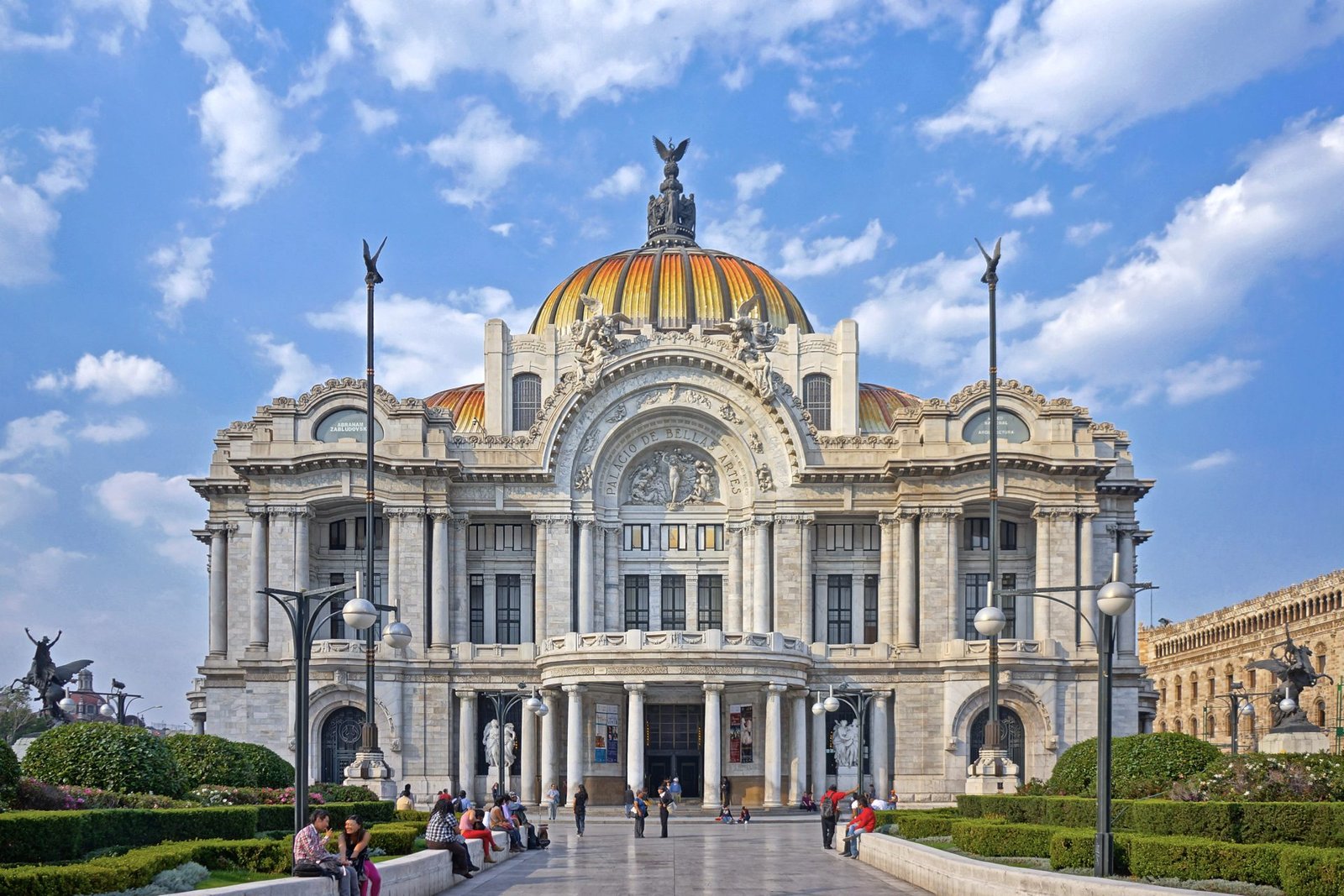
The venue matters as much as the loans. The Palacio de Bellas Artes — the Palace of Fine Arts — is a cultural centre in Mexico City that hosts performing arts, literature events and plastic arts galleries and exhibitions, including important permanent Mexican murals (Wikipedia, Palacio de Bellas Artes). Its exterior is primarily Art Nouveau and Neoclassical, its interior primarily Art Deco, and it is best known for murals by Diego Rivera, Siqueiros and others, as well as for the Ballet Folklórico de México (Wikipedia, Palacio de Bellas Artes).
The building took three decades to arrive. Construction began under Italian architect Adamo Boari in 1904, stalled by 1913 amid the Mexican Revolution, resumed under Mexican architect Federico Mariscal in 1932, and the palace was inaugurated on 29 November 1934 (Wikipedia, Palacio de Bellas Artes). The main facade faces Avenida Juárez, in the historic centre, and the theatre seats 1,590 (Wikipedia, Palacio de Bellas Artes). Usual general admission is 95 Mexican pesos, subject to the conditions applicable to this exhibition (Artprice).
Inside a building that took thirty years to finish, paintings that make stillness move. The pairing is not accidental.
The Centre Pompidou Constellation programme closure, and a 200-year exchange
The Mexico City show is one stop in a much larger detour. The Centre Pompidou’s Paris building, designed by Renzo Piano and Richard Rogers and open since 1977, closed completely on 22 September 2025 for a five-year renovation, with reopening planned for 2030 (Paris je t’aime). During the works, the collection travels under the Constellation programme to partner venues in Paris, across France and abroad (Paris je t’aime).
The exhibition is presented as part of the bicentenary of Franco-Mexican diplomatic relations, and it recalls the role of artists who worked between France and South America in the development of kinetic and optical art (Artprice). Modernity, in this telling, is a history of circulation rather than the outward influence of a single centre (Artprice). The point has a concrete precedent: Vasarely was already the subject of a touring exhibition in Latin America in 1959, so his presence in Mexico City continues a long history of optical abstraction travelling and being received there (Artprice).
There is also a quieter story in the margins. Artprice reports Vasarely ranks 288th worldwide among artists by auction turnover in 2026, with his auction record — Altaï III (1955–1958) — set at $883,034 at Sotheby’s in London in February 2010, while a smaller work, Vega-Tuz III, fetched $247,548 at Natives Auctions in Brussels on 27 October 2026 (Artprice). Paintings and multiples occupy very different positions in his market, and the exhibition puts the paintings in front of people who may never see them at auction.
Analysis: the Pompidou’s closure could have been a five-year silence. Instead it has turned the collection into a travelling argument — that a museum is not its building, and that modern art’s history is written in movement between cities, not in one address. Mexico City, with a palace that itself took a revolution to complete, is a fitting place to make it.
Photo: Xavier Quetzalcoatl Contreras Castillo, via Wikimedia Commons (CC BY-SA 3.0)
Leave a comment
Comment as a guest and verify your email, or sign in or create a reader account. Guest comments reach our review queue after email verification; account holders can submit directly for review.