Listen to this article
Take the story with you. Choose a voice and a pace that suits you.
Or listen in another language / choose a voice
Getting your device voices ready…
The voice follows the displayed language and your browser’s regional preference when available. You can choose another narration voice.
The reel is magnetic. Standing at a construction site under a banner reading “Don’t Buy a House”, the creator of @mylifeordebt lays out a four-step route to a house without buying one: the government will give you land for free; put it in an LLC; get a construction loan with the LLC’s EIN and no money down; live in the house for two years, then sell it and keep $100,000 of profit tax-free. The comment section shows how well it lands: more than two thousand comments, the overwhelming majority a single word — “EIN”. Each step contains a grain of something real. Assembled the way the pitch assembles them, they describe a programme that does not exist. Here is the pitch, checked claim by claim against the sources that govern each step.
Claim 1: “The government gives you land for free”
Verdict: Mostly false — a narrow, conditional reality stretched into a giveaway. There is no federal programme that hands out free residential land to people who ask. What exists are local land banks: public authorities recycling tax-delinquent vacant lots, under conditions. Cleveland’s land bank takes a residential application and attaches requirements to every parcel. Wyandotte County, Kansas runs the most generous version — most land-bank lots can be bought for $1 for new construction — and its own build-on-a-land-bank-lot page shows what “$1 land” means: an approval process of one to two months, review by planning, building inspection, public works and legal departments, sign-off by the county commission, neighbourhood consultation, and the deed is withheld until you produce an approved building permit, a cost estimate, and proof of funds to cover it. The lot is the cheap part, deliberately. Everything after it is on you.
Claim 2: “Get the construction loan with an LLC and an EIN, no money down”
Verdict: False as a general route. An EIN is a tax ID the IRS issues free in minutes. It is not a credit score, a credit history or a lending product, and no bank underwrites a six-figure construction loan to a brand-new LLC because it has one. Lenders who finance LLC borrowers do so on commercial terms, typically with the owner’s personal guarantee — putting the person straight back on the hook. Construction credit, as the Consumer Financial Protection Bureau explains, is short-term, usually carries higher rates than a purchase mortgage, releases money in stages, and converts to permanent financing only if the lender agrees and the borrower’s credit supports it. Mainstream lenders expect a substantial down payment, approved plans and a licensed builder. The genuine near-zero-down routes are narrow and personal: VA and USDA one-time-close loans exist for eligible veterans and eligible rural buyers, borrowing in their own names for a home they will live in. The pitch takes those exceptions, strips the eligibility, and sells the remainder as a system.
Claim 3: “Write everything off”
Verdict: Misleading. A house you build and live in is your home, not a business asset; its ordinary costs are personal expenses. Tax deductions attach to business and rental activity, not to owner-occupied living, and forming an LLC around your own residence does not convert your mortgage, utilities or groceries into business write-offs. This is where viewers most need a professional rather than a comment thread: the rules are fact-specific, and getting them wrong is expensive in both directions — deductions wrongly claimed, and an exclusion wrongly lost.
Claim 4: “Sell it in two years and keep $100K tax-free”
Verdict: A real rule, mis-stated in ways that can break it. The rule the pitch is reaching for is Internal Revenue Code §121: under IRS Topic No. 701 and Publication 523, a seller who has owned the home and used it as their main home for at least two of the five years before the sale may exclude up to $250,000 of gain — $500,000 for a married couple filing jointly. Two corrections matter. It is gain that is excluded, not “profit” or sale price; and the two years are an ownership test and a use test, both personal to the seller. And here the pitch eats its own tail: §121 is written for an individual who owned the home. Take title through an LLC, as step two instructs, and the individual’s exclusion is at risk: where the LLC is taxed as a corporation or partnership it is generally lost, and only disregarded single-member structures are generally treated as the owner themselves. Whether yours survives is a question for a tax professional before anything is titled — not a discovery for the closing table.
Why the funnel works, and what to check instead
This check makes no claim about the creator’s intent. What is observable is the funnel’s shape: a comment section engineered around a single keyword, and a creator whose bio offers business-credit services — the audience’s hunger for the loan step is the product. The pitch also lands because the problem underneath it is real: millions of households are cost-burdened by ordinary housing, paying more for a roof than standard measures say they can afford. Add the costs the pitch never mentions — septic or sewer work, utility hookups, permits, insurance, interest on draws — and the “free” house is a construction project with a marketing department. If the underlying idea still appeals to you, the real version is checkable in an afternoon. Read the local land bank’s terms, including what it demands before the deed moves. Get Loan Estimates from at least three lenders and compare the construction terms. Talk to a tax professional before — not after — titling anything in an LLC. And never pay anyone for information about a public programme: the programmes publish their own rules free — the one genuinely free thing in this story. Information verified through 1 November 2026.
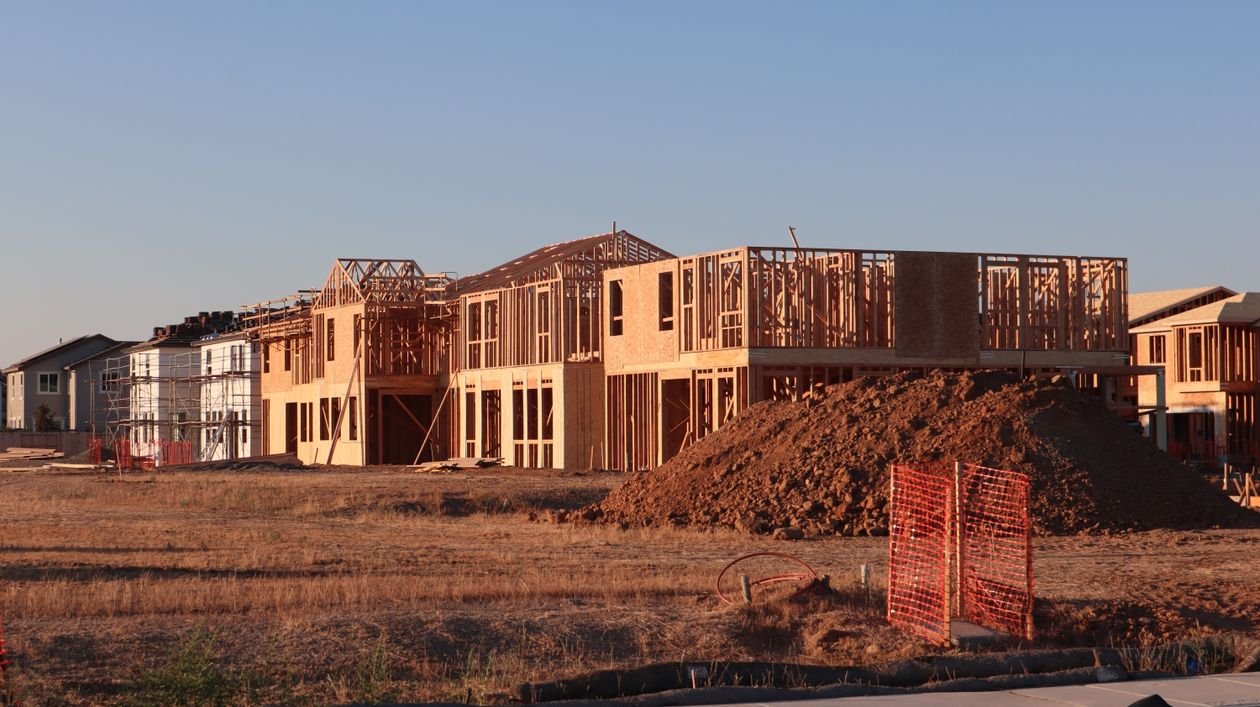
Photo: D Goug, via Pexels.
Sources
- Cuyahoga Land Bank, Residential Land Bank Application (application and conditions for land-bank lots): https://www.cuyahogalandbank.org/residential-land-bank-application/
- Unified Government of Wyandotte County / Kansas City, Kansas, How to Build on a Land Bank Lot ($1 lots; deed withheld until permit, cost estimate and proof of funds are produced): https://www.wycokck.org/Departments/Economic-Development/Land-Bank/Build-Land-Bank-Lot?OC_EA_EmergencyAnnouncementList_Dismiss=cf6406b3-a931-4886-893e-461b9dd6c2d8&lang_update=638531535953190055
- Consumer Financial Protection Bureau, What is a construction loan? (short-term, higher rates, staged advances, conversion depends on lender and credit): https://www.consumerfinance.gov/ask-cfpb/what-is-a-construction-loan-en-108/
- U.S. Department of Veterans Affairs, VA home loan types (the eligible-individual route to low/no-down-payment financing): https://www.benefits.va.gov/homeloans/purchasecashout.asp
- IRS, Topic No. 701, Sale of Your Home (§121 exclusion amounts and the ownership/use tests): https://www.irs.gov/taxtopics/tc701
- IRS, Publication 523, Selling Your Home (eligibility test for the exclusion): https://www.irs.gov/publications/p523
Leave a comment
Comment as a guest and verify your email, or sign in or create a reader account. Guest comments reach our review queue after email verification; account holders can submit directly for review.