Listen to this article
Take the story with you. Choose a voice and a pace that suits you.
Or listen in another language / choose a voice
Getting your device voices ready…
The voice follows the displayed language and your browser’s regional preference when available. You can choose another narration voice.
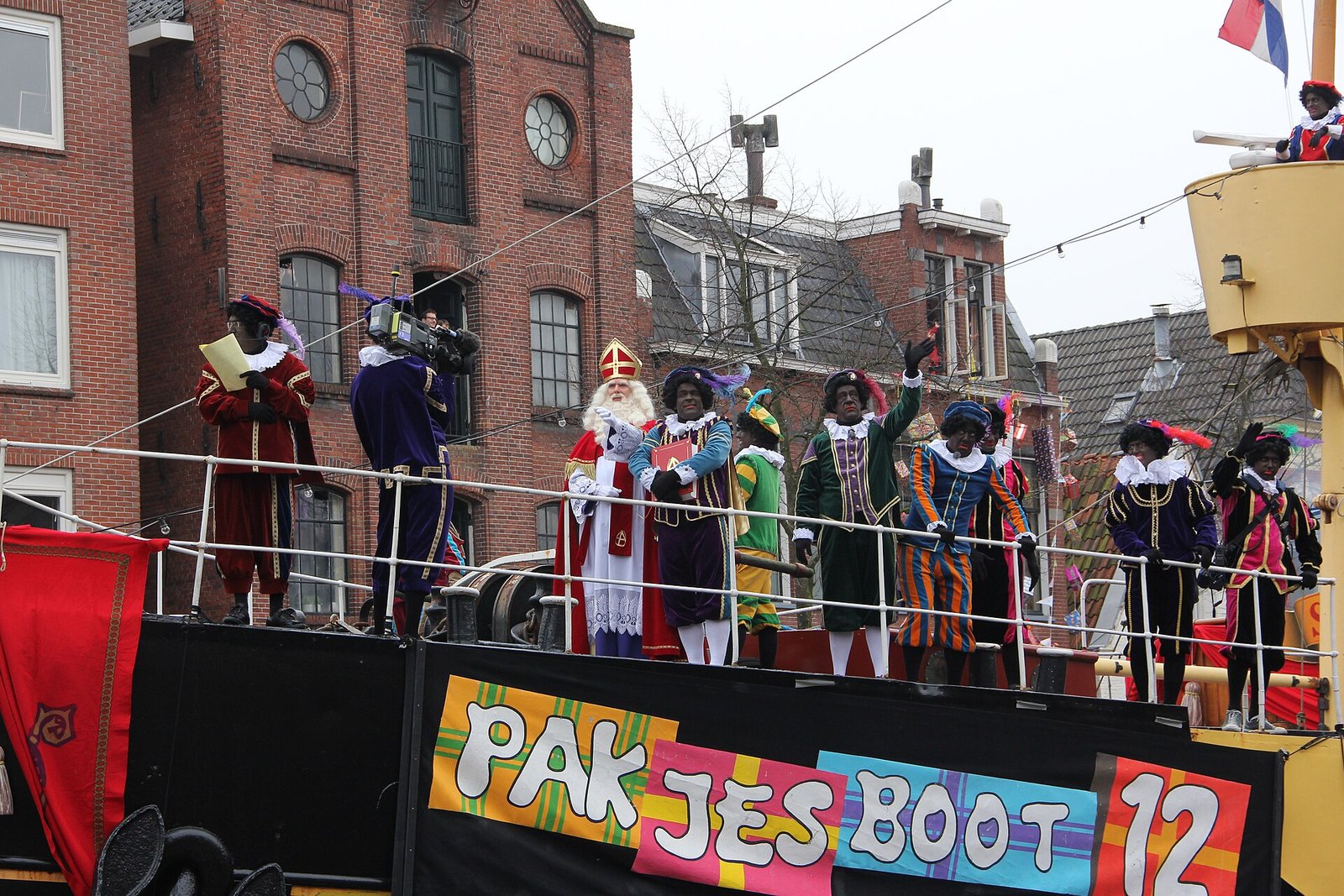
Every November a steamboat noses into Dutch harbours carrying Sinterklaas: white beard, red bishop’s robes, a book of who has been good. Around him stand his helpers — Zwarte Piet (Black Pete), played by white performers in blackface: jet-black make-up, red lips, a curly wig, gold ear hoops. The Dutch argument about him now has a four-word shorthand — Zwarte Piet Jim Crow — the claim that the helper’s face was formed not in an old Dutch winter but on the American minstrel stage. The evidence is stronger than many here like to hear — and it has a clear edge, marked below.
Information verified through 1 November 2026.
Meet Sinterklaas — and the servant beside him
Sinterklaas is the solemn centre of the feast; American Santa Claus partly descends from him. His companion began as a single servant. In Jan Schenkman’s 1850 picture book Sint Nikolaas en zijn Knecht — the book that fixed the modern feast — the servant is nameless, a dark-skinned page, as the history of Zwarte Piet records. The name is older Dutch slang for the Devil; St Nicholas had travelled with chained demons for centuries. Parts of the figure are genuinely old, genuinely European. The argument is about his face.
📚 Key terms
- Zwarte Piet — Sinterklaas’s helper in the Dutch feast: traditionally played in blackface — jet-black make-up, red lips, a curly wig, gold hoops — and the centre of the country’s longest-running argument about an image.
- Roetveegpiet — “sooty Pete”: the revised helper, his cheeks marked with chimney-soot smudges instead of full blackface; the only Piet on national Dutch television since 2019.
- intocht — the arrival parade: Sinterklaas’s ceremonial entry into a town by steamboat each November, which opens the feast season.
- Pakjesavond — “presents evening,” 5 December: the night of gifts and teasing poems — the feast’s main event.
- typetje — a recurring comic character built from an accent, a costume and a set of mannerisms; a stock figure a Dutch performer can build a whole career on.
1828: a stage joke called Jim Crow
In 1828, in Louisville, Kentucky, the white entertainer Thomas D. “Daddy” Rice blacked his face with burnt cork and performed “Jump Jim Crow” — an act playing an enslaved Black man as a grinning, dimwitted buffoon. The Jim Crow Museum at Ferris State University documents the spread: New York 1832, London 1836, an industry behind him. Minstrelsy — white performers in blackface working one fixed caricature — became America’s dominant entertainment, and, in ArtsJournal’s phrase, its first cultural export.
How the joke’s name became law
The name outlived the act. After Reconstruction, the South’s segregation statutes took the stage character’s name — Jim Crow laws, as the Jim Crow Museum traces. A joke first; a legal system decades later. The caricature was touring the world as entertainment while it hardened into law at home.
Minstrelsy crosses the Atlantic
Rice conquered London in 1836; American troupes followed for a generation, and European stages absorbed the act whole. Writers on the form describe the imagery absorbed into other cultures wherever the tours reached. Set the dates side by side: minstrelsy’s European heyday falls in the 1840s through the 1860s — exactly the decades in which Schenkman’s servant, first drawn in 1850, acquired his permanent form across edition after edition.
1850: Schenkman’s servant gets a face
Schenkman’s servant starts as a Moorish page — the defenders are right about that, and the feast’s geography agrees, since Sinterklaas sails from Spain. Across the later nineteenth century the drawn figure changes: the skin goes jet black, the lips swell and redden, gold hoops appear in the ears, the hair becomes a tight curly wig. University of Groningen researchers later found the image barely changed between 1850 and 2013 once it set. The modern explanation — Piet is black from climbing down chimneys — accounts for none of it: soot does not produce red lips or an afro wig.
🕐 Timeline
- 1593 — Cesare Ripa’s Iconologia publishes the four continents as female allegories — Europe crowned and learned, Africa and America drawn exotic.
- 1850 — Jan Schenkman’s Sint Nikolaas en zijn Knecht fixes the modern feast; across later editions, his servant’s look hardens toward caricature.
- 1870 — The Emrik en Binger lithograph locks the mature image in print: jet-black skin, swollen red lips, gold hoops.
- 2011 — “Zwarte Piet is Racisme” — Quinsy Gario’s slogan turns an old, scattered discomfort into a national argument.
- 2019 — The national broadcaster and the national intocht go Roetveegpiet-only.
- 2025 — Kick Out Zwarte Piet and Nederland Wordt Beter dissolve, declaring their goals reached.
Zwarte Piet Jim Crow: the face, feature by feature
Lay the mature Zwarte Piet beside the minstrel-stage caricature and the match is point for point: the coal-black skin, the exaggerated red mouth, the gold earrings, the clownish page costume, comic attendant to a white master. John Helsloot of the Meertens Institute argues Piet arose in a world marked by slavery and colonialism, and calls the resemblance to its caricatures undeniable. Gloria Wekker’s White Innocence (2016) reads him as where Dutch culture stores its ideas about race while insisting it has none — see the St. Nicholas Center’s account of the debate.
The act: buffoonery and “broken Dutch”
The resemblance, on this argument, was never only painted on. History writer Spencer McDaniel contends that twentieth-century Dutch stage and television Pieten absorbed minstrelsy directly: the dimwitted-buffoon routine and the “broken Dutch” speech schtick working as a Dutch version of minstrel dialect parody. McDaniel writes a history blog, not peer-reviewed scholarship: weigh it as argument, not verdict. The performances sit on tape, in living memory.
The other case, in its own words
Defenders deserve a fair hearing. The companion of St Nicholas is far older than the United States: devils, Knecht Ruprecht, Krampus. The servant in Schenkman is a Moorish page, not an American. On the specific charge of copying, Michiel C. de Jong of the Sint Nicolaas Genootschap points out that even researchers at the Meertens Institute concede there is no documentary evidence of a direct link to Schenkman’s page.
🔎 Look closely
Two voices from the record, in their own words:
“…blackface minstrels toured Australia, India, South America, South Africa and other places… They were seen as American and therefore exotic — and their imagery was absorbed into other cultures.”
— ArtsJournal, “Blackface Minstrelsy, America’s First Cultural Export”
“Zwarte Piet is nou eenmaal zwart”
— Prime Minister Mark Rutte in 2013 — “Black Pete is just black.” In 2020 Rutte told parliament he had changed his view, and now understood why people experience the figure as racist.
What the evidence does — and does not — prove
Analysis: no surviving document shows Schenkman copying Rice, and investigators should stop implying one might turn up. What the record shows is harder to wave away: a caricature invented in America in 1828, touring Europe through the very decades the Dutch figure’s face was being fixed; and a final image matching the stage original feature for feature, beyond what older explanations cover. The strongest honest verdict is convergence and absorption — an old European servant-and-bogeyman figure whose look and act formed inside a transatlantic visual culture American minstrelsy dominated.
✏︎ Try this
A media-literacy exercise. Take any image you meet every year — a mascot, a logo, a festive face — and put three questions to it:
- Who drew it first — and for whose eyes?
- What stayed frozen in it while everything around it changed?
- What would it look like drawn by the people it depicts?
Why the Netherlands argues every November
The argument has already changed the feast. Since 2019 the national broadcaster and the national arrival have used only Roetveegpiet — soot-smudged cheeks, no wig, no red lips. In December 2025 the movement behind that change, Nederland Wordt Beter and Kick Out Zwarte Piet, dissolved and declared its goals reached. Yet a Hart van Nederland panel this October found 72 percent preferring the traditional figure. The steamboat sails again on 14 November, into Grave — a dignified old saint, and beside him a face whose passport, on the evidence, was stamped in America long before it was ever Dutch.
❓ Check your understanding
- “Jump Jim Crow” began on stage in 1828. What did the character’s name later come to label?
- What did University of Groningen researchers find about how much Piet’s drawn image changed between 1850 and 2013?
- Of the two explanations this article weighs — direct copying, or convergence and absorption — which does the evidence support, and what is missing for the other?
Sinterklaas and his Pieten aboard Pakjesboot 12 at the 2013 arrival in Groningen. Photo: Rudi Niemeijer, via Wikimedia Commons (CC BY-SA 3.0).
Sources
- Zwarte Piet — Wikipedia: https://en.wikipedia.org/wiki/Zwarte_Piet
- Jim Crow Museum, Ferris State University — who Jim Crow was: https://jimcrowmuseum.ferris.edu/who/index.htm
- “Blackface Minstrelsy, America’s First Cultural Export” — ArtsJournal: https://www.artsjournal.org/2019/02/19/blackface-minstrelsy-americas-first-cultural-export/
- “Debating Discrimination in the Netherlands” — St. Nicholas Center: https://www.stnicholascenter.org/around-the-world/customs/netherlands/zwarte-piet/piet-controversy-continues/debating-discrimination
- Nederland Wordt Beter — Wikipedia: https://en.wikipedia.org/wiki/Nederland_Wordt_Beter
Leave a comment
Comment as a guest and verify your email, or sign in or create a reader account. Guest comments reach our review queue after email verification; account holders can submit directly for review.