Listen to this article
Take the story with you. Choose a voice and a pace that suits you.
Or listen in another language / choose a voice
Getting your device voices ready…
The voice follows the displayed language and your browser’s regional preference when available. You can choose another narration voice.
A monument does not have to be stone. The Woven Monuments Senegal tapestry exhibition, which opened at the Baltimore Museum of Art on 25 October 2026, makes its case in wool: about 12 huge woven works, bright with colour, built to carry a young country’s story across a room — and across an ocean.
Information verified through 26 October 2026.
The museum calls it the first US museum exhibition in 45 years dedicated to Senegalese tapestries, according to its exhibition page. It runs through 7 March 2027. If you have never thought of tapestry as a major art form rather than a decoration, that 45-year gap is part of the point. A whole national school of modern art grew up in weave, travelled the world as diplomacy, and barely registered in American museums.
Woven Monuments Senegal tapestry exhibition: Senegalese tapestries Baltimore Museum of Art on the walls
The works were produced primarily at the state-supported Manufactures senegalaises des arts decoratifs de Thies, the BMA says. Nine artists are named: Badara Camara, Ansoumana Diedhiou, Theodore Diouf, Bocar Pathe Diong, Khalifa Gueye, Boubacar Goudiaby, Souleymane “Souley” Keita, Papa Ibra Tall, and Mouhamadou “Zulu” M’baye.
Look at how the museum credits one work and you learn how these pieces were made. A detail image is listed as: designer Souleymane Keita, weaver Ismaila “Ibou” Cisse, Untitled, c. 1980, courtesy of the Keita estate via the BMA. Designer and weaver are separate people, both named. That split matters. A painting has one hand. A monumental tapestry has at least two kinds of skill — the artist who invents the image and the weaver who translates it, thread by thread, at scale.
The show is curated by Carlee S. Forbes, the BMA’s Associate Curator of African and Oceanic Art, and it pairs the tapestries with related designs and archival materials, according to the museum’s July announcement carried by BmoreArt. The subjects, the BMA says, blend modernist abstraction with scenes from Senegal’s history, daily life and natural landscapes. Artcentron’s fall guide puts it plainly: weaving here is a vehicle for history, diplomacy, memory and national identity, not a backdrop.
The museum has been collecting toward this moment. Its recent acquisitions include Ansoumana Diedhiou’s Polygamie, c. 1978 — the first Senegalese tapestry to enter the BMA collection and one of only a few in US public institutions, according to ArtDaily’s acquisitions report. Diedhiou trained at the Ecole des Beaux-Arts in Dakar and became a prolific designer in the Thies workshop.
The Thies tapestry workshop Senegal built as a statement
To get why a government would pour money into looms, go back to 4 April 1960. That is the date Senegal gained independence from France, BmoreArt notes in its summary of the museum announcement. Senegal’s first president, Leopold Sedar Senghor, was a poet and philosopher as well as a politician. He championed the arts as central to Senegal’s identity and global presence, and encouraged artists to draw on the culture and history of the country and on inspiration from across the African continent.
The Thies workshop was set up in 1966 as part of that arts programme, according to ArtDaily’s account of the Diedhiou tapestry. Senghor’s government did not treat culture as the garnish on independence. It treated culture as evidence of it — proof, hangable on a wall in a foreign capital, that Senegal was a civilisation with its own modern visual language.
That is what the BMA means by cultural ambassadors. These tapestries were made to travel, to be given, shown and seen abroad. Their bold colour and dynamic composition were not accidents of taste. They were a national style, argued in public.
Post-independence Senegal national identity art, woven rather than carved
There is a quiet argument running through this exhibition about which art forms get called monumental. Western museum habits rank painting first, sculpture second, and textiles somewhere near craft. Senegal’s post-independence artists worked inside a different ranking because their state backed the loom. The result, ArtDaily wrote of the Thies works, merges modernist abstraction with African visual traditions and themes of nature, spirituality and ancestral heritage — a distinctly Senegalese modernism.
Baltimore makes a good test case for that argument this autumn. A few weeks after Woven Monuments closes its opening run, the same museum opens work by Diedrick Brackens, the contemporary American artist whose handwoven tapestries take on Black life and liberation — a pairing Artcentron flagged as a conversation between the two shows. Senegal in the 1970s, Baltimore in 2026: different continents, same refusal to treat weaving as a minor art.
Go and stand close, then stand far back. Close, you see labour — thousands of decisions in thread, the weaver’s craft the credits insist on naming. Far back, the abstraction resolves into landscape, figures, history. The monument effect needs both distances. So does the history: a designer with a vision, a weaver with the hands to build it, and a young republic betting that art could say, in rooms Senegal could never otherwise reach, we are here and this is who we are.
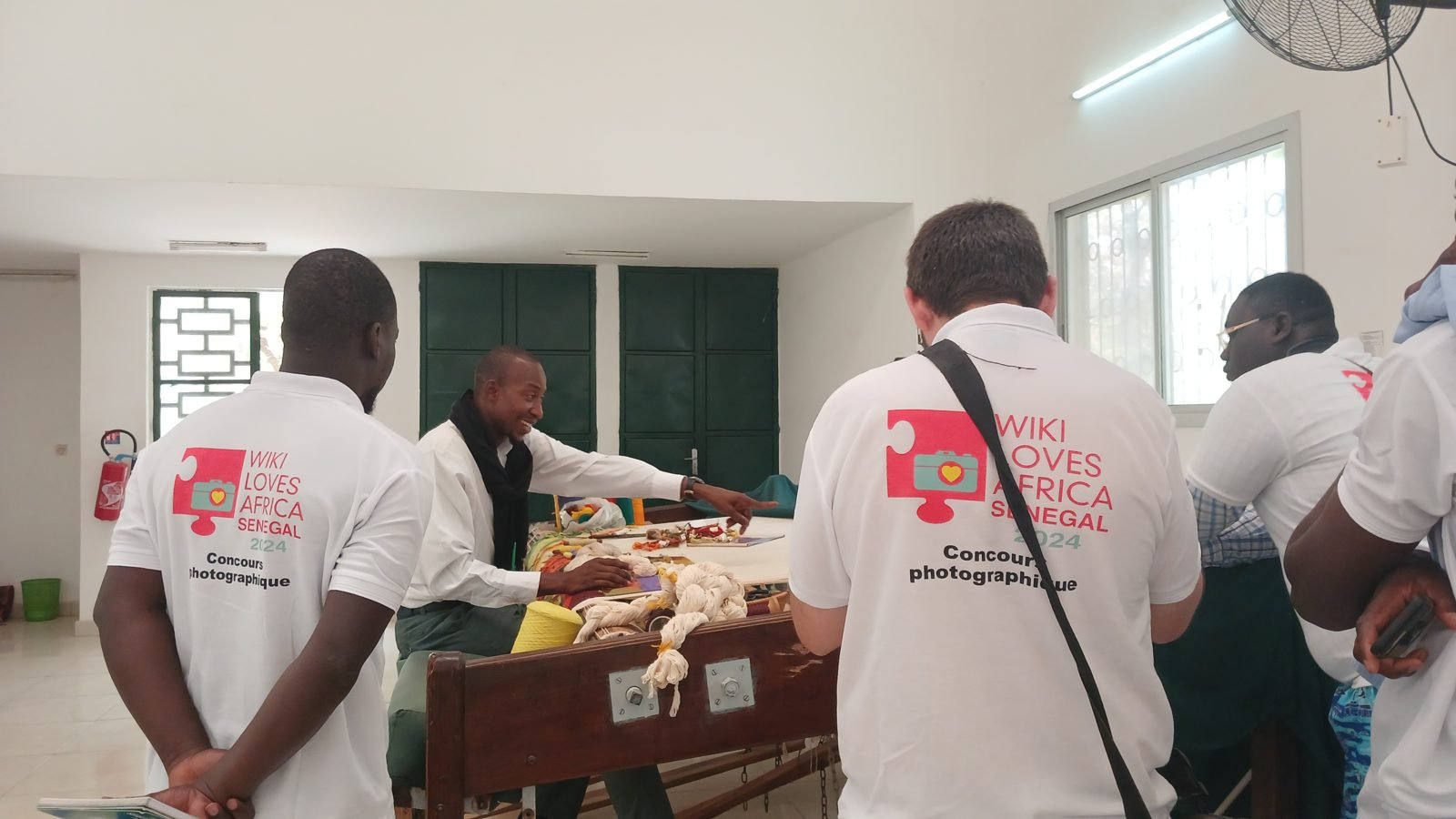
Photo: Serieminou, via Wikimedia Commons (CC BY-SA 4.0) — tapestry being made at Thies, Senegal.
Sources
- Baltimore Museum of Art, “Woven Monuments: Tapestry and Identity in Senegal”, exhibition page, https://artbma.org/exhibition/woven-monuments-tapestry-and-identity-in-senegal/
- BmoreArt, “BmoreArt News: Upcoming BMA Exhibition Explores the Vibrant Tapestries of Post-Independence Senegal” (BMA press release, 17 July 2026), https://bmoreart.com/2026/07/bmoreart-news-kevin-tervala-devoted-exhibition-at-mica-bma-textile-exhibitions.html
- Artcentron, “Baltimore Museum of Art Fall Exhibitions 2026: What to See This Season”, 21 August 2026, https://artcentron.com/2026/08/21/baltimore-museum-of-art-fall-exhibitions/
- ArtDaily, “Baltimore Museum of Art adds 150 artworks to its collection from around the globe”, https://artdaily.com/news/183545/Baltimore-Museum-of-Art-adds-150-artworks-to-its-collection-from-around-the-globe
Leave a comment
Comment as a guest and verify your email, or sign in or create a reader account. Guest comments reach our review queue after email verification; account holders can submit directly for review.