Listen to this article
Take the story with you. Choose a voice and a pace that suits you.
Getting your device voices ready…
The voice follows the displayed language and your browser’s regional preference when available. You can choose another narration voice.
Korean Pavilion Catabolism urban shrinkage sounds like a provocation. It is, instead, a work order. For the Venice Architecture Biennale 2027 Korean Pavilion, a team of architects will treat a country losing people — fast, and unevenly — as the brief itself, not as background sadness behind the real design work ArchDaily.
The exhibition is commissioned by the Arts Council Korea (ARKO) and led by curator Janghwan Lee, with architects Bae Yoonkyung, Kyo Suk Lee and Jaehyub Ko ArchDaily. Its subject is what the team calls hyper-shrinkage: the accelerated stage of population contraction and societal ageing ArchDaily. The Biennale runs from 8 May to 21 November 2027 K-ArtNow/ARKO.
Information verified through 24 October 2026.
Korean Pavilion Catabolism urban shrinkage, explained
Catabolism borrows its name from biology: the metabolic process through which complex molecules break down into simpler units and release energy ArchDaily. Applied to a city, the metaphor flips the usual story. Breakdown is not the end of the process. Breakdown releases material, space and energy for something else.
The team uses the concept to read shrinkage as a reconfiguration of existing relationships, and as the emergence of new uses and ways of living, rather than as simple decline ArchDaily. Briefly’s summary of the announcement makes the same point in shorter form: hyper-shrinkage framed as urban reconfiguration, using the mutations of existing spaces to enable new living beyond growth Briefly.
An earlier ARKO announcement, reported by K-ArtNow in June 2026, carried a working title — Disappearing Cities, Accumulating Architecture — and described the project as reinterpreting change in small and mid-sized regional cities not as local decline but as a form of adaptation that emerges once growth-oriented thinking is abandoned K-ArtNow/ARKO. The title changed. The argument did not.
Urban perforation shrinking cities: holes as a pattern
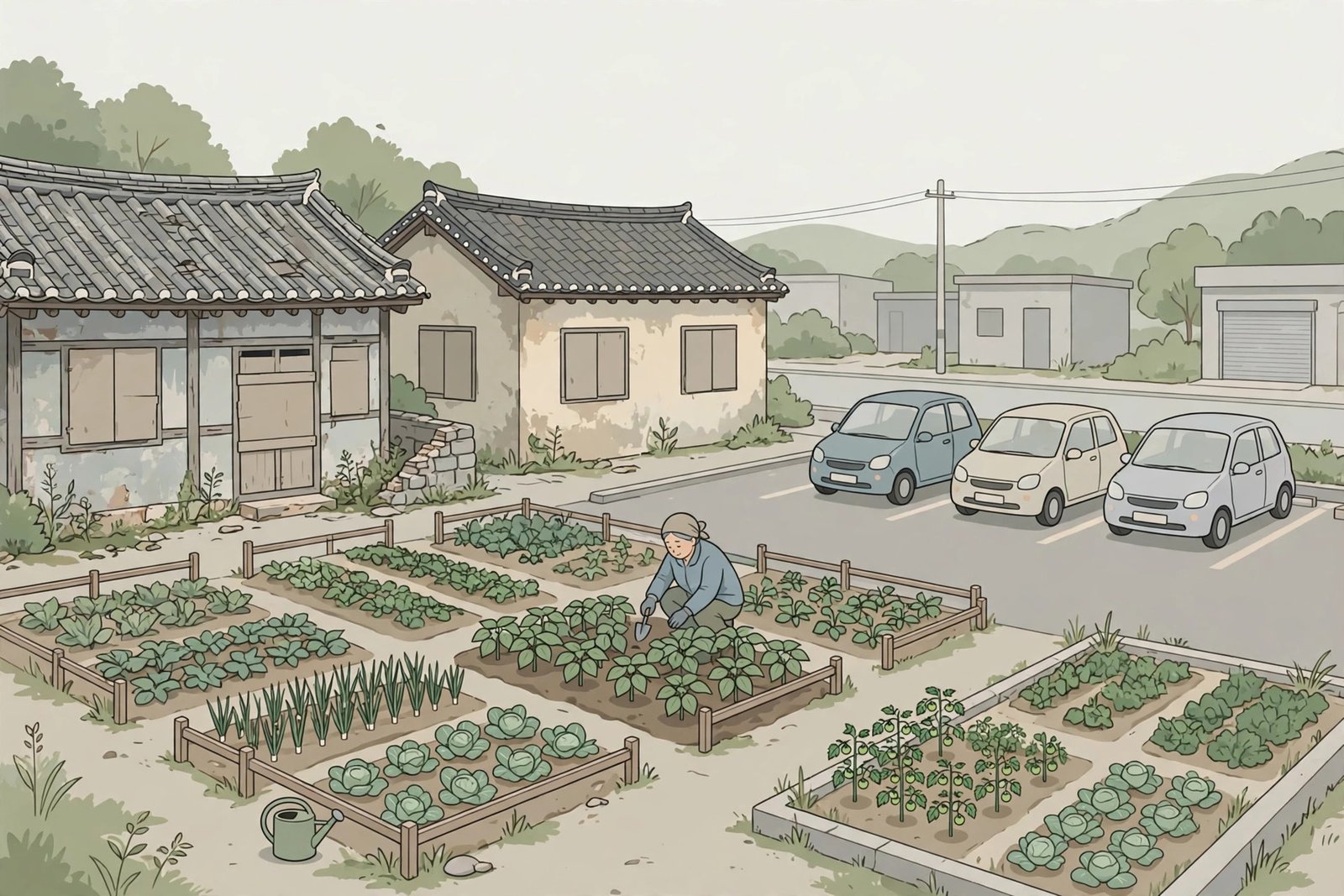
Outside Korea’s major metropolitan regions, the intensity of urban use is gradually declining, and demolishing vacant houses leaves scattered open plots behind ArchDaily. The Mid-Size City Forum, the research collective behind much of the pavilion’s fieldwork, calls this pattern “urban perforation.” Vacant plots become parking lots or vegetable gardens, or remain unused, reconfiguring the urban fabric and city life around them ArchDaily.
Perforation is a useful word because it refuses drama. A perforated city is not a ruin. It is a street with gaps — a house, a gap, two houses, a garden where a house stood, a car park where a family lived. People still live there. They live differently, among absences that have acquired uses.
What do architects do with the buildings that remain? The pavilion’s answer is a verb list, not a style: existing buildings are adapted by subdividing, connecting, demolishing, repairing, subtracting and adding, to fit new and different uses ArchDaily. Drawing on the Forum’s field observation, data analysis and spatial documentation of small and medium-sized Korean cities, the exhibition asks what should remain, and how it can be used, under conditions of gradual, constant change ArchDaily.
That question — what should remain — is a design question and a civic one at the same time. An ageing resident, a newly settled migrant and a temporary visitor need different things from the same shrinking street, and the pavilion team notes that new users do take root even as functions disappear ArchDaily.
Architecture beyond growth degrowth, inside a growth-minded Biennale
The wider Biennale frame makes the Korean position sharper. The 2027 exhibition’s overall theme, set by curators Wang Shu and Lu Wenyu, is “Do Architecture – For the Possibility of Coexistence Facing a Real Reality,” in K-ArtNow’s account of the Biennale presentation K-ArtNow/ARKO. A pavilion about taking buildings apart, carefully, lands well inside a call to return to the physical act of making.
Analysis: Architecture beyond growth degrowth is easy to sloganise and hard to practise, because the profession’s fees, prizes and portfolios still reward the new, the large and the finished. Catabolism’s wager is that dismantling, removing and reusing can be skilled, visible design work — the architect’s role redefined around judgement about what stays ArchDaily. The team is explicit that shrinking cities should not be reduced to places of decline or deficiency, and that disappearance should not be romanticised either. Disappearance, in their framing, is movement. Movement can be designed with, if someone bothers to document it first — which is what a decade of mid-size city fieldwork is for.
Venice will show grander pavilions. Few will bring a harder fact: in much of the developed world, the next building boom is not coming, and the buildings already standing are the project.
Sources
- ArchDaily — The Korean Pavilion to Explore Urban Shrinkage Through “Catabolism” at the 2027 Venice Architecture Biennale, 20 October 2026 — https://www.archdaily.com/1187154/the-korean-pavilion-to-explore-urban-shrinkage-through-catabolism-at-the-2027-venice-architecture-biennale?ad_campaign=normal-tag
- Briefly — The Korean Pavilion to Explore Urban Shrinkage Through “Catabolism” at the 2027 Venice Architecture Biennale (summary of ArchDaily), accessed 24 October 2026 — https://briefly.co/anchor/Berlin/story/the-korean-pavilion-to-explore-urban-shrinkage-through-catabolism-at-the-2027-venice-architecture-biennale
- K-ArtNow — Lee Janghwan Appointed Artistic Director of the Korean Pavilion at the 2027 Venice Architecture Biennale, 9 June 2026 — http://k-artnow.com/posts.php?co_id=1780642541
Leave a comment
Comment as a guest and verify your email, or sign in or create a reader account. Guest comments reach our review queue after email verification; account holders can submit directly for review.