Listen to this article
Take the story with you. Choose a voice and a pace that suits you.
Or listen in another language / choose a voice
Getting your device voices ready…
The voice follows the displayed language and your browser’s regional preference when available. You can choose another narration voice.
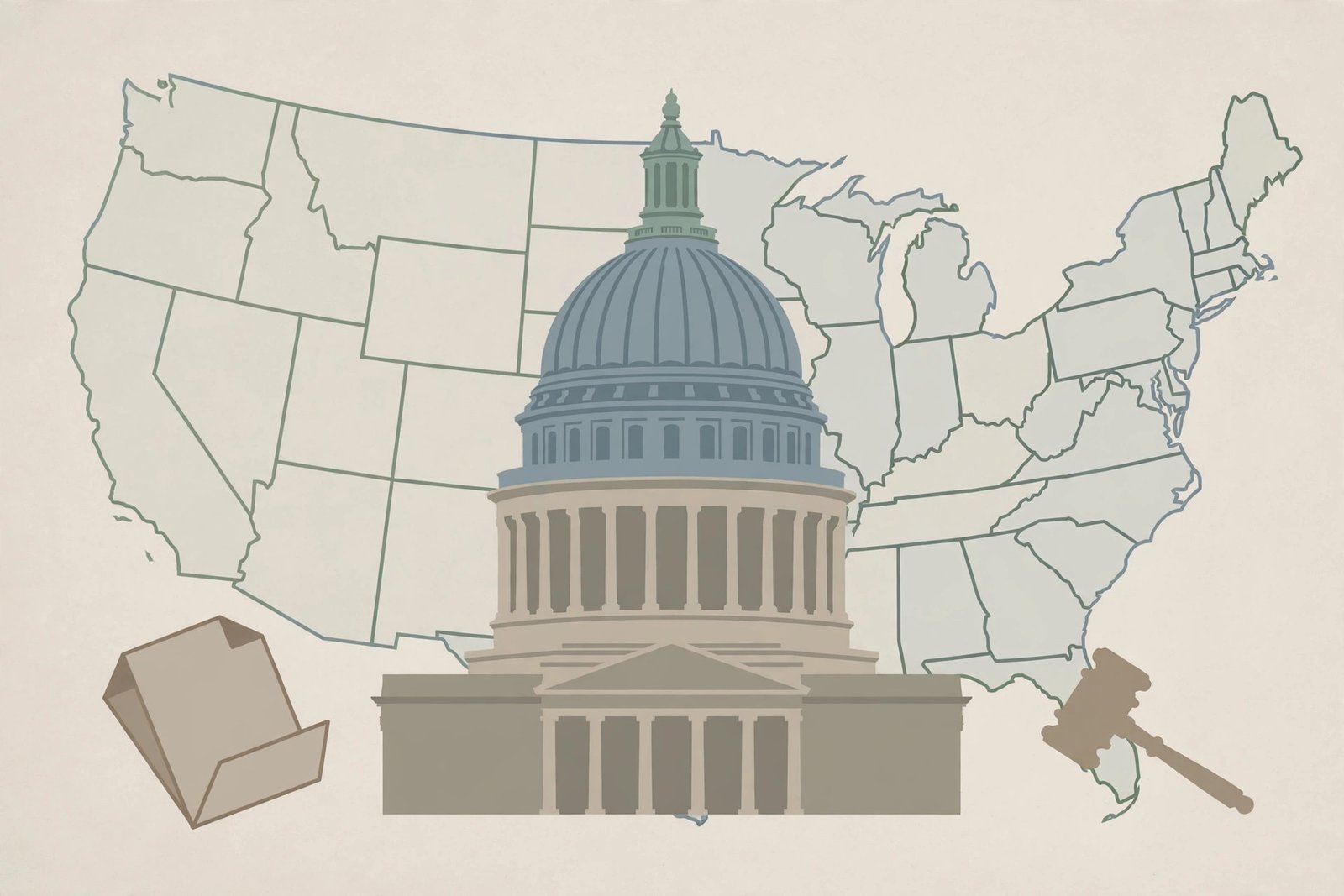
State AI laws 2026 are now the closest thing the United States has to a national AI rulebook, and a new count shows how fast that rulebook is growing. The Transparency Coalition, a Seattle-based nonprofit that tracks AI policy, released its 2026 State AI Legislation Report on 27 October 2026. It tracks 115 AI-related measures passed or enacted across 30 states between 1 January and 15 October 2026, a nearly 58% increase on the 73 laws in its 2025 report (Transparency Coalition; TechTimes).
One caution before the headline number hardens. The Coalition says its count mainly covers enacted laws but also includes a small number of measures approved by legislatures and still awaiting governors’ decisions because of late signing deadlines (Transparency Coalition). So 115 is a count of measures, not 115 identical obligations.
Information verified through 28 October 2026.
State AI laws 2026 in numbers: how many states passed AI laws in 2026, and why the states moved first
Thirty states, per the Coalition’s tally. Congress, by contrast, has enacted no federal AI law, despite more than 150 federal AI bills introduced across the past two sessions, according to TechTimes’ account of the report (TechTimes). A federal push to preempt state AI rules collapsed in the Senate in July 2025 on a 99–1 vote, and a bipartisan House preemption draft floated in June 2026 remains stalled, TechTimes reported.
“State lawmakers in both parties have stepped up to the challenge of regulating AI for the good of our communities,” said Rob Eleveld, the Coalition’s CEO, in the report announcement (PRWeb). He noted that legislators are deciding complex questions with limited staff, limited time and intense industry pressure.
Chatbot safety laws 2026: children first
The busiest single topic was chatbots. Fourteen states advanced chatbot safety measures addressing self-harm and suicidal ideation, sexually explicit content, emotionally manipulative engagement and other harmful interactions with minors, with California, Oregon and Washington enacting particularly extensive protections (Transparency Coalition).
Seven states — California, Colorado, Connecticut, Idaho, Illinois, Minnesota and South Carolina — went after the design underneath the conversation, adopting measures on addictive or compulsive features in digital products used by children and teens, including algorithmic feeds, autoplay and rewards (Transparency Coalition). That pairing matters. Lawmakers are no longer treating a chatbot as a neutral text box; they are regulating the engagement machinery around it.
Healthcare drew a second hard line. Eight states — Alabama, Colorado, Georgia, Illinois, Indiana, Iowa, Utah and Washington — limited insurers’ ability to rely solely on AI when making adverse medical authorisation or coverage decisions (Transparency Coalition). Five states, Colorado, Maine, Rhode Island, Tennessee and Vermont, prohibited or restricted AI chatbots offering mental health therapy, leaning on states’ existing authority over licensed professions.
The Illinois frontier AI audit law changes the top end
At the largest end of the market, Illinois enacted the AI Safety Measures Act, requiring frontier AI developers to run risk-management frameworks and undergo annual independent third-party audits, while California set standards and infrastructure for independent auditing organisations (Transparency Coalition). TechTimes described Illinois as the first jurisdiction in the United States to mandate independent third-party audits of the largest developers, citing legal analysis of the law (TechTimes).
Around those headline items sits a wider spread: disclosure duties when AI is used in advertising, customer service, campaign communications and chatbot interactions; a Washington law requiring provenance information embedded in synthetic or altered media; stronger deepfake protections in at least eight states; and education measures covering AI procurement, classroom use and the role of human teachers (Transparency Coalition).
Not everyone welcomes the patchwork. TechTimes quoted Anton Dahbura of Johns Hopkins’ Institute for Assured Autonomy calling the state-by-state approach “mostly bad,” arguing that AI crosses state lines and inconsistent rules burden companies (TechTimes). The Coalition’s own 2027 forecast expects the state wave to keep building anyway: AI product liability, stronger chatbot safeguards, wider independent auditing, procurement standards and frontier-model safety are all on its watch list (Transparency Coalition).
Analysis: a company shipping one national product now faces thirty variations of disclosure, child-safety and audit duties, and that friction is itself a policy outcome. States have effectively set the floor while Washington argues about whether a floor should exist. Whether Congress eventually harmonises these rules or preempts them, the compliance departments are already working from state law — because state law is what exists.
Photo: Daniel Schwen, via Wikimedia Commons (CC BY-SA 4.0)
Sources
- https://www.transparencycoalition.ai/news/2026-tcai-state-ai-legislation-report-2026-full-year
- https://www.techtimes.com/articles/329592/20261027/record-115-state-ai-laws-2026-illinois-sets-frontier-audit-mandate-congress-still-silent.htm
- https://www.prweb.com/releases/new-report-tracks-115-state-ai-laws-in-2026-as-chatbot-safety-emerges-as-top-legislative-issue-302919949.html
- https://superpowerdaily.com/posts/transparency-coalition-counts-115-ai-measures-across-30-states-up-nearly-58
Leave a comment
Comment as a guest and verify your email, or sign in or create a reader account. Guest comments reach our review queue after email verification; account holders can submit directly for review.