Listen to this article
Take the story with you. Choose a voice and a pace that suits you.
Or listen in another language / choose a voice
Getting your device voices ready…
The voice follows the displayed language and your browser’s regional preference when available. You can choose another narration voice.
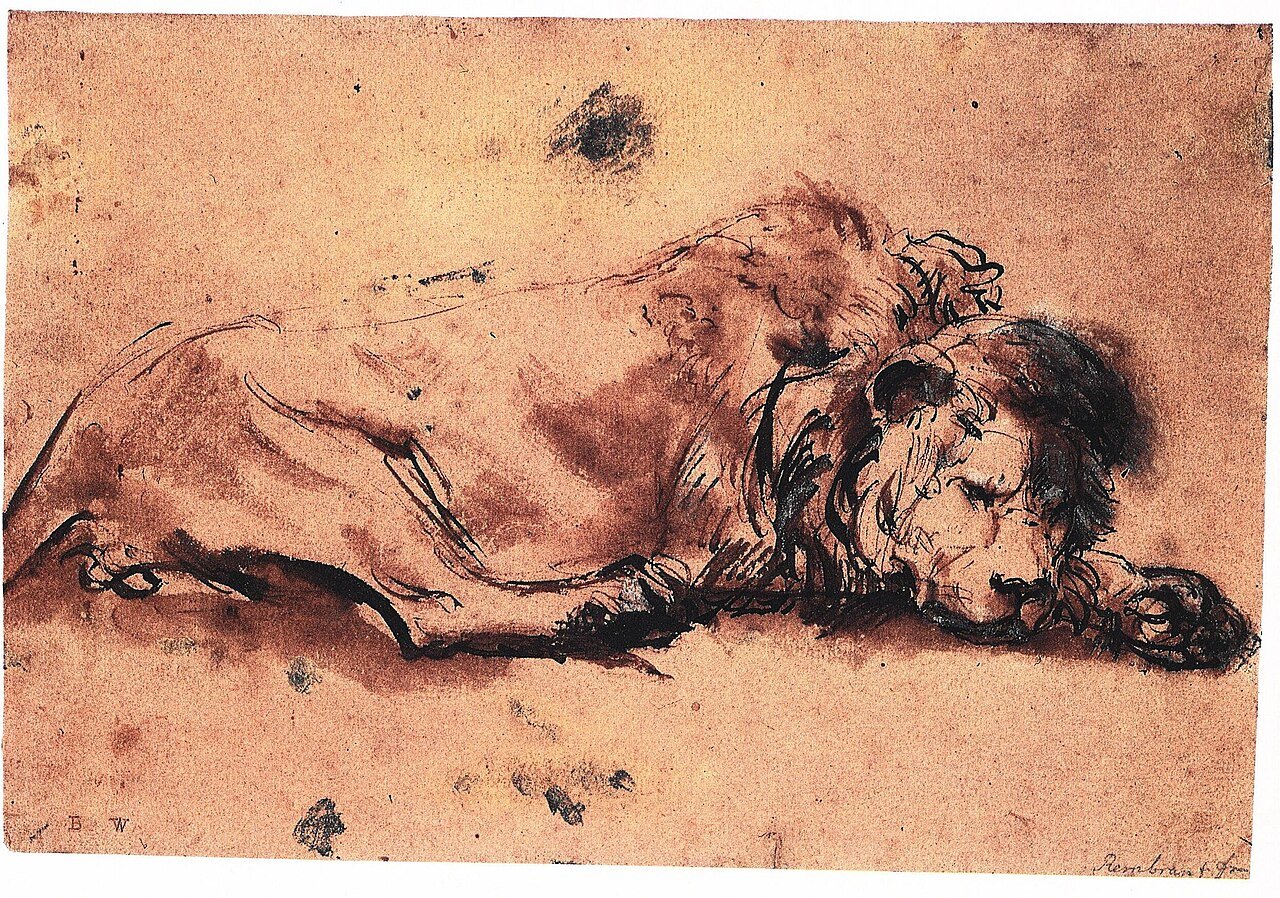
The Rembrandt’s Lions exhibition opened at the Morgan Library & Museum in New York on 23 October 2026, and its star is asleep. Rembrandt drew the Recumbent Lion around 1660 in reed pen and brown ink on a sheet barely five by eight inches, smudging the mane with a wet finger or brush; the drawing, on loan from the Rijksmuseum, now lies in the Morgan Stanley West Gallery as the calling card for a show about people, not cats (The City Politic). Rembrandt’s Lions: Art and Exile in the Dutch Republic runs through 31 January 2027 at 225 Madison Avenue (CODART).
The Rembrandt’s Lions exhibition and its art and exile in the Dutch Republic argument
The title is only partly zoological. The show’s real subject is the migrants, immigrants, exiles and refugees who made Rembrandt’s Amsterdam, in a century when, by the Morgan’s count, up to 60 percent of the city’s residents came from elsewhere (ArtDaily). The Dutch Republic, newly formed and fighting catastrophic religious and political wars around it, established a right to personal religious freedom and became a haven for people leaving home by force or by choice, though the museum is careful to note that not everyone enjoyed equal freedoms, especially in Dutch colonial territories (CODART).
“We are in the habit of treating Rembrandt as Dutchness itself,” is the assumption the show pushes against. In his own time, the Morgan argues, “the very definition of ‘Dutch’ identity was still being shaped,” and newcomers did much of the shaping (The City Politic). Colin B. Bailey, the Morgan’s director, said the exhibition offers “fresh perspectives on a well-known and thoroughly studied artist through a modern interpretive lens,” built around the museum’s Rembrandt etchings, “the largest and finest in North America,” formed largely by J. P. Morgan himself (ArtDaily). Curator Sarah Mallory put the point directly: the show asks visitors to consider “the parallels between Rembrandt’s Amsterdam, New Amsterdam, and New York City” (ArtDaily).
Six sections, one lion
The lion works double duty. It was the young Republic’s emblem, stamped on maps and coins, and it recurs in Rembrandt’s etchings “often in the context of stories about exile, refuge, and migration,” the museum says (CODART). Its most frequent companion is Saint Jerome, who, in legend, pulled a thorn from a lion’s paw in his desert exile and kept the animal beside him ever after; the Morgan reads the pair as “an expression of compassion, loyalty, and acceptance amid the difficulties of exile” (ArtDaily).
The show is organised in six sections. “Pride of Lions” opens with the Republic’s founding and Amsterdam’s haven status. “Republic of Refugees” looks at migrant and exiled communities in the Bible and in the city. “The Lion’s Share” turns to global stories and colonial aggression. “Home/Lands” walks the neighbourhoods where migrant communities lived, through Rembrandt’s eyes; he lived among them. “Fitting In” widens into his portrait practice, and “Beyond Belonging” closes with marginalised figures at the end of his life (ArtDaily).
Individual works carry the thesis quietly. A 1639 etching portrays Manasseh Ben Israel, the Portuguese-born rabbi who settled in Amsterdam’s growing Sephardic community and founded the first Hebrew press in Holland (ArtDaily). The Flight into Egypt: A Night Piece, from about 1651, sends the Holy Family travelling through near-total darkness, a displacement story told at the scale of one family on a road (The City Politic).
Rarely exhibited etchings, and a lion that never chose to travel
Prints are fragile. They live in boxes, away from light, and the Morgan’s best Rembrandt impressions are, in the museum’s own words, “celebrated, but rarely exhibited” (CODART). This show takes them out together: St. Jerome Reading in an Italian Landscape (about 1653, printed on Japanese paper, bought by J. Pierpont Morgan in 1905), three impressions of The Three Crosses (about 1653), and The Hundred Guilder Print (about 1648), alongside the Rijksmuseum’s Recumbent Lion and the National Gallery of Art’s painting The Mill (about 1645–48) (ArtDaily).
One detail does the exhibition’s work in miniature. Rembrandt never left the Dutch Republic. Any lion he drew from life had been shipped there through the trade networks of the age, an unwilling traveller in a city full of them (The City Politic). The drawing’s calm is the point reviewers keep returning to: Apollo’s preview praised the artist’s “sharp and empathetic eye” for the figures he encountered (The City Politic).
Analysis: Museum shows about migration can turn didactic fast. This one has a structural advantage: its evidence is the art itself, made by a man whose neighbourhood, sitters, printers and subjects were the newcomers in question. The argument does not need wall text to shout, because a 1639 portrait of a Portuguese rabbi in Amsterdam is already the argument, sitting in a frame. Whether visitors take the contemporary parallel Mallory offers is their choice. The sheets on the walls make it hard to pretend the parallel is not there.
Rembrandt’s Lions: Art and Exile in the Dutch Republic is at the Morgan Library & Museum, 225 Madison Avenue at 36th Street, New York, from 23 October 2026 through 31 January 2027 (The City Politic).
Photo: Rembrandt van Rijn, via Wikimedia Commons (public domain)
Sources
- https://citypolitic.com/2026/10/27/rembrandts-lions-morgan-library-art-and-exile/
- https://artdaily.com/news/201541/The-Morgan-Library-presents–Rembrandt-s-Lions—exploring-exile-and-migration-in-17th-century-Amsterdam
- https://www.codart.nl/guide/agenda/rembrandts-lions-art-and-exile-in-the-dutch-republic/
- https://arthistory.news/news/rembrandt-s-lions-lead-an-exhibition-on-art-and-exile-at-the-morgan-6a0cd204-0e66-4503-99ec-725557310ab2
Leave a comment
Comment as a guest and verify your email, or sign in or create a reader account. Guest comments reach our review queue after email verification; account holders can submit directly for review.