Listen to this article
Take the story with you. Choose a voice and a pace that suits you.
Or listen in another language / choose a voice
Getting your device voices ready…
The voice follows the displayed language and your browser’s regional preference when available. You can choose another narration voice.
Walk a block this week and count. The pumpkins are out, the porch lights work, and a striking share of those pumpkins have never met a knife. No-carve pumpkin decorating ideas — stick-on gems, pastel paint, pressed flowers, ribbon round the stem — have moved from craft-table novelty to the default look of Halloween 2026 (The Coolist). Halloween falls on Saturday 31 October this year. Information verified through 27 October 2026.
It reads as a style story. Underneath sit two plainer reasons: hands, and time.
No-carve pumpkin decorating ideas and the bedazzled pumpkin trend behind them
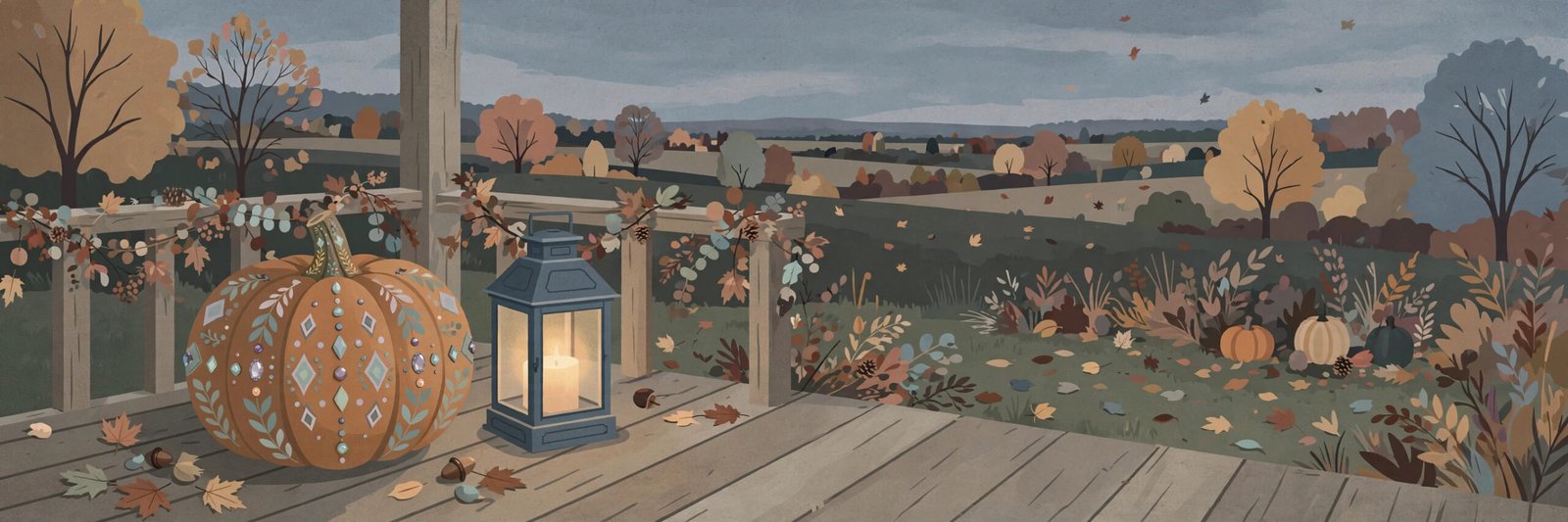
Home site Hunker flagged the look on 9 October 2026 and gave it a label: the bedazzled pumpkin trend (The Coolist). Whole pumpkins get covered in glued-on flat-back rhinestones and stick-on gems, colour-matched — clear stones on white pumpkins, purple on dark ones, gold on pale green. The Coolist ties the porch version to a wider sparkle wave that Grazia and Vogue tracked through 2026, from gem manicures to crystal-heavy autumn runways.
Gems are just the loudest variant. Homes & Gardens showcased Blake Lively’s pastel-and-floral pumpkins, Martha Stewart has posted painted and fabric-wrapped designs, and Good Housekeeping gathered more than 60 no-carve ideas this month, per The Coolist’s roundup of the coverage. One household-friendly version needs no shop run at all: Deanna Talerico dresses white pumpkins with dried pressed flowers, leaves, ferns and herbs, fixed with a homemade non-toxic cornstarch glue so the finished pumpkin stays compostable (The Weather Channel). Mod Podge works too, she notes, though that version should not go on the compost heap.
Pumpkin carving injuries emergency room doctors count every October
Here is the figure that changes the mood at the craft table. A study in the American Journal of Emergency Medicine, covering United States emergency department records from 2012 to 2021, counted about 20,579 pumpkin carving injuries emergency room visits over that decade, as reported by The Coolist. Almost 88 percent of those injuries were to the hand, the thumb and index finger hit most often, and the largest single group of patients was girls aged 10 to 19.
Hand surgeon Dr Trajan Cuellar of Sanford Health puts a typical year at roughly 2,300 emergency trips, spiking the day before Halloween. His warning, quoted in the same reporting, is blunt: “The worst ones are tendon injuries. Even if the repair goes well, you sometimes don’t get full use of the hand back.”
Nobody needs to ban the carving knife on the strength of that. Plenty of households will still cut a face on 30 October, carefully, with an adult holding the pumpkin. But a parent choosing stickers for a seven-year-old is not being precious. They have read the same numbers the surgeons publish.
How long do uncarved pumpkins last, honestly?
Longer than most people expect, and that gap sells the trend as much as safety does. Cornell University pumpkin specialist Steve Reiners, quoted via ZME Science in The Coolist’s reporting, gives a healthy whole pumpkin 8 to 12 weeks. A carved one gets 5 to 10 days. Utah State University Extension explains the mechanism: cutting lets air reach the flesh, and mould follows within days. Michigan State University Extension goes further for storage — a whole, undamaged pumpkin kept cool, around 45 to 50 degrees Fahrenheit, can last three to six months.
Practical habits decide which end of that range you land on. Pick a firm pumpkin with its stem attached, carry it from the bottom, rinse and dry it fully before decorating, and keep it shaded with air moving around it. Moisture trapped under gems or paint is where rot starts.
Paint first, then ask where it ends up
One caution arrived this week from the other direction. A 26 October guide to painted pumpkins points out that ordinary acrylic and craft paint is not food-grade, and a porch pumpkin is food — to squirrels, deer and the occasional dog (Go Viral). A painted rind also blocks the easy afterlife: it cannot go straight into compost unless the painted layer is cut away, so most painted pumpkins end up in the trash. Wildlife agencies discourage leaving pumpkins out for animals even unpainted, the guide notes, since it can spread disease and draw predators toward homes.
The fixes are undramatic. Use water-based, non-toxic paint and keep the pumpkin where animals cannot reach it, then bin it. Or choose decorations that peel off cleanly — ribbon, fabric, felt shapes, twine — and compost the plain pumpkin underneath in November.
Analysis: the no-carve shift holds because it solves three small problems at once. No knife near small hands. No collapsed, fruit-fly pumpkin by the 28th. No guilty trip to the bin with something that could have fed the soil. The rhinestones are the photograph. The arithmetic underneath is why the photograph keeps repeating, porch after porch, this October.
Sources
- https://www.thecoolist.com/halloween-pumpkin-carving-is-officially-over-in-2026-the-no-knife-trend-people-are-switching-to-worldwide/
- https://weather.com/2026/10/22/lifestyle/home-garden/dont-carve-your-pumpkins-dress-them-up-with-dried-flowers-and-botanicals
- https://go-viral.com/the-reason-you-should-think-twice-before-painting-pumpkins-this-halloween/
Leave a comment
Comment as a guest and verify your email, or sign in or create a reader account. Guest comments reach our review queue after email verification; account holders can submit directly for review.