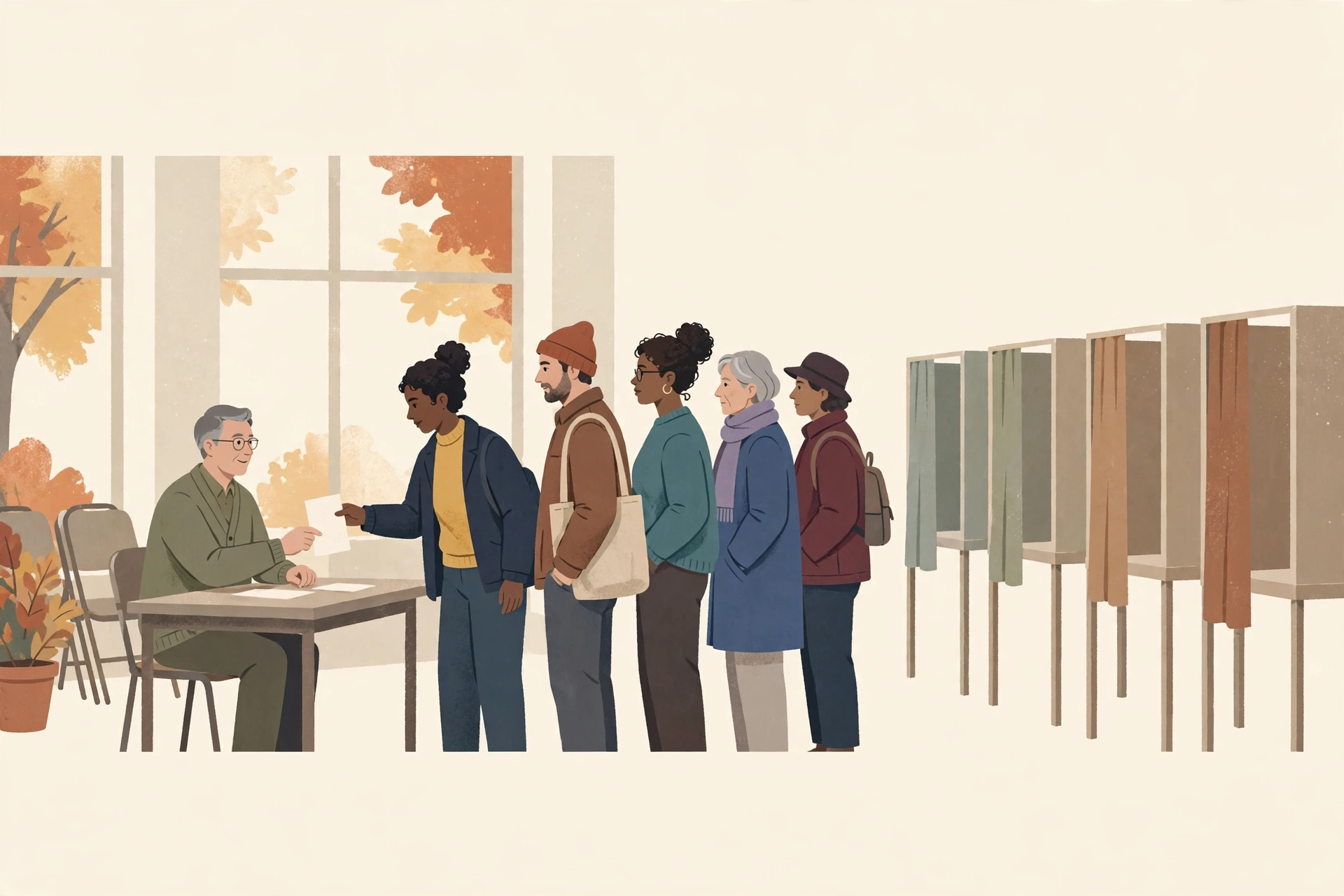
On Monday, 19 October, early voting centers open in South Carolina for the 3 November general election — two weeks out, no reason or excuse required, any registered voter welcome. The state’s election commission announced the window on 14 October: centers run from 19 to 31 October, 8:30 a.m. to 6:00 p.m., Monday through Saturday. South Carolina is not ahead of the country; it is somewhere in the middle of it. In the earliest states, ballots have been cast for weeks already.
So what does “early voting” actually mean in 2026? Less than the name suggests, and more. It isn’t one system. It’s fifty-one variations on a simple idea: you don’t have to wait for the first Tuesday in November.
One election, dozens of rulebooks
The United States runs federal elections through state law, and early voting shows it. As of April 2026, 47 states, the District of Columbia, Guam, Puerto Rico and the Virgin Islands offered early in-person voting to all voters, according to the National Conference of State Legislatures (NCSL). Three states — Alabama, Mississippi and New Hampshire — did not, though voters there may still qualify for absentee ballots.
The windows differ wildly. Early voting periods range from three days to 46, with an average of 20, and in some states the first ballots can be cast as much as 50 days before Election Day. Minnesota’s in-person absentee voting opens 46 days out. Kentucky, by contrast, gives voters three days: the Thursday, Friday and Saturday before the election. Eight states and Washington, D.C. have gone further still, running elections primarily by mail while keeping in-person sites open.
What happens at an early voting site
From the voter’s side of the table, the experience is close to Election Day: check in, show whatever identification your state requires — South Carolina asks for a photo ID — receive a ballot, mark it, cast it. Two differences matter.
The first is place. On Election Day you vote at your assigned precinct. During early voting, you can usually use any early voting center in your county, which is why South Carolina’s commission warns that early voting locations may differ from your Election Day polling place and should be checked before you set out.
The second difference is invisible, and it explains the alphabet soup of state terminology — “early voting,” “advance voting,” “in-person absentee.” In a true early-voting state, your completed ballot goes straight into a tabulator or ballot box, as it would on Election Day. With in-person absentee voting, you fill in an absentee ballot at the site and seal it in an envelope carrying your identifying information, to be processed like a mail ballot. The NCSL notes that from the voter’s perspective, the two experiences are essentially the same.
Hours are local too. Some states require weekend voting; others leave it to counties. There is no national answer to the simple question “when can I vote?” beyond: it depends on your state, and often your county.
A decade of quiet expansion
None of this arrived at once. The NCSL’s tracking of state law shows early in-person voting offered in 37 states and D.C. at the November 2016 election, rising to an expected 47 states and D.C. in November 2026 — ten states added in a decade. The Congressional Research Service describes the same pattern for mail voting: states have typically introduced changes step by step, testing expanded access on smaller elections first. Early voting in 2026 is less a reform than an accumulation.
The argument running alongside
Expansion hasn’t ended the argument; it has given the argument more to work with. The CRS, in its overview for Congress, lays out the two cases in neutral terms. Supporters of wider early and mail voting point to access — people who work through polling hours, who will be travelling, who live with illness or limited mobility — and to resilience: more time to fix a problem with a ballot or registration record, and slack when something goes wrong, as it did with hurricanes Helene and Milton in 2024. Critics answer that mail voting in particular creates openings for fraud, error and coercion, that long voting windows can slow the reporting of results, and that a ballot cast in September can’t respond to news in late October.
This year the dispute has a courtroom chapter. On 29 June 2026, the U.S. Supreme Court ruled in Watson v. Republican National Committee that the federal statutes establishing Election Day do not require ballots to be received by Election Day — a decision about mail ballots that sits behind many state deadlines. Executive orders touching mail voting, issued in March 2025 and March 2026, remained in litigation as of the CRS report’s July 2026 update; their outcome could still reshape the rules states are using this autumn.
Before you go
If you’re voting early: confirm your site, because it may not be your usual polling place; confirm the days, because the next county — or state — over may allow a longer window; and bring the identification your state asks for. Local election officials, not national websites, hold the final word on hours, a point the NCSL makes to every voter who asks.
3 November is still called Election Day. Increasingly, it’s the deadline rather than the event. The event started weeks ago, at early voting centers across most of the country — and for millions of voters, it’s already over.
Information verified through 18 October 2026.
Sources
- National Conference of State Legislatures — Early In-Person Voting
- National Conference of State Legislatures — Evolution of Absentee/Mail Voting Laws, 2016–2026
- South Carolina Election Commission — Make Your Plan to Vote Early for the November 3 Statewide General Election (14 October 2026)
- Congressional Research Service — Early Voting and Mail Voting: Overview and Issues for Congress (updated 10 July 2026)