Listen to this article
Take the story with you. Choose a voice and a pace that suits you.
Or listen in another language / choose a voice
Getting your device voices ready…
The voice follows the displayed language and your browser’s regional preference when available. You can choose another narration voice.
The winner will be announced on 3 November 2026 at the Paulskirche in Frankfurt. Until then, the International High-Rise Award 2026 finalists amount to a short, sharp argument about what a tall building is for. The jury picked five projects from 30 nominated buildings in 12 countries, and none of the five wins its place by being the tallest thing in sight.
That was deliberate. The jury, chaired by Brian Yang of BIG, looked for buildings that combine architectural quality with value for their surroundings and stay relevant for years, Stylepark reports. Height is barely mentioned. Usefulness is, constantly.
Information verified through 2 November 2026.
The International High-Rise Award 2026 finalists open with a ZIN Brussels transformation
ZIN is the finalist most likely to start an argument in a planning office. The Brussels complex stands where the World Trade Center towers WTC I and II rose under the 1960s Manhattan Plan, and instead of demolishing them, the architects kept their circulation cores and five basement levels and built between them, the award’s background notes set out.
A slab inserted between the two cores joins them into one structure. Its double-height floors need no separate access, and the storeys cut off from the slab can be used independently. The eastern tower now alternates offices and a hotel. The western one holds offices and apartments. Add a sports complex, a public orangery and a roof garden, and the building stays busy well past office hours.
The jury called it an “exemplary transformation of high-rises from the 1970s,” Stylepark records. Yang put the point bluntly: skyscrapers should no longer be merely towering symbols of power. The design team — 51N4E, l’AUC and JaspersEyers Architects — describes a complex “not designed for a specific purpose but can evolve over time,” with the existing structure treated as a material bank. At 129 metres and completed in November 2024, ZIN is not the biggest finalist. It may be the most copied idea among them.
One Pearl Bank Singapore sky allotments: density with somewhere to grow tomatoes
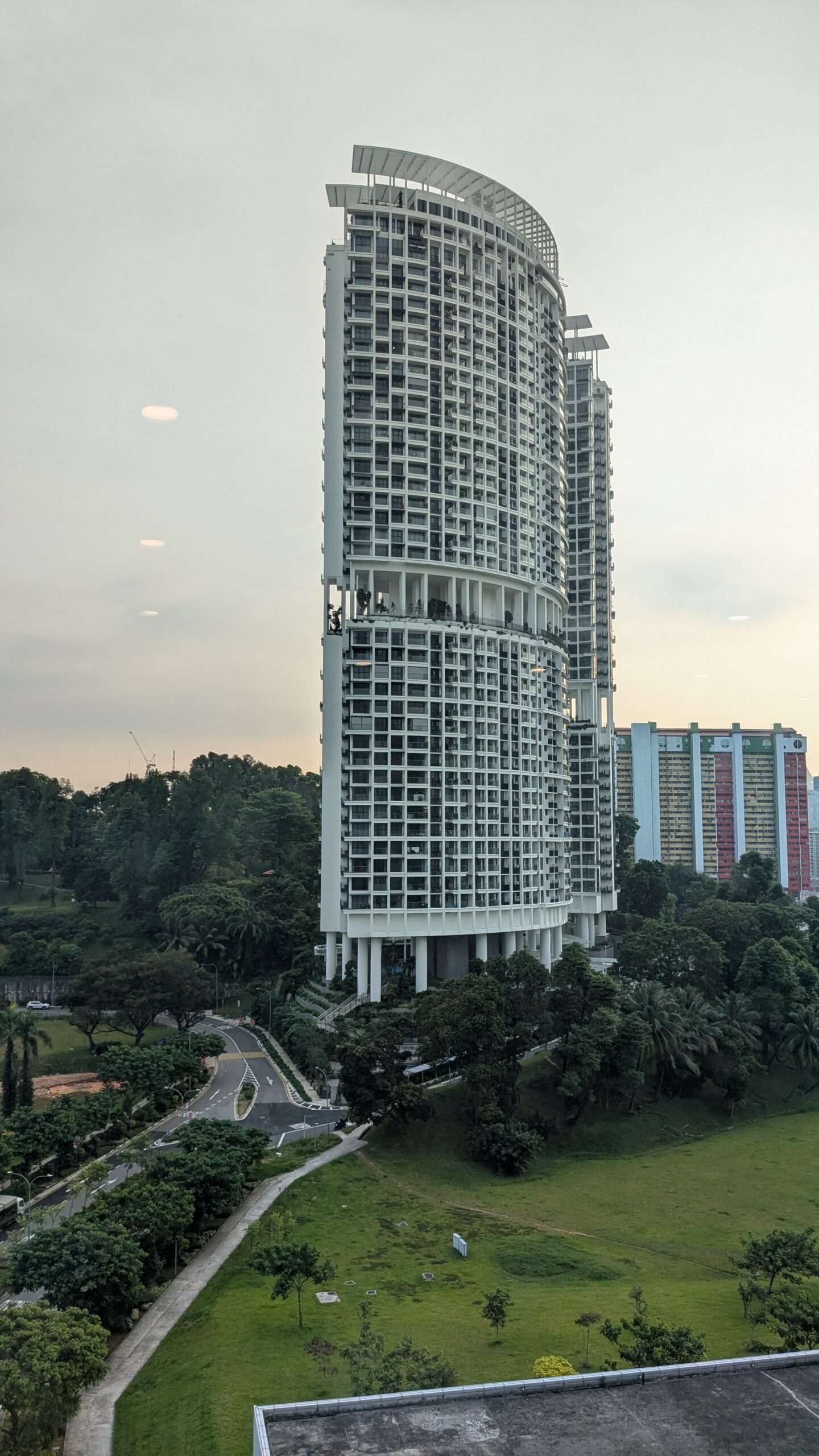
One Pearl Bank in Singapore takes the opposite route: a new building where a famous old one stood. Pearl Bank Apartments, completed in 1976, held 272 homes and was, on completion, the private residential building with the highest occupation density in Singapore, the background notes recall. The replacement fits 774 apartments on roughly the same footprint.
Two curved, staggered towers do the squeezing. Their shape protects views and limits how directly neighbours look into each other’s homes. Down the narrow sides sit 18 small garden plots — the Sky Allotments — with nearly 200 raised beds for fruit and vegetables, repeated every four storeys. Roof bridges link the towers, a planted ground floor leads into Pearl’s Hill City Park, and between the towers sit a pool, pavilions, a playground and fitness areas.
The jury’s phrase was “a residential high-rise that takes urban density to a new level.” Density is the easy part in Singapore. Density that hands residents soil, shade and a path into a park is harder.
A concrete sculpture in Curitiba, a vertical city in Guangzhou
AGE 360 in Curitiba, Brazil, is the smallest residential bet on the list: 33 homes inside a 124-metre tower. Its pale concrete exoskeleton does three jobs at once — structure, sunshade and appearance — which frees every floor plan of columns, the background notes explain. Shared spaces are threaded through the tower rather than dumped at the base: fitness and meditation rooms, terraces, a pool, and a two-storey tree-planted outdoor level at mid-height. The jury called it a “monolithic sculpture in which the structural framework and architecture are one.”
Tencent Tower in Guangzhou, by Ateliers Jean Nouvel, scales the same instinct up to 207 metres. A public shopping street runs from the city centre through the complex to the Pearl River bank. Every tenth floor, oversized “sun roofs” jut out — the top one by almost thirty metres — carrying greenhouses, workshops and meeting rooms, the background notes describe. At night, LED spots under those roofs make the tower’s contours dissolve.
The 88 Walker Sydney hovering tower, and what the winner gets
Sydney’s 88 Walker plays the politest trick of the five. Its glazed tower shares a plot with a nineteenth-century fire station, and the southern section only begins at the sixth storey, suspended nine metres above the historic building on angled steel and concrete supports, the award’s background notes say. Forty-five levels hold a 252-room hotel and column-free offices, in what is now North Sydney’s tallest tower. A public thoroughfare reopens the site’s old alleyways at ground level.
One of these five collects the prize on 3 November: a statuette by artist Thomas Demand and a cash prize, the award organisers confirm. An exhibition of the finalists opens at the Deutsches Architekturmuseum on 4 November and runs into April 2027.
Analysis: Read the five together and a pattern hardens. Two finalists keep or answer an older building on the site. Two treat shared space as structure, not decoration. Every one is mixed in use or in company. The lonely, single-purpose glass slab — the default tower of the last fifty years — is simply absent. Whoever wins on Tuesday, that absence is the result worth noticing.
Photo: Justanothersgwikieditor, via Wikimedia Commons (CC BY 4.0)
Sources
- https://www.international-highrise-award.com/assets/Presse/2026-27/Finalisten_26-27/IHA-2026_27_Press-Release_Finalists_260908.pdf
- https://www.international-highrise-award.com/assets/Presse/2026-27/Finalisten_26-27/IHA-2026_27_Press-Release_Finalists_background-information_260908.pdf
- https://www.stylepark.com/en/news/international-high-rise-award-dam-frankfurt-sustainability-architecture-stylepark-magazine
- https://art-news.space/2026/architecture/australian-commercial-tower-among-top-five-finalists-in-international-high-rise-award/
Leave a comment
Comment as a guest and verify your email, or sign in or create a reader account. Guest comments reach our review queue after email verification; account holders can submit directly for review.