Listen to this article
Take the story with you. Choose a voice and a pace that suits you.
Or listen in another language / choose a voice
Getting your device voices ready…
The voice follows the displayed language and your browser’s regional preference when available. You can choose another narration voice.
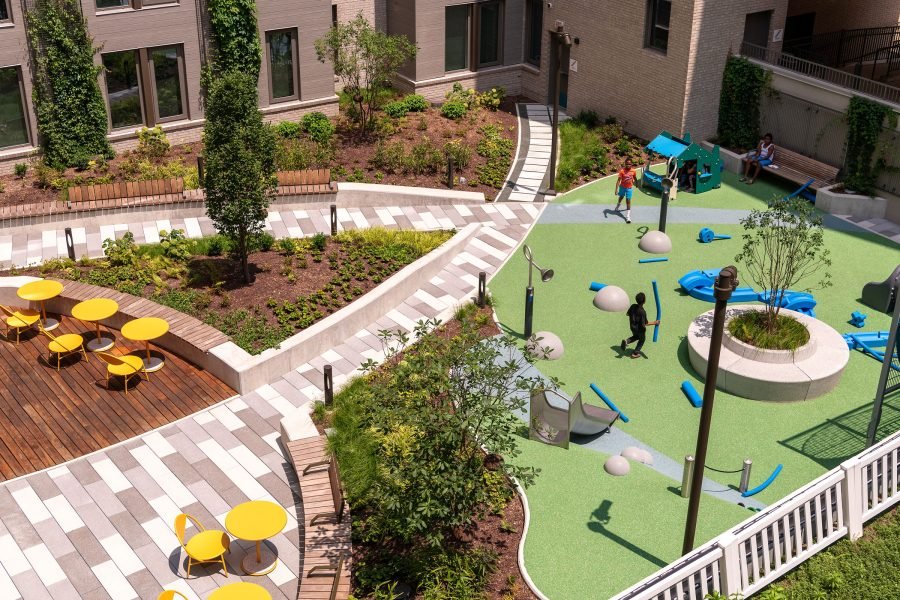
The Phius passive house design competition 2026 named its Best Overall Project this month, and the winner is not a showpiece house. It is The Faircliff, an eight-storey, 125-home building in Washington, D.C. where every apartment is permanently affordable. Phius announced the winners during PhiusCon 2026 in Phoenix, in a juried programme recognising fully certified passive building projects across building types and climate zones (gb&d, 29 October 2026).
Information verified through 31 October 2026.
The Faircliff Washington DC passive house, in detail
The Faircliff stands in Columbia Heights, at 2641 14th Street NW. Phius’s own project spotlight describes an eight-storey, 144,771-square-foot building with 125 permanently affordable apartments — 46 one-bedrooms, 40 two-bedrooms and 39 three-bedrooms — all affordable at or below 60 per cent of area median income, including nine homes designated as permanent supportive housing at 30 per cent (Phius Project Spotlight, October 2026).
The site previously held Faircliff Plaza East, an 80-unit garden-style affordable community the development team had owned since 2002. The Faircliff replaced all 80 homes one-for-one after residents voted unanimously in 2021 to proceed; more than 80 per cent chose to return after temporarily relocating (Phius). A neighbouring 197-unit market-rate building, Novel 14, was built on the other half of the site, quadrupling the homes on the block and using its market strength to cross-subsidise The Faircliff.
The building is all-electric, holds Phius CORE 2021 and LEED Platinum certification, and is described by Phius as Washington, D.C.’s greenest multifamily building. A combined green roof and 67 kW solar array sit on top; the concrete mix incorporated mineralised carbon dioxide, sequestering about 1.2 million kilograms of carbon in the structure and cutting embodied carbon emissions by 30 per cent (Phius). Building Design + Construction, reporting the winners on 15 October, put the project cost at $93.2 million and noted 30 per cent of units are designated accessible (BD+C).
Construction ran from January 2023 to December 2024, finished on time and under budget, and the building reached full lease-up on 27 June 2025, within six months of opening (Phius). The design team was Eric Colbert & Associates, with John Moriarty & Associates building it.
Inside the Phius passive house design competition 2026: passive building design principles at scale
Phius defines passive building through five principles: continuous insulation with thermal bridging minimised; an extremely airtight envelope; high-performance windows and doors with solar gain managed by season; balanced heat- and moisture-recovery ventilation; and a much smaller space-conditioning system, because loads are lower to begin with (gb&d).
Entries were judged on performance against the Phius standard, the difficulty of the climate and site, cost-effectiveness, design, craftsmanship and health, including the use of non-toxic materials (gb&d). That judging frame explains the rest of the winners list, which reads less like a style contest and more like a stress test:
- Best Single-Family: New Hope Passive House, New Hope, Pennsylvania, by Studio Modh Architecture.
- Best High-Rise Multifamily: 2147 Washington Street, Roxbury, Massachusetts — a 99,000-square-foot mixed-use building with 74 homes, most of them affordable rentals aimed at local artists, plus a bakery café, gallery and artist studios (BD+C).
- Best Low-Rise Multifamily: Leland House, Waltham, Massachusetts, for 2Life Communities.
- Best Commercial/Institutional: Ryerson Woods Education Center, Deerfield, Illinois, by Lake Flato Architects — designed to produce as much energy as it consumes, using about 80 per cent less energy than a comparable code-compliant building, and the first Phius-certified project in the U.S. with integrated bird-friendly glass (BD+C).
- Best Retrofit: 369 Warren Street, Brooklyn, New York. Best Source Zero: MiNet0-1, Grand Rapids, Michigan. Best Project by a Young Professional: Beach Green Dunes III, Far Rockaway, New York — 138 affordable apartments, including 31 senior homes, built for a flood-prone coastal site with a geothermal system and emergency battery power (BD+C).
- International Recognition: Habitation Léon-Deschamps, Sherbrooke, Quebec, a social housing project.
Affordable passive house housing stops being a pilot
Read the list again and a pattern forms. Affordable housing, senior housing, social housing, supportive housing. The categories where energy bills bite hardest and maintenance budgets are thinnest are exactly where this year’s jury found its strongest work.
That is a shift in what passive building is for. A tight envelope and recovered heat are comfort features in a custom home. In a permanently affordable building they are operating economics: lower loads, smaller systems, bills a household at 30 per cent of median income can actually carry, and — at The Faircliff — a lease-up completed in six months in a building residents chose to come back to (Phius).
Analysis: Competitions reward finished buildings, so they lag the market they claim to describe. If the 2026 winners are a lagging indicator, the news is still good: passive standards have moved from demonstration projects into the hardest brief in housing — affordable, dense, resident-approved, delivered under budget. The open question is no longer whether the physics works at scale. It is whether procurement, finance and codes in other cities will let teams like this one repeat it without a cross-subsidising neighbour next door.
Photo: Anice Hoachlander Photography, courtesy of Phius
Leave a comment
Comment as a guest and verify your email, or sign in or create a reader account. Guest comments reach our review queue after email verification; account holders can submit directly for review.