Listen to this article
Take the story with you. Choose a voice and a pace that suits you.
Or listen in another language / choose a voice
Getting your device voices ready…
The voice follows the displayed language and your browser’s regional preference when available. You can choose another narration voice.
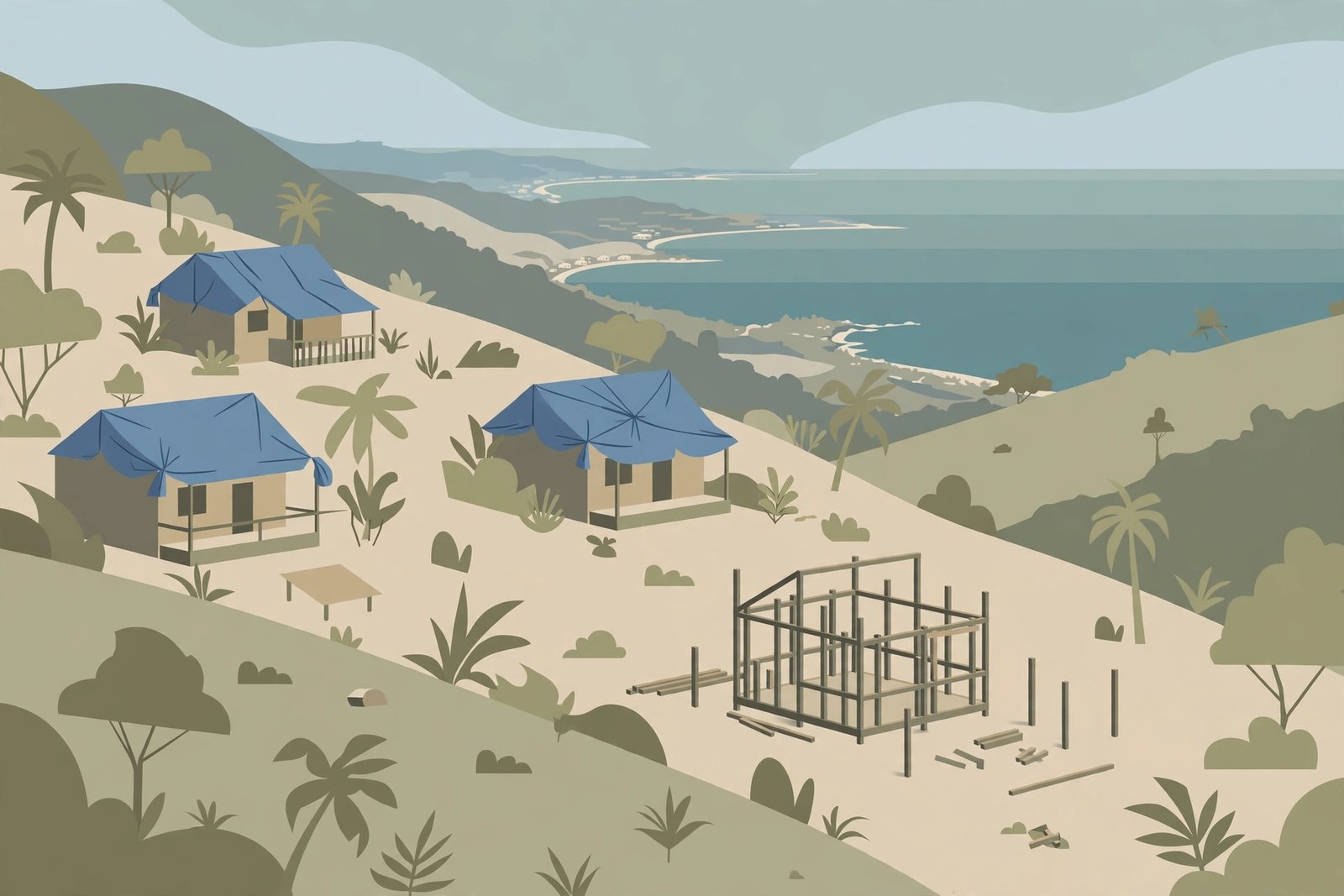
The hurricane melissa recovery one year later has a colour, and in western Jamaica it is blue. Tarpaulins still stretch over rafters in Westmoreland and St Elizabeth, weighted down with stones, a full year after the storm came ashore. Hurricane Melissa made landfall in south-western Jamaica on 28 October 2025 as a Category 5 storm, the strongest on record to strike the island, according to the Jamaica Homes News anniversary account. Information verified through 30 October 2026.
The hotels in Montego Bay are open. The main roads are clear. Houses are another matter.
Hurricane Melissa recovery one year later, in numbers
Melissa killed at least 45 people in Jamaica and tore the roofs off well over 100,000 homes, the anniversary account reports, citing official briefings. The International Federation of Red Cross and Red Crescent Societies puts the affected population higher still: 1.6 million people, more than half of Jamaica’s population.
The damage count kept growing after the wind dropped. By mid-November the Office of Disaster Preparedness and Emergency Management (ODPEM) had counted 156,000 damaged dwellings and 24,000 total losses across six parishes, according to the Jamaica Homes News account. A UN ECLAC and Planning Institute of Jamaica assessment put the total cost at J$1.95 trillion (US$12.2 billion), or 56.7% of GDP — more than four times Hurricane Gilbert.
Jamaica housing recovery after Hurricane Melissa: two programmes, two speeds
The government’s housing response has run on two tracks. ROOFS — the Restoration of Owner or Occupant Family Shelters programme — pays families to repair their own homes: J$75,000 for minor damage, up to J$200,000 for major damage and up to J$500,000 for severe damage, the anniversary account explains. Roughly J$12 billion has been paid out. Yet Prime Minister Andrew Holness acknowledged this week that only about half of the 118,000 assessed households had been paid, and he allocated another J$9.65 billion, with a target of reaching 90% by the end of December and the rest by January 2027.
The second track was meant for families with nothing left to repair. The National Housing Trust signed an emergency contract for 2,500 foldable modular units, and by August about 1,500 were on the island, according to the anniversary account. Putting them on the ground has proved far harder than buying them. Each unit needs a site, a certified concrete base, water, sewage and power. Contracts for the first 268 Shelter Recovery Programme homes were signed only on 3 September, and at Shrewsbury in Westmoreland 20 homes have been erected out of about 50 planned, with no move-in date announced.
Holness has said plainly that he is “not satisfied” with the pace, acknowledging that some families are still sleeping outside, the anniversary account reports.
Hurricane Melissa shelters Jamaica: 136 people still waiting
The shelter figures tell a quieter version of the same story. One hundred and thirty-six people remain in 24 shelters a year after the storm, ODPEM Director General Commander Alvin Gayle told a post-Cabinet briefing on 28 October, reported by the Jamaica Inquirer. Sixty-six per cent of them are in Westmoreland and St James, and Gayle said people in shelters will be prioritised for semi-permanent housing under the shelter recovery programme.
At the peak, more than 25,000 people slept in public shelters. Emptier shelters do not mean housed families, though. Many displaced people moved in with relatives, rented elsewhere, or went back to damaged houses — and once they left the shelters, they largely dropped out of the official count, the anniversary account notes.
Individual cases fill in the gaps between the statistics. In Mount Peto, Damion Brown, 63, told EFE he sheltered in a neighbour’s home as the storm hit, then lived for four months under a tarp on the spot where his house had stood before the organisation United for Jamaica helped him build a proper structure, according to De Último Minuto’s report of the EFE interview. United for Jamaica’s president, Kebre Treston, told EFE the government “could have done more and, to this day, continues to not do enough” — a criticism the Holness acknowledgement, quoted above, partly concedes on timing while the government points to the scale of spending.
Jamaica Red Cross cash assistance reaches 91,000 people
Aid groups have filled some of the space the state programmes have not yet reached. The Jamaica Red Cross, supported by the IFRC, has reached more than 91,000 people in a year, shifting from shelter relief to cash assistance that lets families lead their own recovery, the IFRC reported on 27 October. To date, 7,161 households have received Red Cross cash and voucher assistance totalling J$486.1 million (USD 3 million) — the largest cash programme in the history of the Red Cross in Jamaica and the Americas, the federation says.
The money goes on ordinary things. School fees. Medicines. Food. A roof repair a family chooses for itself. In the operation’s second year, running to October 2027, the Red Cross and IFRC plan to support 1,600 more rural households to restore farming and fishing livelihoods, according to the IFRC.
Why has housing moved so slowly? About 45% of Jamaica’s 900,000 land parcels have no title, and the government will not build on land a beneficiary cannot show a right to use, the anniversary account records. The Auditor General found only 1.8% of cash donations to ODPEM had been spent by late February. Jamaica’s catastrophe bond paid out US$150 million in full, the Caribbean Catastrophe Risk Insurance Facility paid US$91.9 million, and government spending on the wider response has reached about J$84 billion.
Analysis: the money, on paper, largely arrived. Insurance payouts, donations of about J$1.7 billion, repair grants in the billions — the ledger is long. What lagged was conversion: turning funds into foundations, titles into permissions, and stored modular units into homes somebody can sleep in. That is a less visible kind of disaster work, and a year on it is the part Jamaica is still waiting for.
Sources
- https://news.jamaica-homes.com/2026/10/28/hurricane-melissa-one-year-victims-still-waiting-for-homes/
- https://www.ifrc.org/press-release/hurricane-melissa-one-year-jamaica-red-cross-assists-91000-people-record-breaking
- https://jamaicainquirer.com/136-people-remain-24-shelters-one-year-after-hurricane-melissa-hit-jamaica/
- https://deultimominuto.com/en/international/wounds-yet-to-heal-one-year-after-the-passage-of-the-destructive-hurricane-melissa-in-jamaica/
Leave a comment
Comment as a guest and verify your email, or sign in or create a reader account. Guest comments reach our review queue after email verification; account holders can submit directly for review.