Listen to this article
Take the story with you. Choose a voice and a pace that suits you.
Or listen in another language / choose a voice
Getting your device voices ready…
The voice follows the displayed language and your browser’s regional preference when available. You can choose another narration voice.
The Power of Community Voice Gallup report landed on Wednesday, 28 October 2026, with a split picture of American local life. Most adults like where they live. Far fewer think anyone in charge wants to hear from them. Gallup and the Walton Family Foundation released the report, titled The Power of Community Voice: How Being Heard Expands Opportunity, in Washington, D.C. (Walton Family Foundation).
Information verified through 29 October 2026.
Start with the affection, because it is real. Seventy-two percent of U.S. adults agree the area where they live is worth investing in, 60% feel hopeful about its future, and half say their town or city is moving in a positive direction (Gallup). Willingness is not the problem either. Forty-nine percent feel a strong sense of responsibility to help improve their town or city, and 46% feel motivated to give back (Gallup).
Then the numbers fall off a cliff.
The Power of Community Voice Gallup report in numbers: pride up, voice down
Only 42% agree that people like them have a voice in local decisions that matter. Just 34% agree someone would listen if they had an idea to improve their town or city, while 40% neither agree nor disagree and 26% disagree outright (Walton Family Foundation). Read that middle group again. Four in ten adults aren’t hostile to the idea of being heard. They simply have no evidence either way, which may be its own kind of verdict on how local consultation usually works.
Confidence in readiness is thin, too. Forty percent agree their town or city is prepared to handle future challenges; 34% sit on the fence and 26% disagree (Gallup).
The findings rest on a Gallup Panel web survey of 6,732 U.S. adults conducted 26 February to 6 March 2026, with a margin of sampling error of ±1.5 percentage points for results near 50% (Walton Family Foundation).
Americans who feel heard give back at twice the rate
Here is the finding the whole report turns on. Among residents who agree someone would listen to their ideas, 71% feel motivated to give back to their community. Among those who are neutral or disagree, the figure is 33% (Gallup). Expecting a hearing more than doubles stated motivation.
The same pattern shows up in how people judge their home turf. Eighty-five percent of those who expect to be heard say their area is worth investing in, against 65% of the rest (Gallup). Preparedness tracks along as well: 60% of adults who think their community can handle future challenges feel motivated to give back, compared with 36% of everyone else, and 88% of the confident group call their area worth investing in, versus 60% (Gallup).
Gallup’s Justin Lall put the gap plainly: “Americans aren’t short on willingness to improve their communities… What’s in shorter supply is the belief that it would make a difference” (Walton Family Foundation). Luis Gonzalez of the Walton Family Foundation framed the other side of it, saying opportunity grows when people have “a voice in the future of their communities” (Walton Family Foundation).
One caution, and Gallup states it itself: the survey measured both attitudes at once, so it can show that expecting to be heard and wanting to give back move together, not which one causes the other. Each was measured with a single agree-or-disagree question, and motivation is what people say, not what they later do (Gallup).
A voice in local decisions that matter matters less to the young — or does it?
The age split is the strangest part of the data. Adults aged 18 to 34 are less likely than those 55 and older to call their area worth investing in (64% vs. 76%), to feel hopeful about it (54% vs. 66%), to expect a hearing (30% vs. 38%), or to think their community is prepared (38% vs. 45%) (Gallup). On having a voice in local decisions that matter, the young trail 40% to 45%.
And yet motivation barely moves: 45% of the youngest group feel moved to give back, against 46% of 35-to-54-year-olds and 47% of the oldest group (Gallup). Whatever is discouraging younger adults, it hasn’t killed the impulse to help. It has just detached that impulse from any expectation of being listened to.
That detachment matters beyond town halls. In the partnership’s earlier How Opportunity Takes Root study, one in three Americans said their lives felt mostly dictated by circumstances beyond their control, and adults who could rely on their neighbours were 16 to 22 percentage points more likely to feel able to shape their own path (Gallup). Being heard locally and feeling any agency at all appear to be neighbouring rooms in the same house.
Analysis: The report’s real subject isn’t apathy. Apathy would be easier. The respondents are attached to their places, feel responsible for them, and still mostly doubt that speaking up leads anywhere. A council that reads this as a communications problem will miss it — the 40% who neither agree nor disagree that anyone would listen are describing experience, not messaging. The cheapest civic infrastructure on offer here is a visible loop: an idea submitted, an answer given, a reason recorded when the answer is no. Whether that loop would shift the 34% is a testable question. Nobody in this data has run the test yet.
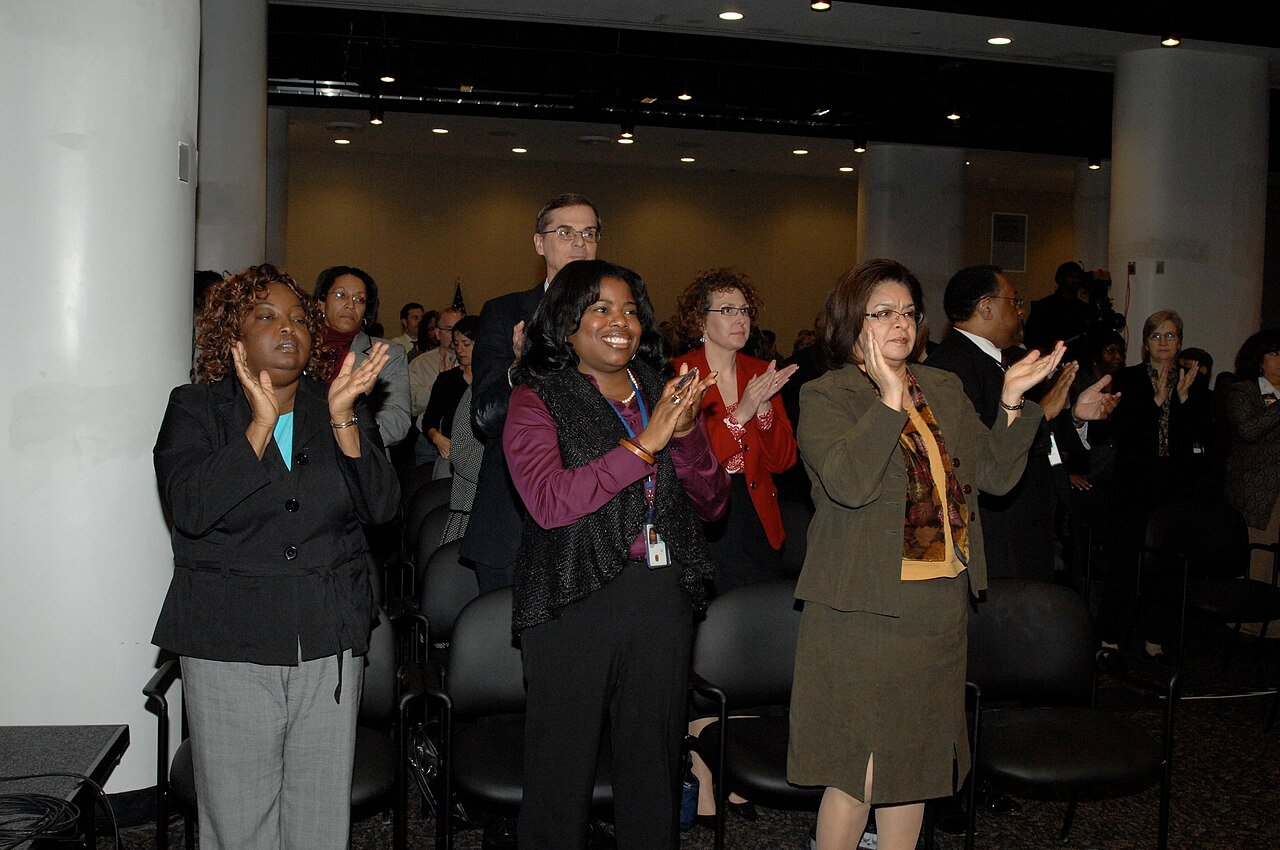
Photo: HUD Staff Photo, U.S. Department of Housing and Urban Development, via Wikimedia Commons (public domain)
Sources
- https://news.gallup.com/poll/716120/say-town-worth-investing-expect-heard.aspx
- https://www.waltonfamilyfoundation.org/about-us/newsroom/new-gallup-report-shows-americans-believe-in-their-communities-but-many-doubt-their-ideas-will-be-heard
- https://www.gallup.com/analytics/709121/opportunity-in-america.aspx
- https://news.gallup.com/poll/710510/opportunity-thrives-communities-strong.aspx
Leave a comment
Comment as a guest and verify your email, or sign in or create a reader account. Guest comments reach our review queue after email verification; account holders can submit directly for review.