Listen to this article
Take the story with you. Choose a voice and a pace that suits you.
Getting your device voices ready…
The voice follows the displayed language and your browser’s regional preference when available. You can choose another narration voice. Enhanced device voices are preferred; availability varies.
Start with a question that sounds like a joke at a dinner party. Is everything conscious? University of Southampton philosopher Sam Kimpton-Nye, writing in Aeon on 12 October 2026, suggests that if the question makes no sense to you, you should spend some time with the principle of sufficient reason — the idea that everything in the world is, in principle, intelligible. A critical survey of his essay, published this month, walks through his three routes into panpsychism and the toll each one charges.
The problem panpsychism claims to solve is real, and it has a name. However completely we describe the physical arrangements of matter in a conscious being, Kimpton-Nye notes, that description leaves out what it feels like from the inside. David Chalmers called this the hard problem of consciousness. You can map every neuron firing while someone tastes coffee. The map is not the taste.
Move the mystery to the bottom
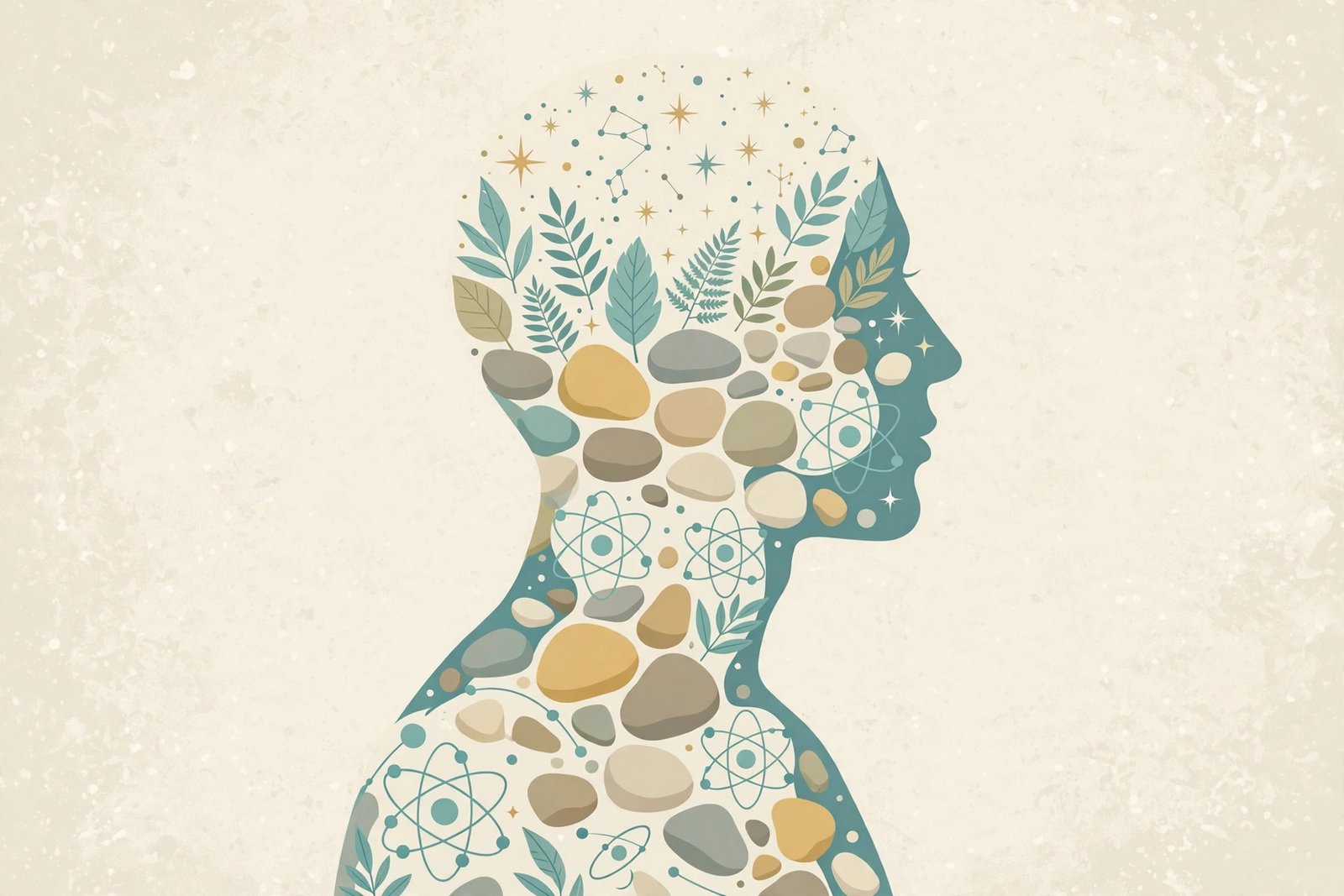
Panpsychism’s core move is disarmingly simple. Why assume fundamental matter is non-conscious, then struggle to explain how consciousness emerges from it? If consciousness is a fundamental property of matter, the emergence problem as formulated does not arise. The explanatory gap closes — because you never opened it.
Critics reply that a closed gap isn’t the same as an explanation. The Mind Matters survey puts the rival position bluntly, via philosopher Edward Feser: consistent materialism ends up eliminative, denying the mind that did the theorising — “a snake that eats its own tail,” in the survey’s phrase. Panpsychism avoids that snake. What it catches instead is the combination problem, even if the survey dwells on a different cost: if charge, mass and spin are themselves conscious mental properties, as Norwegian philosopher Hedda Hassel Mørch argues in the second approach Kimpton-Nye surveys, then all paradigm physical properties such as charge, mass and quantum spin are conscious mental properties. The survey’s author asks whether that reintroduces animism — a world of agents in stones and electrons. Supporters would say micro-experience isn’t agency or decision; a charge doesn’t deliberate. That distinction is available, but it has to be argued, not assumed, and the argument is where the hard work now sits.
The third route is older and stranger. Follow Spinoza and you reach a single fundamental substance with both thought and extension, castable in pantheist terms or panpsychist ones. Elegant. Also a very long way from a laboratory.
A neighbouring debate shows why data alone won’t settle this
Free will research offers a cautionary parallel, and it’s worth sitting with. Benjamin Libet’s 1983 experiment found a brain signal, the readiness potential, beginning roughly 550 milliseconds before movement and about 300 milliseconds before subjects reported deciding. Headlines declared choice an illusion. Libet himself refused that conclusion, proposing a conscious veto — “free won’t”. Then in 2012 Aaron Schurger’s team proposed the signal might be ordinary random fluctuations crossing a threshold, not a decision at all, and a later control study found divergence only about 150 milliseconds before action.
Yet philosophers barely moved, because they were never arguing about milliseconds. A 2020 survey cited in the lesson puts roughly 59 percent of philosophers as compatibilists, holding free will compatible with determinism if actions flow from your own reasoning rather than coercion. Same data, different definitions, different verdicts. Panpsychism faces the identical trap: “conscious” stretched to cover electrons may win the argument by changing what the word purchases.
That doesn’t make these debates decorative. At a Doha Debates town hall, Fairfield ethicist Gregg Caruso argued the free will question carries “deep practical significance” for blame, punishment and public policy, and panellists worked through what accepting or rejecting free will means for resentment, anger and moral practice. Consciousness talk has stakes of the same kind — in how we treat animals, patients who cannot report experience, and machine systems whose status is now litigated in public. Getting the definition wrong isn’t a seminar-room error.
Analysis: Kimpton-Nye’s own conclusion is the most honest line in the debate, quoted approvingly even by his critical surveyor: such theories are “better thought of as providing new and enriching perspectives on these mysteries”, and we should stay open to their collapse and replacement. Read panpsychism that way — as a reframing that exposes how much the standard picture simply assumes — and it’s genuinely useful. Read it as a solved problem and you’ve traded one mystery for a slogan. The uncertainty here isn’t a reporting gap; as of this writing no experiment distinguishes a world where electrons carry proto-experience from one where they don’t, and readers should treat any source claiming otherwise with suspicion.
A stone, on this view, might have something it is like to be it — vanishingly thin, nothing like a thought. Or the whole edifice collapses back into metaphor. Either way, the question has done its work the moment you notice your certainty that matter starts out dead was never argued for. You inherited it. Inherited premises are exactly the kind philosophy exists to invoice.
Sources
- Mind Matters — “A Philosopher Looks At the Roots of Modern Panpsychism” (October 2026), surveying Sam Kimpton-Nye, “Is everything conscious?”, Aeon, 12 October 2026: https://mindmatters.ai/2026/10/a-philosopher-looks-at-the-roots-of-modern-panpsyschism/
- English On Topic — “C2 Lesson: Is Free Will Real? Philosophy Meets Neuroscience” (1 October 2026): https://englishontopic.com/c2-lesson-is-free-will-real-philosophy-meets-neuroscience/
- Fairfield University — “Scholars Examine Free Will at Qatar Panel Featuring Fairfield Professor” (2026): https://www.fairfield.edu/news/2026/january/scholars-examine-free-will-at-qatar-panel.html
Leave a comment
Comment as a guest and verify your email, or sign in or create a reader account. Guest comments reach our review queue after email verification; account holders can submit directly for review.