Event date: 7 October 2026. Information verified through 18 October 2026.
On Wednesday 7 October, the Royal Swedish Academy of Sciences awarded the 2026 Nobel Prize in Chemistry to Henri B. Kagan of France and Kenso Soai of Japan, for work that explains how one of life’s strangest features — its one-handedness — can arise on its own (Reuters). Heiner Linke, who chairs the Nobel Committee for Chemistry, put the claim plainly: the pair “have provided a solution to a chemical mystery that is over a century old: how homochirality can emerge spontaneously” (LCGC International).
A mirror world that life largely ignores
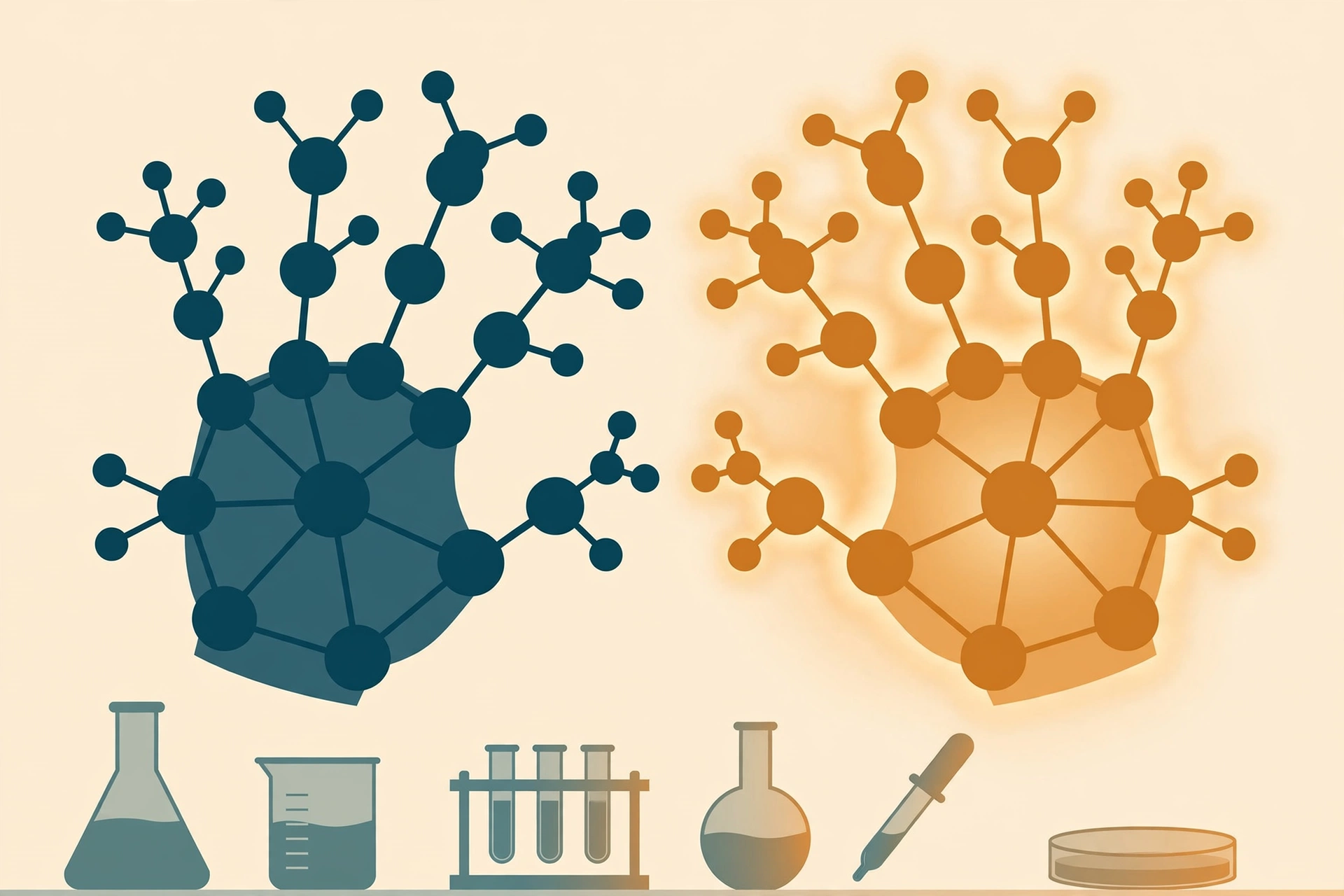
Many molecules exist in two versions. They contain the same atoms, arranged the same way, yet each is the other’s mirror image — alike and not alike, the way a left hand mirrors a right one. Chemists call such molecules chiral, from the Greek word for hand, and call the two versions enantiomers.
Life, oddly, picks sides. The amino acids in your proteins come in both mirror forms, but your cells build with only one of them. The sugars in DNA do the same trick in the opposite direction. The Academy calls this one-sided chemistry homochirality, and notes that the unused mirror versions are rarely found in nature (Nobel Prize popular information). The difference is not academic. One mirror form of the compound carvone smells of mint; the other smells of caraway, the spice in rye bread (Associated Press).
Left alone in a flask, chemistry shows no such preference. Run a reaction that can make either mirror form and you get an even split, half and half. So how did living things end up committed to a single hand?
Pasteur saw it first, with tweezers
The trail starts in the mid-19th century, with Louis Pasteur studying tartaric acid, a substance tied to wine production. He grew its crystals, looked at them under a microscope, and found two shapes, each the mirror of the other. Working with tweezers, he sorted them by hand, dissolved them separately, and watched one solution bend polarised light right and the other left. In 1857 he found something stranger: bacteria fermenting the acid ate the form found in grapes and left its mirror twin untouched. Life was choosing (Nobel Prize popular information).
A theoretical physicist, Charles Frank, sketched the conditions a solution would need in 1953: a chiral catalyst, some way of boosting one form while dampening the other, and a reaction that makes more of its own catalyst, so a small lead snowballs. For decades that stayed a classroom puzzle.
Kagan breaks a straight line
Kagan, at Université Paris-Sud, attacked the second condition. Chemists of the early 1980s assumed a tidy, linear relationship: mix a catalyst with a slight excess of one mirror form and the product would carry the same slight excess. Kagan doubted the tidiness. In 1986 he described three reactions in which the product’s excess came out larger than the catalyst’s — a curved graph where the field expected a straight one. A small imbalance, amplified. The Academy calls these non-linear effects a historic breakthrough, and they became a working tool for anyone designing reactions that must deliver one mirror form rather than both (Nobel Prize popular information).
Soai builds a reaction that copies itself
Soai, at Tokyo University of Science, closed the loop. His 1995 experiment began with a 2 per cent excess of one mirror form of a substance called 5-pyrimidyl alkanol and finished at 87 per cent, because the product catalysed its own formation — Frank’s third condition, met in glassware. In 2003 he reported a reaction producing a single mirror form at up to 99.99 per cent of the product, something nothing except life itself had managed. Which hand wins is settled by chance at the start; repeat the experiment and the other twin can take over instead (Nobel Prize popular information). Nobel committee member Peter Somfai called it “probably the coolest experiment in organic chemistry” (Associated Press).
Why drugmakers run on this
Getting the mirror wrong has a body count. In the early 1960s, the sedative thalidomide caused birth defects in thousands of children; researchers later found the harm lay in the drug’s mirror image (Reuters). “The left-handed version of the drug can have one effect, and the right-handed version can have another effect, and then we need methods for selectively preparing them,” Somfai explained. Rigoberto Hernandez, president of the American Chemical Society, went further: “The medicines we have today would not be possible without this chemistry” (Associated Press). The same control over handedness now feeds into flavours, scents, agricultural chemicals and new materials (Nobel Prize popular information).
Kagan is 95, the third-oldest person ever awarded a Nobel Prize; Soai, 76, was at a neighbourhood supermarket when the news reached him, and told the committee it was “one of the most exciting days in my life.” They share 12 million Swedish kronor, about $1.2 million, and receive their medals in Stockholm on 10 December (Reuters). The work itself is still moving: laboratories are now trying to repeat Soai’s trick with amino acids and sugars, hoping to test how life’s own handedness began (Nobel Prize popular information).
Sources
- Nobel Prize — “Nobel Prize in Chemistry 2026: Popular information” (The Royal Swedish Academy of Sciences): https://www.nobelprize.org/prizes/chemistry/2026/popular-information/
- Reuters — “Nobel chemistry prize goes to pair who solved mystery of ‘mirror image’ molecules”: https://wncy.com/2026/10/07/kagan-and-soai-win-2026-nobel-chemistry-prize/
- Associated Press, via WAMC Northeast Public Radio — “Scientists win chemistry Nobel for discoveries about mirrored molecules that led to many drugs”: https://www.wamc.org/2026-10-07/scientists-win-chemistry-nobel-for-discoveries-about-mirrored-molecules-that-led-to-many-drugs
- LCGC International — “Kagan and Soai Win 2026 Nobel Prize in Chemistry for Solving the Mystery of Life’s ‘Handedness'”: https://www.chromatographyonline.com/view/kagan-and-soai-win-2026-nobel-prize-in-chemistry-for-solving-the-mystery-of-life-s-handedness-