Listen to this article
Take the story with you. Choose a voice and a pace that suits you.
Or listen in another language / choose a voice
Getting your device voices ready…
The voice follows the displayed language and your browser’s regional preference when available. You can choose another narration voice.
Europe joins Ukraine peace talks at the next round. That much, Kyiv and Washington now say out loud. After a day of shuttle diplomacy on Thursday 12 November 2026 — Moscow in the morning, a military airfield outside Dublin in the evening — President Volodymyr Zelensky announced that European delegates “will be in the negotiating team” and “will have a voice” (Silent Dossier). Information verified through 13 November 2026.
US envoys Jared Kushner and Steve Witkoff carried the message between capitals. Kushner said the pair had put the point directly to Vladimir Putin at the Kremlin: “We cannot conclude this deal without the Europeans being at the table,” and of Putin, “he’s willing to give it a try” (Silent Dossier). For Zelensky, who has asked for a European seat for years, the logic is plain: Ukraine hopes to join the European Union, and the war is being fought on European soil (World Right Now).
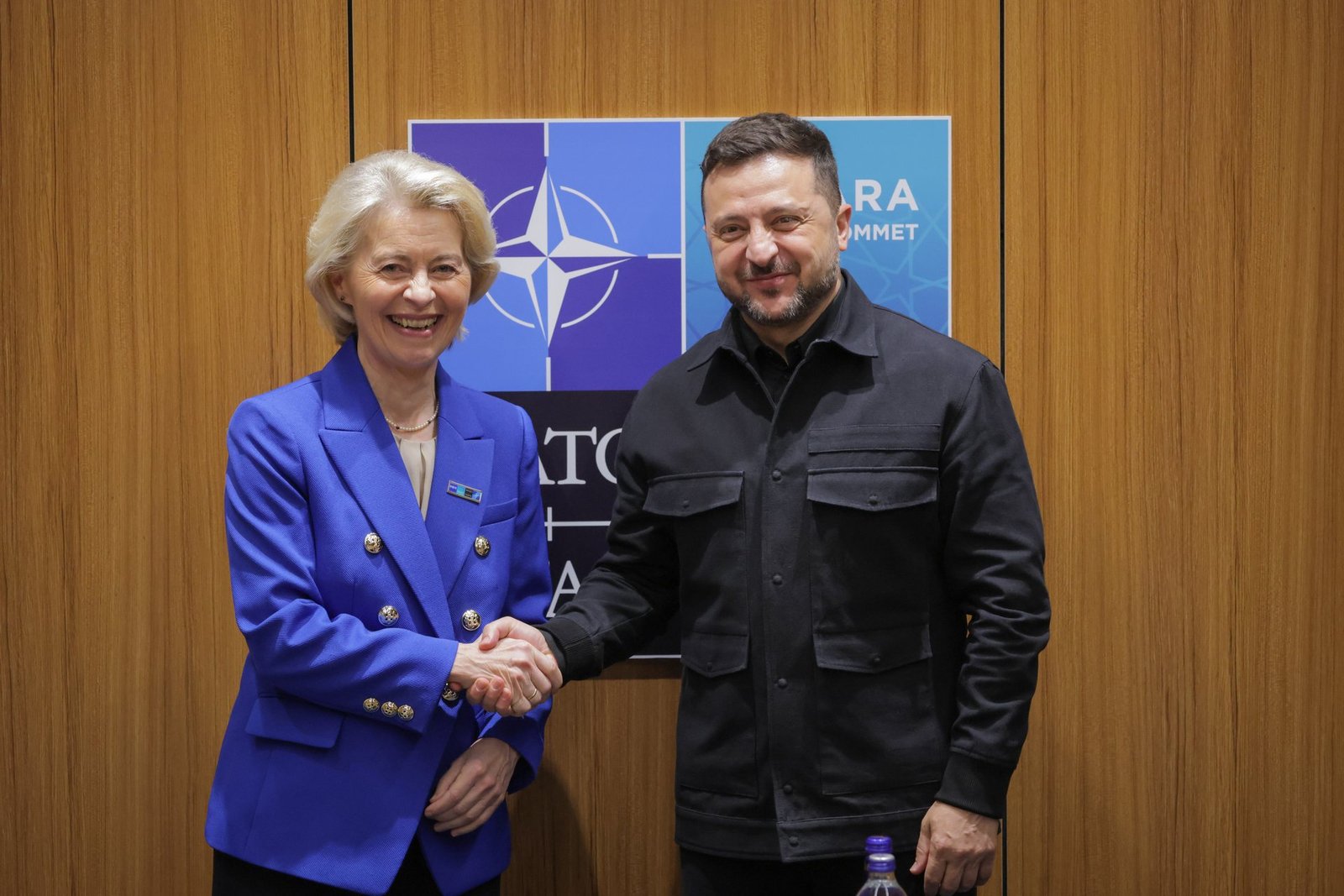
Europe joins Ukraine peace talks, but who will represent Europe in Ukraine talks?
Here is the catch. More than 40 European leaders ended their Dublin summit, the ninth session of the European Political Community, without naming anyone to take the seat (Le Monde). Three formats were floated in a single day. Kaja Kallas, the EU’s foreign policy chief, said the treaties settle it: European Council President António Costa and the High Representative — her — represent Europe on security matters (Silent Dossier). German Chancellor Friedrich Merz pointed instead to the E3 of Germany, France and the United Kingdom, or a group of five adding Italy and Poland, and brushed off the personal question: “It is not about people here, but that Putin is ready to have talks” (Silent Dossier). France’s Emmanuel Macron said the format “will be determined” once Europeans retake the initiative (Silent Dossier).
Zelensky has asked the bloc to decide during November, not later (Zot News). Some diplomats consider Kallas, known for a hard line on Moscow, a divisive pick for talks with the Kremlin; others argue that is precisely the point (Zot News). Italy’s Giorgia Meloni, who had complained in writing about “a Europe that is in disarray,” said she could back Costa (Zot News).
Moscow has not confirmed the seat, and its terms have not moved
Read the Russian account and the picture cools. Putin’s aide Yuri Ushakov said the Europeans “must decide whether they want peace or the continuation of the war,” and his readout of the Kremlin meeting contains no agreement to a European seat (Silent Dossier). Kremlin spokesman Dmitry Peskov said Europe must first name a representative, adding that “the Europeans squabble like spiders in a jar” (Silent Dossier). In Abu Dhabi on 10 and 11 November, where European security advisers attended on the margins, Russia’s delegation had no contact with them at all (Le Monde).
On substance, Putin repeated his standing demands: full control of the four Ukrainian regions Moscow claims to have annexed, and a warning that any European troops deployed to Ukraine after a deal would be treated as targets (World Right Now). Ushakov also revived Russia’s 2021 draft-treaty points — no NATO expansion, no threatening weapons near Russia’s borders, alliance forces back to their 1997 positions (Silent Dossier). European leaders answered with a joint statement on territorial integrity and the inviolability of borders, and Costa declared that “the time of spheres of influence in Europe is long gone” (Le Monde).
One concrete result: the largest prisoner exchange of the war
The day did produce one agreement all three capitals describe the same way. Russia and Ukraine will carry out another prisoner exchange, described by Zelensky as the biggest yet and by Kushner as finalised, potentially returning thousands of people to their families (World Right Now). Ushakov confirmed Putin backed the exchange initiative, with its parameters still being agreed; Zelensky had earlier spoken of a possible 1,000-for-1,000 swap, perhaps 1,200 people (Silent Dossier). No date has been announced for the swap, and none for the next round of talks, which Witkoff said is “on the schedule” without naming a place (Silent Dossier).
Analysis: A seat is not a voice until someone sits in it. Washington announced the seat as won, Moscow left it conditional, and Europe — which spent Dublin arguing over whether the answer is Costa, Kallas, three capitals or five — has perhaps two weeks to fill it before the next round. The envoy fight looks like protocol. It is actually the argument about what Europe is willing to guarantee, pay for and defend after a settlement, conducted by other means. Until the bloc settles that, its seat at the table will be occupied in shifts.
Photo: Alexandros Michailidis / European Union, via Wikimedia Commons (CC BY 4.0)
Sources
- https://silentdossier.com/articles/ukraine-peace-talks-latest-europe-next-round-zelensky-witkoff-kushner-dublin
- https://www.lemonde.fr/en/international/article/2026/11/13/us-envoys-say-europeans-will-be-included-in-upcoming-ukraine-peace-talks_6779500_4.html
- https://worldrightnowlive.com/story/zelensky-welcomes-us-bringing-europe-into-russia-ukraine-peace-talks
- https://zot.news/article/zelenskyy-urges-europe-pick-peace-talk-representative-30g6r
Leave a comment
Comment as a guest and verify your email, or sign in or create a reader account. Guest comments reach our review queue after email verification; account holders can submit directly for review.