
Two people can agree that voters should establish who they are and still disagree about almost every detail of an identification rule. Which documents count? Must they include a photograph? What happens when an eligible person does not have one? The phrase “voter ID” can conceal those differences instead of explaining them.
This comparison looks at selected official guidance and a documented election assessment. It does not claim that identification laws are spreading everywhere, or that a policy has identical effects wherever it is used. It also is not a substitute for checking the official rules for a particular election. The purpose is to show what a useful comparison needs to ask.
Canada: more than one route
Elections Canada’s federal-election guidance offers three routes to proving identity and address. One uses a qualifying government-issued card with a photograph, name, and current address. Another uses two accepted documents bearing the voter’s name, with at least one showing the address. A third involves a written declaration and a qualifying person who knows the voter vouching for them. Conditions apply to that vouching arrangement. [1]
The example demonstrates why the accepted alternatives belong in the description of the rule, rather than in a footnote. Saying only that identification is required would leave out how a person can satisfy the requirement. Elections Canada also cautions that federal requirements are not necessarily the same as those for provincial, territorial, or municipal elections. One country’s name is not enough to specify the relevant procedure. [1]
Australia: a different polling-place process
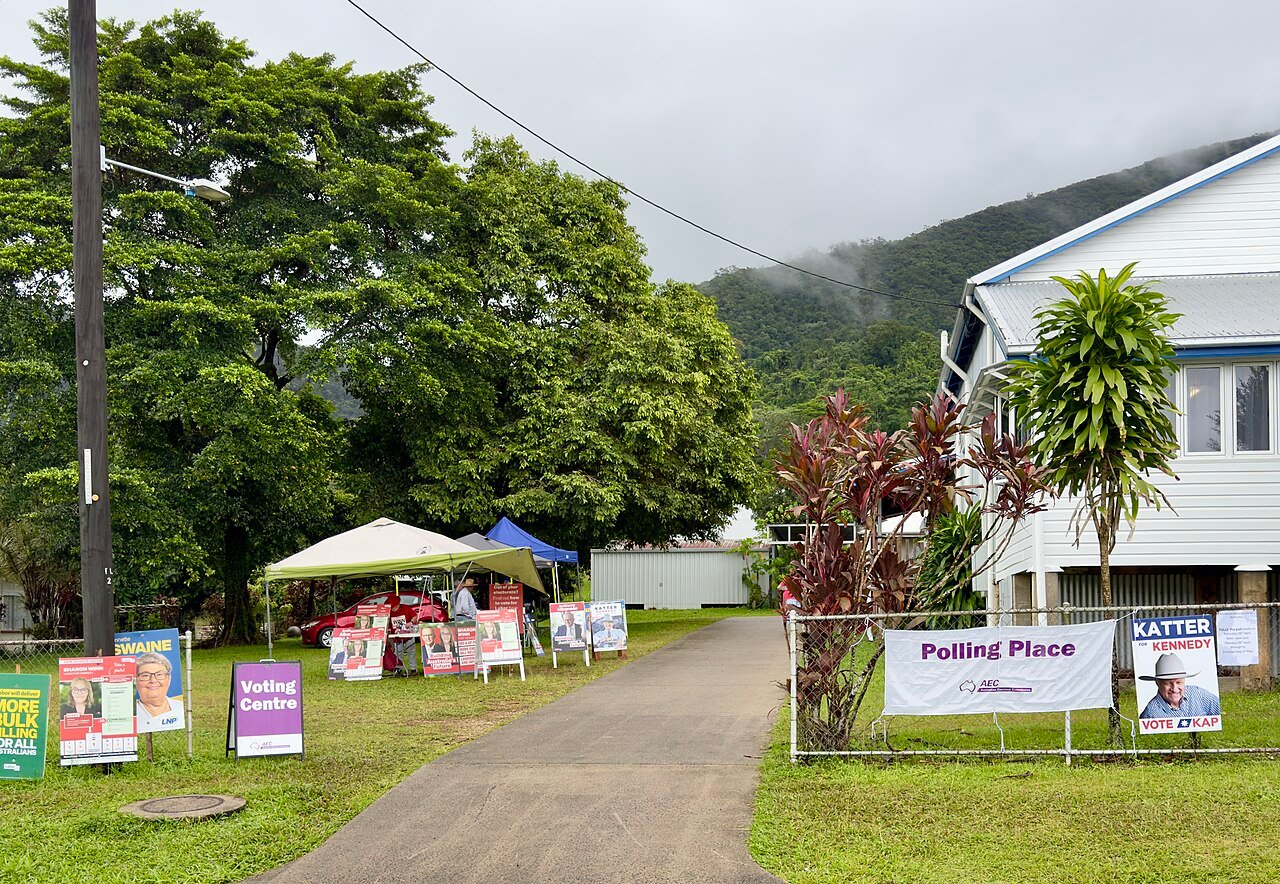
The Australian Electoral Commission describes a polling-place process in which an official asks for a voter’s full name and address and whether they have already voted in the election. It also explains declaration voting for situations including a name or address that cannot be found on the relevant list. [2]
This illustrates a broader point about comparison: an election can have a procedure for establishing and checking a voter’s circumstances without that procedure looking like another jurisdiction’s document check. To understand the system, a reader needs the actual sequence of steps and the relevant exceptions. A comparison based only on a yes-or-no label discards information that may determine the experience of voting.
Measure the effect carefully
The UK Electoral Commission’s report on the July 2024 general election offers a way to discuss implementation with evidence. Based on data from 612 of Great Britain’s 632 constituencies, it reported that 0.08% of people who tried to vote at a polling station were unable to do so because of the ID requirement. The scope and denominator are essential parts of that figure. [3]
It should not be described as the percentage of all eligible voters prevented from voting. A count drawn from people who arrived at polling stations cannot, by itself, establish the experience of everyone who stayed away. Equally, a percentage does not become uninformative merely because it is small. It answers a particular question about a particular recorded group. Good reporting preserves that question rather than silently replacing it with another.
The American comparison has two dimensions
The National Conference of State Legislatures organizes US voter-identification laws by the type of identification involved and by what happens when a voter lacks it. Its distinction between stricter and less strict procedures concerns the available path for having a ballot counted, not simply whether someone is asked for a document. [4]
That framework is useful beyond any one state. A rule can be examined at the moment of arrival and at every subsequent step it requires. Does an alternative exist? Is additional action necessary? Who must take it, and by when? These questions make an administrative proposal concrete without assuming its effects in advance. The answers must come from the current rules of the jurisdiction being discussed.
Ask for the policy, not just the slogan
A balanced assessment should specify both the problem a measure is intended to address and the evidence used to judge its results. Statements about public confidence, administrative convenience, exclusion, and misconduct do not automatically measure the same thing. Treating them as interchangeable makes an argument sound conclusive before the underlying questions have been answered.
For readers following a proposal, three details are worth keeping together: the accepted ways to establish identity, the procedure available to someone who cannot use the usual route, and the evidence gathered after implementation. Those details turn an abstract dispute into a policy that can be examined. They also help keep a person’s eligibility distinct from the practical question of how an election asks that person to demonstrate it.