Listen to this article
Take the story with you. Choose a voice and a pace that suits you.
Or listen in another language / choose a voice
Getting your device voices ready…
The voice follows the displayed language and your browser’s regional preference when available. You can choose another narration voice.
Ask a Dutch child under ten to draw Sinterklaas’s helper and you will probably get a face with smudges on it. The jet-black make-up, red lips, afro wig and gold earrings that defined Zwarte Piet (Black Pete) for generations have been swapped, in most of the country’s classrooms and on its television screens, for a performer in the same page costume whose own skin shows through a few streaks of soot. This is the Sooty Pete the Netherlands now treats as the default, and he did not arrive by law. No parliament banned the old Piet and no court ordered the new one. He arrived the way traditions actually change: one institution at a time, each deciding on its own.
The replacement has a name: Roetveegpiet
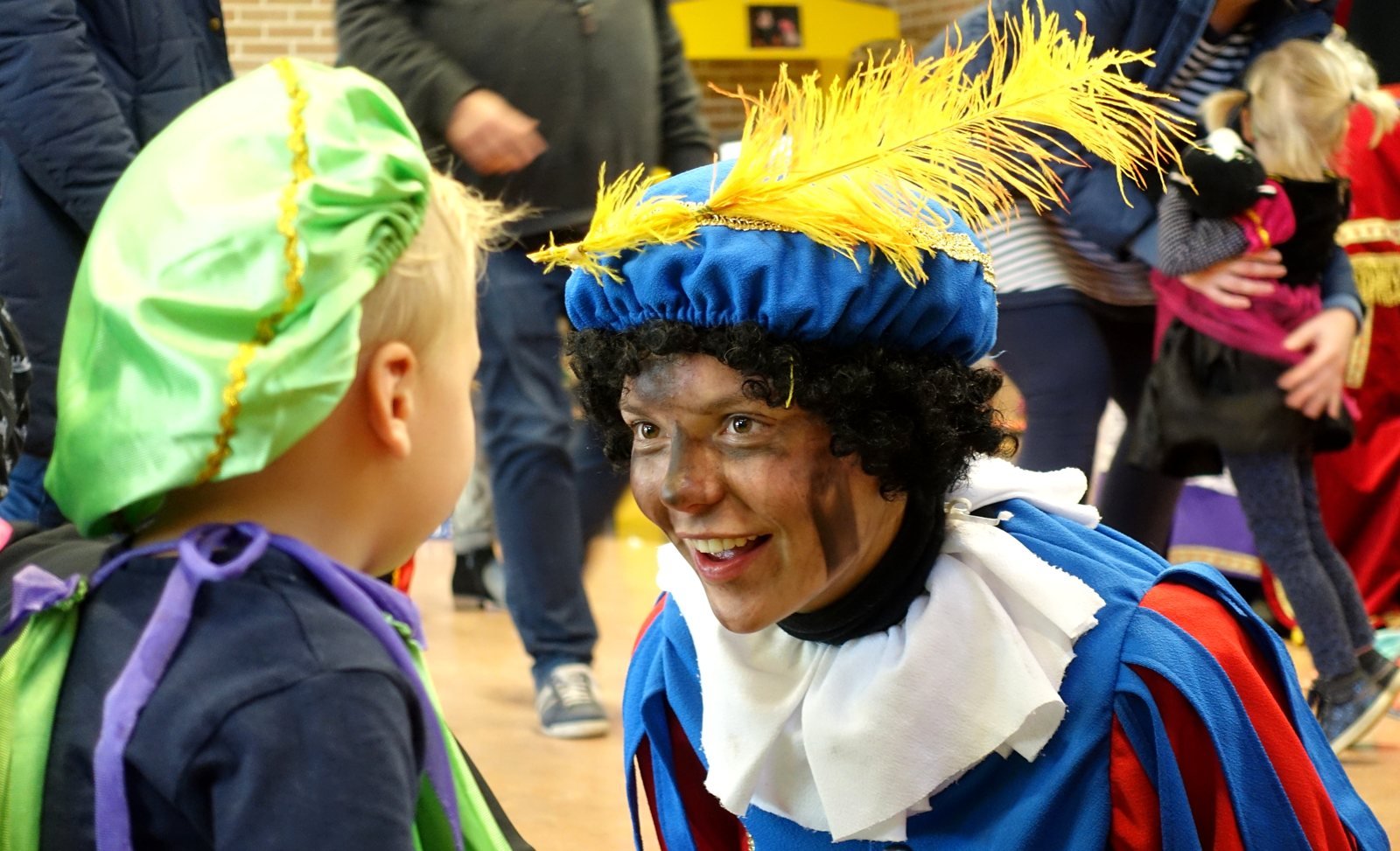
The Roetveegpiet — literally the soot-smudge Pete, rendered in English as Sooty Piet — keeps the costume, the cap and the bag of kruidnoten, and drops everything that made the face a caricature: no wig, no lipstick, no earrings, no blackface, just the performer’s natural skin tone with dark streaks, explained to children as chimney soot. By 2021, Wikipedia’s survey of the change records, Sooty Pete had become more common than the traditional variant at public events and in television specials, films, social media and advertising. The campaign group Kick Out Zwarte Piet, founded in 2014, had set exactly that as its goal — celebrations with Roetveegpieten only — and in December 2025 it dissolved, declaring the goal reached. How the old image was built, and where its blackface grammar came from, is a longer story. This one is about the machinery of the swap.
Schools: where the change started
The first institutions to move were the ones that face children every morning. In 2015, as the national argument sharpened, one in three Dutch primary schools announced plans to alter Piet’s appearance in their celebrations. A 2017 survey of 400 primary-school directors showed the split that still defines the country: in Amsterdam, Rotterdam and The Hague, only 17% of schools still used fully blacked-up Pieten while 84% used the soot version; in the rest of the country, 89% of schools kept the traditional figure. Head teachers did not have to win a national debate — only to decide what would walk into their own assembly hall in December.
The Sinterklaasjournaal effect: television rewrites the character
Schools meet children in person; television sets the template. Nickelodeon Netherlands moved early, casting a racially mixed group of Piet performers instead of white actors in dark make-up. RTL Nederland switched to soot-only Pieten in 2016. The decisive step came from the public broadcaster NTR, whose Sinterklaasjournaal — the nightly children’s news that narrates Sinterklaas’s arrival each November — went definitively Roetveegpiet-only in 2019 after a gradual phase-in, as did the national arrival parade it broadcasts. Change what the Sinterklaasjournaal shows for three weeks each autumn, and you change what a generation of children pictures when they hear Piet’s name — a leverage defenders of the traditional figure understood too, which is why each step drew protests.
Shops, shelves and search results
Retail moved on commercial, not moral, arithmetic. The department store De Bijenkorf replaced its holiday displays of Zwarte Piet with a golden-skinned version in 2015 — a single retail decision that signalled where the market’s centre of gravity was going. In 2020 the change reached the shelf and the search box: Bol, Amazon and Coolblue removed traditional Piet products and promotions, and the platforms drew their lines — Facebook’s blackface ban of August 2020 explicitly covered the traditional Zwarte Piet, and Google’s advertising ban that October went further, covering even the soot version.
Libraries and the books children meet
In November 2020 the Dutch public libraries’ association removed children’s books depicting the traditional Zwarte Piet from its shelves. The decision reached the quietest layer of the tradition: the picture books through which toddlers met Piet before they could read. Defenders called it censorship of heritage; the libraries framed it as a routine collection decision. Either way, the layer where the image had been fixed since the nineteenth century — the printed page — was now being edited too.
National first, local later: the two-speed tradition
Politics endorsed the direction without mandating it. Prime Minister Mark Rutte, who in 2013 had shrugged that “Zwarte Piet is nou eenmaal zwart” — Black Pete is just black — told parliament in June 2020 that he had undergone “grote veranderingen” (great changes) on the question, now understood why people experienced the figure as racist, and expected hardly any fully black Pieten within a few years. He refused a ban. The result is the two-speed tradition the numbers describe: the national layer — broadcasters, platforms, department stores, city schools — changed years before the local layer, and in places still has not. Editie NL’s count in November 2019 found 65% of local arrival parades still using exclusively blackface Pieten, against 31% mixed and just 4% with none.
| Institution | Year | What changed |
|---|---|---|
| De Bijenkorf | 2015 | Golden Piet replaces blackface in holiday displays |
| Primary schools | 2015 | One in three announce plans to alter Piet’s appearance |
| RTL Nederland | 2016 | Soot-only Pieten in its broadcasts |
| NTR Sinterklaasjournaal | 2019 | Definitively Roetveegpiet-only, with the national intocht |
| 2020 | Blackface ban explicitly covers traditional Zwarte Piet | |
| 2020 | Advertising ban covers Zwarte Piet, including soot versions | |
| Public libraries | 2020 | Children’s books depicting Zwarte Piet removed |
| Bol, Amazon, Coolblue | 2020 | Traditional Piet products and promotions removed |
So the answer to what replaced Zwarte Piet is not a single decree but a queue of decisions — a head teacher’s, a broadcaster’s, a buyer’s, a librarian’s — each denounced at the time as the end of the feast, and each absorbed by the next December. Information verified through 1 November 2026.
Photo: Roetveegpiet performer at a Sinterklaas arrival, via Wikimedia Commons.
Sources
- Wikipedia, Zwarte Piet — the replacement timeline, school surveys and platform bans: https://en.wikipedia.org/wiki/Zwarte_Piet
- HowStuffWorks, Black Peter, aka Zwarte Piet, Becomes ‘Soot Piet’ Amid Controversy: https://people.howstuffworks.com/culture-traditions/holidays-christmas/black-peter.htm
- Christmas Wiki, Sooty Piet — the replacement form defined: https://christmas.fandom.com/wiki/Sooty_Piet
- Wikipedia, Kick Out Zwarte Piet — the campaign that set Roetveegpieten-only as its goal: https://en.wikipedia.org/wiki/Kick_Out_Zwarte_Piet
Leave a comment
Comment as a guest and verify your email, or sign in or create a reader account. Guest comments reach our review queue after email verification; account holders can submit directly for review.