Listen to this article
Take the story with you. Choose a voice and a pace that suits you.
Or listen in another language / choose a voice
Getting your device voices ready…
The voice follows the displayed language and your browser’s regional preference when available. You can choose another narration voice.
The Aqar Quf archaeological park opening happened on 20 October 2026, and it changes what a visit west of Baghdad can mean. The first section of the site — ancient Dur-Kurigalzu — is now formally open to the public, according to Italy’s foreign ministry. Italy’s ambassador in Baghdad, Niccolò Fontana, attended the inauguration.
Information verified through 27 October 2026.
This is not a ribbon on an empty field. Behind the path stands a ziggurat roughly 50 metres high. Around it stretch five kilometres of remains. A city that once ran Babylonia is being read again, trench by trench.
What the Aqar Quf archaeological park opening actually opened
The ministry describes the opening as a step in conservation and promotion, not just access. The work sits inside ArTourBagh, a three-year Italian development cooperation project worth EUR 3 million, run through the Italian Agency for Development Cooperation with the University of Bologna, the University of Catania, the Turin research centre CRAST and AVSI, the ministry said.
So far, 156 people have gained skills through its courses, seminars and workshops on conservation. About 320 young people took part in 30 educational initiatives for schools and local communities, on the ministry’s figures. The project also talks openly about jobs — guided tours, crafts, hospitality — with a focus on young people, women and nearby communities.
Excavation is running alongside the visitor work. Professor Nicolò Marchetti of the University of Bologna told the Associated Press the team was in its first season at Aqar Quf for excavation, conservation and public presentation, working across nine excavation areas. They had found statue fragments in the temple. In the palace area, they were finding written documentation.
That last detail matters. Paper — well, clay — changes a site from scenery to evidence.
Dur-Kurigalzu Kassite capital: a city built to last, then left
To understand Dur-Kurigalzu Kassite capital history, start with its founder. Kurigalzu I established the city in the 14th century BCE, and Kurigalzu II later renovated it, UNESCO’s Tentative List entry says. It served as the political capital of the Kassite kingdom. UNESCO gives the ancient city an extent of 425 hectares in its justification, while other accounts put the walled Kassite area at about 225 hectares — the figures describe different boundaries, and visitors should not treat either as a neat modern fence line.
The Kassites ruled Babylonia from roughly the 16th to the 12th centuries BCE. That’s a long run. Longer than most states manage. They adopted cuneiform, Babylonian administration and older religious forms, then blended them into something distinct, UNESCO notes. A cuneiform letter to a Hittite king was found in the royal palace here. Letters went from here to an Egyptian pharaoh, too. This was no backwater.
The city was occupied continuously until the fall of the Kassite dynasty around 1155 BC, then largely abandoned, according to the site’s documented history. Its name even appeared on toponym lists in the funerary temple of Amenophis III in Egypt. People far away knew where this was.
The Aqar Quf ziggurat Enlil still dominates the plain
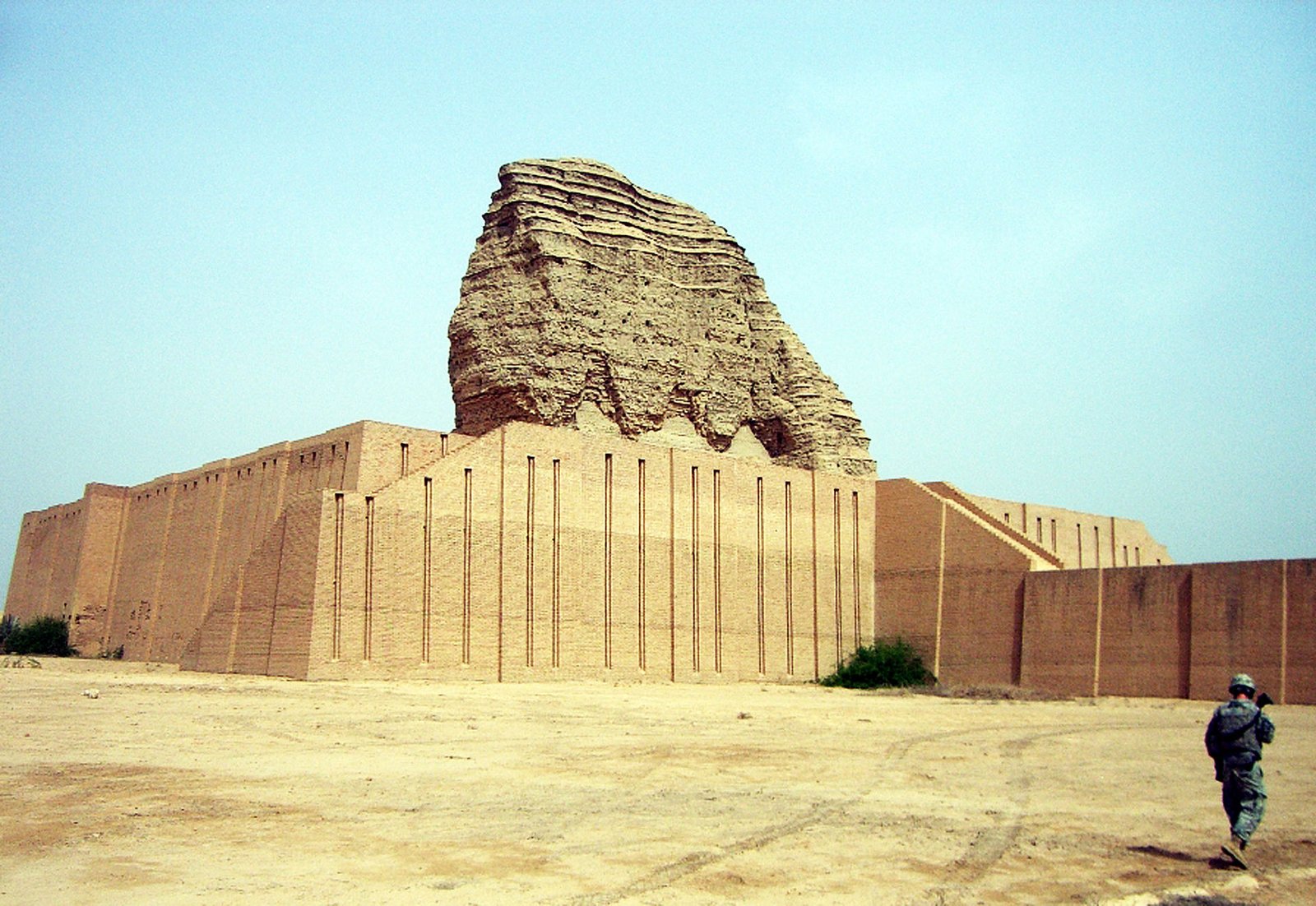
Walk the site and one thing organises everything: the Aqar Quf ziggurat Enlil was dedicated to. Enlil was the chief Sumerian deity. The ziggurat rises about 50 metres above the plain in UNESCO’s description — about 52 metres in other accounts — built of mudbrick, with ancient reed mats and twisted ropes still binding it together.
Its base measures 69 by 67 metres. Three main staircases led up to the first level, the documented record says. Travellers once mistook it for the Tower of Babel. You can see why. It doesn’t sit politely in the landscape. It interrupts it.
South-west of the ziggurat, about a kilometre away at Tell al-Abyadh, sits the royal palace. UNESCO calls it the largest structure of its kind in the whole Near East, almost three times the southern palace of Nebuchadnezzar in Babylon, with frescoes from the late 13th century BCE that are the most impressive surviving Kassite figurative art. Much of that palace complex remains unexcavated. The park opening is, in that sense, an opening in both senses — a gate, and a beginning.
Systematic digging here is not new. Iraqi archaeologists under Taha Baqir led the first systematic excavations in the 1940s, UNESCO records, recovering more than 100 cuneiform tablets. An Iraqi-Italian expedition has operated at the site since autumn 2024.
An Iraq UNESCO Tentative List site, aiming higher
Aqar Quf joined the Iraq UNESCO Tentative List on 31 January 2025, submitted by Iraq’s permanent delegation, UNESCO records. Marchetti was blunt about the ambition in his AP remarks: the site is on the tentative list, and the team is aiming for full World Heritage inscription.
Tentative listing is not inscription. UNESCO’s own page carries that disclaimer, and the site still faces urban encroachment, climate pressure and thin resources for maintenance and security, on UNESCO’s assessment. Baghdad is close — about 30 kilometres away. That closeness is the site’s blessing and its threat. Few ancient ziggurats sit within reach of a modern capital’s day-trippers. Fewer still survive the suburbs growing toward them.
Analysis: The honest test of this opening won’t be the ceremony. It will be whether conservation money, trained local staff and school visits outlast the project cycle. ArTourBagh is a three-year project. Mudbrick does not care about funding cycles; rain and groundwater erode it on their own schedule. If the park turns visitors into a constituency — people in Abu Ghraib and Baghdad who expect this place to be kept — then October 2026 will count as more than a photo opportunity. The Kassites held Babylonia for centuries by adopting what worked and making it their own. Keeping their capital will take the same unglamorous skill.
Photo: U.S. Army photo by Spc. David Robbins, via Wikimedia Commons (CC0)
Leave a comment
Comment as a guest and verify your email, or sign in or create a reader account. Guest comments reach our review queue after email verification; account holders can submit directly for review.