Listen to this article
Take the story with you. Choose a voice and a pace that suits you.
Or listen in another language / choose a voice
Getting your device voices ready…
The voice follows the displayed language and your browser’s regional preference when available. You can choose another narration voice.
The Westminster Abbey Roman sarcophagus has carried the wrong name for more than 150 years — or rather, only half the story. Westminster Abbey announced on 21 October 2026 that new research suggests the skeleton inside the limestone coffin belonged not to the Roman named on its side, but to a medieval abbot who died roughly six centuries later (Westminster Abbey).
Suggests. That word is doing real work in this story, and it should stay.
Information verified through 25 October 2026.
Westminster Abbey Roman sarcophagus: the Valerius Amandinus sarcophagus and its second occupant
Workers excavated the limestone sarcophagus on the Abbey’s North Green in 1869. Its inscription commemorates Valerius Amandinus, a wealthy resident of Roman Britain who lived around AD 300 to 400 (Westminster Abbey).
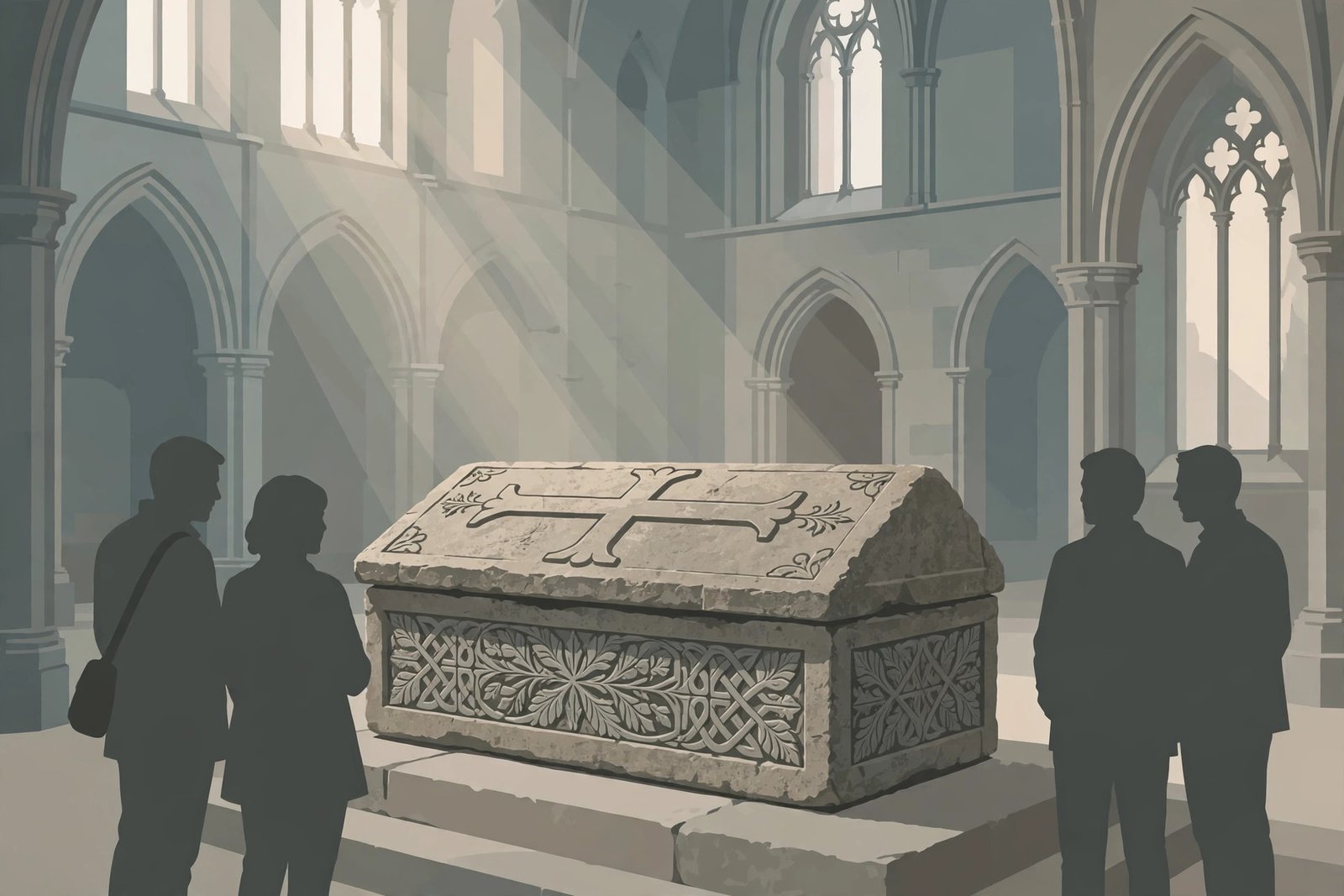
But the lid never matched the inscription. A large Latin cross was carved into it in the 10th or 11th century — hundreds of years after the Roman text was cut. Someone, long after Amandinus, had taken the old stone coffin and given it a second life (Forbidden Unveiled).
The bones told the same story once science got a proper look. Bone specialist James Young Langthorne of Pre-Construct Archaeology assessed the skeleton as a man aged 35 to 49, about 5ft 9in tall — revising a Victorian assessment of a young man of about 5ft 7in, aged no more than 30 (Westminster Abbey). A sample sent to the Scottish Universities Environmental Research Centre returned a radiocarbon date of AD 987 to 1052 for his death.
Six centuries separate the two men. One coffin holds both their stories.
Traces of lime inside the stone, forming a rectangular outline, suggest a wooden coffin once rested within the sarcophagus and decayed, leaving its ghost in residue (Forbidden Unveiled). The Abbey’s account agrees on the shape of the burial: the occupant was “honoured” with burial in a “fine sarcophagus”, his wooden coffin placed inside before the lid was re-carved with its cross (Westminster Abbey).
Abbot Ælfwig Westminster Abbey: the favoured candidate
The Warwick Rodwell sarcophagus research, published in the Journal of the British Archaeological Association, concludes that the bones belonged to a high-ranking medieval monk. Archaeology Magazine’s account of the same research reaches the same reading of the evidence — a reused coffin, late Saxon bones, an abbot’s burial (Archaeology Magazine). Rodwell, the Abbey’s consultant archaeologist, favours Ælfwig, abbot of Westminster’s Benedictine monastery, who died around 1020. The alternative is his successor Wulfnoth, who died in 1049 (Westminster Abbey).
Rodwell is candid about the limits. “We have two viable contenders for the occupant of the sarcophagus,” he said. “We do not know the date of birth of either. But either would fit equally well if we assume the Abbot was in his early twenties when the appointment was made and close to fifty when he died. The fact Aelfwig was already a monk of Westminster might favour him.”
That prior connection is the edge — a man formed by the community, buried with its highest honour. No inscription on the medieval lid names the second occupant. Nothing personal survives to settle it.
Narrowed, not proved
Why reuse a Roman coffin at all? A fine stone sarcophagus was rare and valuable, and recarving its lid with a cross made it a fitting resting place for an abbot. One further possibility, flagged as theory rather than finding, is that the monks believed the coffin carried early Christian associations. Amandinus’s own religious identity is not established, so that explanation rests on what medieval monks may have believed, not on what the Roman believed (Forbidden Unveiled). Even the coffin’s original Roman location is uncertain; it may once have stood in a mausoleum somewhere near Westminster.
Analysis: This is historical detective work at its most honest. Radiocarbon dating killed the easy assumption that inscription and skeleton belonged together. Documentary history then supplied two names that fit the dates, the status and the place. What it cannot supply is certainty, and Rodwell does not pretend otherwise. “Compelling, not conclusive” is exactly the right register — a phrase more headlines should borrow.
Visitors can judge the evidence with their own eyes. The sarcophagus is on permanent display in the Queen’s Diamond Jubilee Galleries, Roman inscription on its side, medieval cross on its lid: two faiths, two eras, one block of limestone (Westminster Abbey).
Sources
- Westminster Abbey, “Mystery of Abbey’s Roman sarcophagus solved”, 21 October 2026 — https://www.westminster-abbey.org/abbey-news/mystery-of-abbeys-roman-sarcophagus-solved
- Forbidden Unveiled, “Westminster Abbey Roman Sarcophagus: The Skeleton That Didn’t Belong”, 24 October 2026 — https://www.forbiddenunveiled.com/2026/10/24/westminster-abbey-roman-sarcophagus-medieval-skeleton/
- Archaeology Magazine, “Roman Sarcophagus at Westminster Abbey Likely Held Remains of Medieval Monk”, 23 October 2026 — https://archaeology.org/news/2026/10/23/roman-sarcophagus-at-westminster-abbey-likely-held-remains-of-medieval-monk/
Leave a comment
Comment as a guest and verify your email, or sign in or create a reader account. Guest comments reach our review queue after email verification; account holders can submit directly for review.