Listen to this article
Take the story with you. Choose a voice and a pace that suits you.
Getting your device voices ready…
The voice follows the displayed language and your browser’s regional preference when available. You can choose another narration voice. Enhanced device voices are preferred; availability varies.
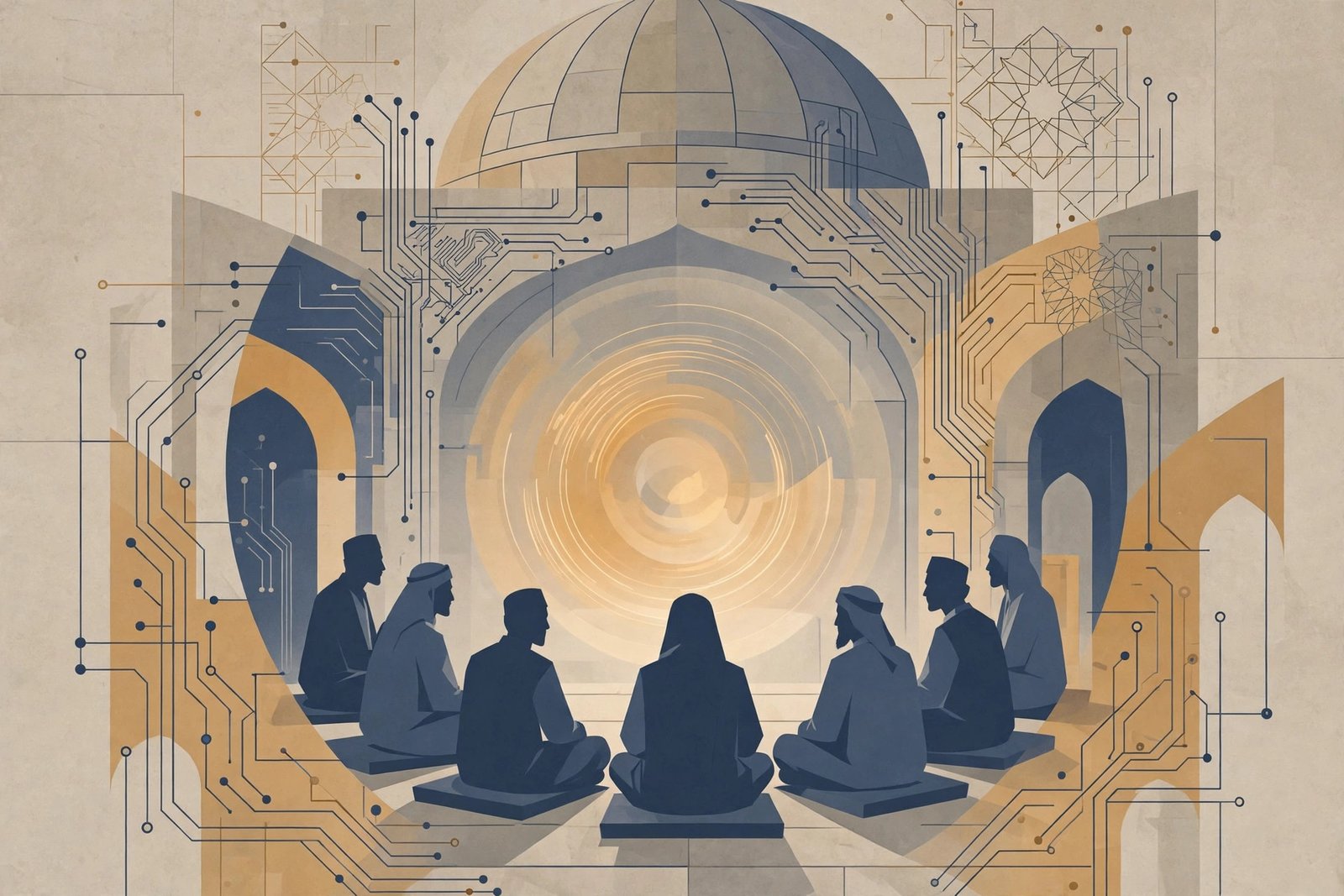
Every AI system you use was built to someone’s specification of acceptable behaviour. The question who should set the moral rules for AI asks whose specification that ought to be. On 15 October 2026, Doha Debates staged that argument in public, in a town hall titled “Should AI be shaped by faith?” at Multaqa, the Education City Student Centre in Doha (Deutsche Tageszeitung). Information verified through 23 October 2026.
The format was deliberate. Doha Debates, a Qatar Foundation production, used a Majlis-style discussion moderated by Mozilla Foundation chief executive Nabiha Syed, with AI philosopher Yaqub Chaudhary, Notre Dame Law School canon law professor Monsignor John Paul Kimes, and author and transhumanist Max More as guests (Deutsche Tageszeitung). Students and recent graduates from Qatar weren’t an audience in the usual sense — they questioned the guests directly, per the same report. The event listing framed the stakes in one line: for centuries people looked to religious traditions to distinguish right from wrong, and AI now challenges that authority (Eventbrite).
Amjad Atallah, Doha Debates’ managing director, put the provocation bluntly in comments reported after the event. “The leaders of AI companies are putting a lot of faith in their products, and they are asking for a lot of faith from us,” he said. “But what about our faith traditions? Are they part of the makeup of these tools?” (Deutsche Tageszeitung). His deeper question followed from it: “Are humans going to be shaping the machines or are the machines going to be shaping us?”
Should AI be shaped by faith — or left to the secular world?
That was the motion, and the listing for the town hall set out the live positions without pretending they reconcile. Some argue faith traditions should help shape and govern AI. Others say it’s best left to the secular world. Some fear, in the listing’s words, “making an idol of a machine, trusting it the way we should only trust God”; others see no threat, only the next chapter in the human story (Eventbrite).
Atallah, previewing the session in remarks carried by Qatar News Agency, gave the case for holding the debate at all rather than for either side. “Every generation introduces a technological breakthrough that compels us to ask what kind of future we want to build. With AI, that question is outpacing our institutions’ ability to answer it,” he said (Fana News). Bringing religious and secular experts together with young people who will live longest with the results was, in his phrase, “timely and consequential.”
Notice what nobody at the town hall was asked to defend: the status quo. “Today, the question of values rests largely with the companies creating AI, even though the consequences of their decisions affect us all,” Atallah said afterwards (Deutsche Tageszeitung). The debate wasn’t faith versus no values. It was faith versus corporate default.
AI values pluralism and moral neutrality: the problem with one system for everyone
Atallah named three tensions, and the second is the philosophically hard one. First, authority: who decides which values a global technology reflects? Second, pluralism. If one system serves people holding different beliefs and moral frameworks, is moral neutrality possible — or even desirable? Third, function: should AI be “a tool for retrieving basic knowledge, a trusted mentor, or something else?” (Deutsche Tageszeitung).
The pluralism problem has no clean exit. A system tuned to one tradition’s answers will misfire for users outside it. A system tuned to offend nobody still makes choices — about what counts as harm, whose framing of a contested question gets presented first, which topics get hedged. Neutrality, pushed hard enough, turns into a position of its own, just one that declines to sign its work.
Universities are working the same seam from the classroom side. At the University of Tampa, an Ethics and Artificial Intelligence course has students test exactly these allocation-of-authority questions — who is accountable when a biased loan algorithm denies a family, who should decide how self-driving cars weigh lives in variations of the trolley problem (University of Tampa). The same report describes how differently the big labs have already answered, in practice: Anthropic taking a virtue ethics approach, building character in its model, while OpenAI follows a deontological, duty-based approach descended from Kant, according to department chair Marcus Arvan. Two companies, two classical traditions, chosen in-house. That’s Atallah’s status quo, documented.
Faith traditions and AI ethics after the town hall ends
Doha Debates didn’t try to settle any of this. “Complex questions rarely have a clear answer,” Atallah said. “We don’t expect everyone to agree, but the search for truth is a meaningful outcome in its own right” (Deutsche Tageszeitung). The full town hall is due for release on DohaDebates.com and other platforms in December, per the same report. The January Doha town hall had asked whether humanity was ready for superintelligence; this one deliberately moved from capability to values.
The youth emphasis was structural. Atallah argued that within a generation AI will be as universal as phones, and that today’s students still remember life before it — a rare position from which to judge its direction (Deutsche Tageszeitung).
Analysis: The honest contribution of the Doha format is procedural. It treats the values inside AI as a public question while there’s still time to influence the answer. Whether faith traditions get a formal seat or none, the alternative currently running is that a handful of firms answer these questions privately, product by product. A town hall can’t govern that. It can refuse to let it pass as a purely technical matter.
His parting questions were aimed at users, not executives: “Whose values are built into the tools we use? Who made those choices, and who benefits from them?” You don’t need a position on the motion to sit with those for a while.
Sources
- https://www.deutschetageszeitung.de/en/Technology/936436-doha-debates-examines-who-should-set-the-moral-rules-for-ai.html
- https://www.eventbrite.com/e/doha-debates-town-hall-should-ai-be-shaped-by-faith-tickets-2000657342969
- https://news.utampa.edu/2026/philosophy-s-state-of-being-in-the-age-of-ai
- https://www.fananews.com/language/en/doha-debates-to-host-should-ai-be-shaped-by-faith-on-october-15/
Leave a comment
Comment as a guest and verify your email, or sign in or create a reader account. Guest comments reach our review queue after email verification; account holders can submit directly for review.